The Knotted Rope at Zahra's Gate
A free B2-level English story for language learners, readable online in 7 languages, with an option to listen via the free Storyteller app.
A pumpkin grower unties one knot in a strange old rope and makes a small wish, and the answer follows him home in a form he never imagined.
That was the preview! Hear the full story in the free Storyteller app. Get the app
Audio isn't available right now.
Zahra sold things from a wooden stall beside the farm gate on Orchard Road, and most of them were ordinary. She had jars of honey, bundles of firewood and eggs in cardboard cartons. The rope was different. It hung from a nail at the back of the stall. It was a thick brown length of hemp with so many knots that it looked like a necklace made by a nervous giant. Nobody had asked about it in three years.
Ferran noticed it on a Saturday in late autumn. He had come to the gate, as he did every week, to sell pumpkins from the back of his cart. He had set up his scales on the empty trestle table next to Zahra's stall. He was a good grower and a poor seller. Customers who bought his pumpkins somehow always paid less than he had meant to charge. He went home each evening with a lighter purse than his arithmetic promised.
"That is a lot of knots," he said, nodding at the rope.
"Eighty-one," Zahra said, without looking up from her honey. "I counted them once."
"What are they for?"
"They are not for anything. Each one is a request that somebody made and never finished. The rope arrived on my counter when I took over this stall, and the woman who left it did not say where it came from." She wiped her hands on her apron. "She did say one thing, though. If you untie a knot and ask for something out loud, the rope will answer. It gives you what you ask for, not what you mean."
Ferran laughed. It was a short, polite laugh, the kind people use when they suspect a seller of improving the story to raise the price. But the day was slow and the lane was empty. He was tired of doing sums in his head only to be proved wrong at closing time.
"May I try?" he asked.
"It is free," Zahra said. "Choose a small one, though. The big knots are old, and nobody knows what is inside them."
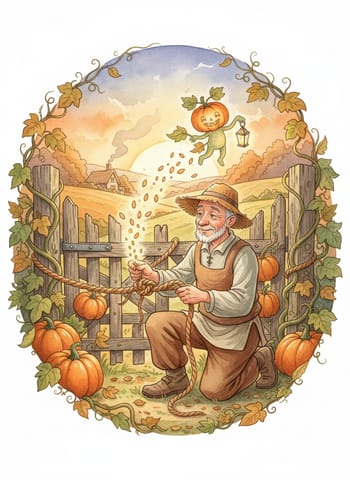
He walked to the back of the stall and lifted the rope from its nail. It was heavier than it looked, and slightly warm, as if somebody had been holding it. At the very end, where the fibres were thinnest, he found a knot no bigger than a walnut. His fingers worked at it for a minute. Then it loosened and fell open, and the ends of the rope lay still in his palm.
"I wish," Ferran said, feeling foolish, "that I always knew exactly how much I had sold."
Nothing happened. A crow landed on the gatepost and left again. Ferran handed the rope back to Zahra, who hung it on its nail without comment. He packed up his scales a little earlier than usual.
On Sunday morning he went out to feed his hens and found the rope draped over his own gate. He stared at it for a long time. It had not been there the night before, and the nearest neighbour lived a mile away. He lifted it with two careful fingers. The knots had moved. At one end there was now a neat group of nine knots. After a gap came a group of four, then another gap and a single knot.
He walked to Zahra's stall with the rope coiled over his shoulder.
"Nine big pumpkins, four small ones, one lumpy one," Zahra said, when she had examined it. "I think that is what you sold on Saturday."
"I sold nothing on Saturday. I was talking to you."
"You sold nine pumpkins before you came to talk to me. I remember them going. You were very pleased with yourself."
Ferran counted in his head and found that she was right. He had forgotten the early customers entirely.
"But I asked to know how much I had sold," he said. "I did not ask for a rope to follow me home."
"No," said Zahra. "You asked to always know. A rope that is only there on Saturdays would not be doing that, would it?"
So the rope stayed with him, and for a month it was the most useful thing he owned. He hung it from the front of his stall. By the end of each day it had tied itself into a clear record of everything that had changed hands. It showed how many pumpkins had gone, how many coins had come in, and which customers had paid before leaving. When the last buyer walked away, Ferran only needed to look at the knots to know whether his purse was full or short.
It was not always comfortable. One afternoon a man in a long coat lifted two pumpkins from the pile. He held out a single coin, hoping, perhaps, that nobody was watching. Before Ferran could speak, the rope slid off its hook and curled around the man's wrist like a friendly snake. Then it pulled itself into a tight, deliberate knot. The man looked down at it. Then he looked at Ferran, and Ferran, who had never in his life been brave about money, looked at the sky.
"I think," the man said eventually, "that I owe you one more coin."
After that, word travelled along the lane. People who had once paid in a hurry now paid carefully, and a few of them started to bring exact change. Ferran noticed that his sales did not fall, as he had feared. They rose. Strangers told each other that his stall was the honest one, the one with the clever rope. They came from three villages away to see it work.
On the last Saturday of the season, he carried the rope back to Zahra's stall and set it on her counter.
"It is a wonderful thing," he said. "But I do not think it belongs to me. I only ever wanted to know what I had earned."
"Then you have what you asked for," Zahra said. "Is something wrong with it?"
Ferran thought about the question honestly. "It is very good at its job. It is simply that I would like to understand why a rope is better at selling pumpkins than I am. I think I need a lesson, not a miracle."
"You have just had one," Zahra said. "People watched the rope tie itself to the truth for a month. Some of that truth stuck to you. Haven't you noticed that you stand differently?"
He had not. But when he looked down at his hands, he saw that they were resting flat and steady on the table. They were not folded behind his back, as they usually were when a customer asked him a price.
"Then I will keep the rope for the winter," he said at last, "if you will lend it to me. I will bring it back in spring."
"It will be waiting," Zahra said. "But there is one condition. You must never ask it for a loan."
"Why not?"
"Because it will want interest."
Ferran grinned, then looked down at the rope in his arms. It had already tied itself into a tiny, smug bow.
"Is it honest?" he asked her, half joking.
"Not exactly," said Zahra, turning back to her honey. "It is only tied to the facts."