Twelve Doors and a Tin of Buttons
A free B2-level English story for language learners, readable online in 7 languages, with an option to listen via the free Storyteller app.
Two rival neighbours find a tin of numbered buttons that fit the locks of every door on their street, but the doors open fully only when they work as a pair.
That was the preview! Hear the full story in the free Storyteller app. Get the app
Audio isn't available right now.
Counting Lane has twelve houses, and every house has a door with a brass number on it. The numbers run up one side from one to six and back down the other from seven to twelve. The street looks like a long, narrow clock. Nobody knows who built it. Nobody has ever seen the doors open from the outside, either, because every resident goes in through the back garden and out the same way.
Fergus lives behind door four. Saskia lives behind door nine. They have been rivals since the first day of school. Both of them tried to be first in line and ended up wedged together in the gate.
Since then, the rivalry has grown a great deal. They race to the lamp post at the middle of the street every morning, and whoever touches it first earns a point. Fergus is ahead by seven, but Saskia insists that the points before March do not count because his shoelace was untied. They argue about this daily, loudly, and with real enjoyment.
On Saturday, the argument is interrupted by a clinking noise.
"Did you hear that?" Fergus asks.
"I am not falling for it," says Saskia. "You always pretend to hear something when you are losing."
"I am not losing. I am ahead by seven."
"Ahead by seven minus the shoelace."
The clink comes again, from the foot of the lamp post. A round tin sits there, dented and rusty, about the size of a loaf of cake. It was not there yesterday. Fergus is sure of it, because he walked past this exact spot with his eyes closed as a dare. He crouches and reaches for it. Saskia drops to her knees at the same moment and grabs the other side.
"I saw it first," Fergus says.
"You saw it second. I was already looking."
"At what? At the clouds?"
"At the tin, with my mind."
They tug. The lid, which has probably been loose for years, flies off, and a cascade of buttons spills across the cobbles in every direction. They are all shapes and colours: round brass ones, square wooden ones, a tiny glass one that glints like a drop of water. Each of them has a number stitched into its face in white thread.
For a moment, both of them stop pulling and simply look.
"Ten," Saskia whispers, picking one up. "This one says ten."
"Mine says four." Fergus turns it over in his palm. It is a heavy brown button with two holes, and the stitched number shines as if it has just been sewn. "Four. Like my door."
They look at each other. Then they look at the street.
On door four, the brass plate suddenly seems to have a different shape. Where the keyhole should be, there is a round, shallow dip, no bigger than a coin. Fergus runs across the road and presses the button into it. It fits perfectly. The door swallows it with a quiet click, and a thin line of golden light appears around the frame.
"Don't," Saskia says, but he has already pulled the handle.
The door opens a hand's width and stops. Behind it is not a hallway but a narrow staircase going down into the dark. A smell of warm dust and old paper comes up from the bottom. Fergus peers in and does not move.
"It is not working properly," he says. "It will only open a little."
"Maybe it needs more than one button." Saskia is already at door nine, pressing a button into the dip at its centre. The door clicks, and golden light traces its edge. It opens exactly one hand's width, then sticks. "See? The same thing."
"So each door needs two buttons."
"Or one button from each of us."
They stare at each other across the street. Fergus opens his mouth to say that he has no interest in sharing. Then he notices the look on Saskia's face. It is stubborn and wary, as though they have both just discovered the same inconvenient fact.
"I will not forget about the shoelace," Saskia says.
"I would be disappointed if you did."
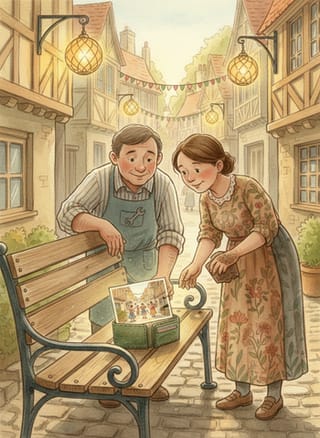
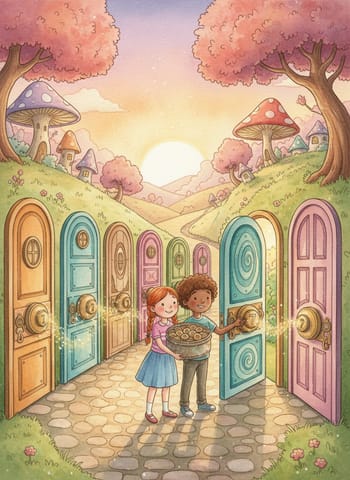
It takes them an hour to sort the buttons. They lay them out in rows on the cobbles, from one to twelve. A pattern appears at once. Each number turns up exactly twice, but no two buttons of the same number look alike. The glass ten is clearly meant to be matched with the dull iron ten. Door four already holds the brown button, so it needs the pearl one.
Fergus and Saskia take turns. He reads out a number; she finds the partner button; they press them into the plate together, one button each. At door one, the first pair makes a sound like a bell. At door two, the street gives a faint shiver. By door six, the golden light has spread from the frames to the cobbles. The lamp post in the middle of the lane is humming.
"Is it supposed to do that?" Saskia asks.
"I have no idea. I did not even know the street had a hum."
"It is probably friendly."
"You have no evidence for that."
"I have the evidence of my own good judgment," Saskia says.
At door twelve, the final pair clicks home. For a moment, nothing happens. Then, all at once, every door on Counting Lane swings wide with a soft sound, like twelve people drawing a breath. Light pours out of the houses and meets in the middle of the street. The air fills with the smell of old books and warm bricks.
Neighbours come hurrying out of their back gardens, blinking, holding spoons and watering cans and sleepy cats. Someone laughs. Someone else says that she has lived here for thirty years and never once seen the street from the front. A small girl runs through the open door of number seven and comes back with a glowing paper star in her hands.
Fergus and Saskia stand in the middle of it, still holding the empty tin between them. Neither of them seems to remember who picked it up first.
"Seven," Fergus says at last.
"What?"
"I said I was ahead by seven. I think we should stop counting."
Saskia looks at the doors, at the golden light, and at the tin in her hands. She is quiet for so long that he starts to worry she is composing a clever answer. When she finally speaks, her voice is almost shy.
"If we stop counting," she says, "who is going to tell everyone how the doors got opened?"