The Sign That Lost a Letter
A free B2-level English story for language learners, readable online in 7 languages, with an option to listen via the free Storyteller app.
At a rink built over a wish-granting spring, a missing letter on the warning sign sets small wishes loose, and two workers have minutes to replace it.
That was the preview! Hear the full story in the free Storyteller app. Get the app
Audio isn't available right now.
The sign above the lobby door of the Lantern Street Rink had always read NO WISHING ON THE ICE. Until that Tuesday, Osman had never given it a second thought. The letters were made of pale blue iron, each one as long as his forearm. The rink's founder had bolted them to the beam more than a century ago. Every new skater asked about it. Every old skater smiled and said nothing.
The rink had been frozen from a spring that ran beneath the building, and the spring was not ordinary water. Anyone who said the word wish while skating found that the ice listened. Most of the time this caused only small trouble. A teenager who wished to skate faster would shoot across the rink like a stone from a sling. A woman who wished her feet were warmer would melt a puddle the size of a dinner plate. Years ago, a man had wished for a quiet life and had been found asleep on the boards for three days.
So the sign stood as a kind of lock. As long as its letters were whole, the spring was calm, and the ice behaved like ice.
On Tuesday morning, Osman unlocked the front door and glanced up out of habit. Then he stopped.
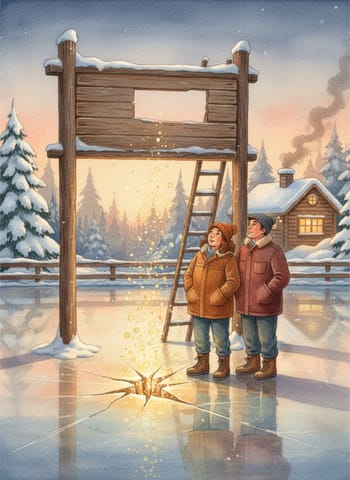
The sign said NO WI HING ON THE ICE. Spoken aloud, it sounded like "No wi-hing on the ice", because the S of WISHING was gone.
In the gap, a pale square of beam showed where the letter had been. A thin line of frost was creeping out of the hole, spreading across the wood like a crack in a window. Beneath the sign, a coat lay in a heap on the tiles, its hanging loop torn.
"Ula!" Osman shouted.
Ula appeared from the back office, rubbing her eyes with one hand and holding half a sandwich in the other. She worked the night shift, driving the machine that smoothed the ice after closing. She lived on sandwiches and silence, and she was rarely seen before noon.
"What is it?" she asked.
Osman pointed. Ula followed his finger and chewed slowly, and the colour drained out of her face.
"Ah," she said.
"What does 'ah' mean?"
"It means that last night, when I was hanging up my coat…" She swallowed. "I used the S as a hook. It looked like a hook. I did not think."
"You hung your coat on the founder's sign."
"A sign that looked a lot like a coat hook," said Ula weakly.
Osman closed his eyes and counted to five. When he opened them, two children were already standing in the doorway with their skates over their shoulders. A third was pointing at the frost on the beam. Behind them, in the rink, somebody laughed, and the sound had a strange echo to it, as though the ice was repeating it back.
"We open at nine," Osman said. "It is ten to nine. Find that letter."
They searched the lobby, the coat room, and the floor around the sign. They searched the bucket where the cleaning cloths lived. Ula even climbed a ladder and checked the beam itself, running her hands along the dusty wood. All she found was a single iron bolt, still warm.
"It must have fallen into the rink," she said.
"Then we will have to look on the ice."
"We cannot go on the ice right now. The wishes are already leaking." Ula pointed through the glass doors. "Look."
A small shape was drifting across the rink, hanging a handspan above the surface. It was a boy of about eight, still wearing his hat. His arms were stretched wide, and his mouth was open in perfect delight. As Osman watched, the boy rose a little higher, turned a slow circle, and settled back down on his skates with a gentle bump.
"I only wished I could fly," the boy said happily. "Just a bit."
"That is exactly what we are afraid of," Osman muttered.
Ula was already looking at the letters that remained. "The S is gone, and we cannot buy another," she said. "The founder cast them from the same iron as the rink's old skate blades. There is no foundry left in town that knows how."
Osman thought about this. He looked at the blue letters, at the frost spreading along the beam, and at the gap in the sign.
Then he looked at Ula's coat, lying crumpled beneath the gap, with the hanging loop torn in two.
"Iron from skate blades," he said slowly.
"Yes. What of it?"
"Where do we keep the old blades?"
Ula stared at him. Her eyes moved to the workshop door at the back of the lobby. Inside it stood a rusty barrel full of retired skates, left behind over the decades by people who had outgrown them.
They worked fast. Ula dragged out the barrel while Osman cleared the workbench. From the pile, Osman chose a long, curved blade from a pair of figure skates. The steel was dark and already slightly bent, as if it remembered being an S in a former life. He clamped it in the vise. Ula took the heaviest hammer from the wall and began to tap it into shape. One patient blow after another, she rounded the top curve and flattened the lower tail.
"Watch the rivet holes," Osman said.
"I am watching."
"You are talking to the hammer."
"The hammer understands me."
At four minutes to nine, the new letter was done. It was not as pale as the others, and the curve was a little uneven. Still, when Osman held it up, it was unmistakably an S. They carried it back to the lobby on a folded cloth, as though it might spill. Ula climbed the ladder again, and Osman handed up the bolts one at a time.
It took three tries to hold the letter in place. On the third, Ula's hand shook, and the bolt rang against the iron with a clear, ringing note. The frost on the beam stopped. For a moment the whole lobby seemed to hold its breath.
Then the cold seeped slowly back out of the wood, and the blue letters glowed once, softly, and went dull.
Out on the rink, the boy settled onto his skates with a final, graceful bump.
"I think it worked," Ula said from the ladder.
"I think so too." Osman took a step back to look at the sign. NO WISHING ON THE ICE, it said again, with one letter a little darker than the rest. Some people would notice. Most would not. He decided that was fair, and that the founder would have agreed.
He glanced at his watch, and then at the doors, behind which a line of skaters was already growing. He pulled the keys from his pocket and handed them to Ula.
"Open up," he said. "And next time, Ula, read the sign before you hang your coat on it."