The Sign That Lost a Letter
Una historia gratuita en inglés de nivel B2 para estudiantes, para leer en línea en 7 idiomas, con opción de escucharla en la app gratuita Storyteller.
At a rink built over a wish-granting spring, a missing letter on the warning sign sets small wishes loose, and two workers have minutes to replace it.
¡Ese fue el avance! Escucha la historia completa en la app gratuita Storyteller. Descargar la app
El audio no está disponible en este momento.
The sign above the lobby door of the Lantern Street Rink had always read NO WISHING ON THE ICE. Until that Tuesday, Osman had never given it a second thought. The letters were made of pale blue iron, each one as long as his forearm. The rink's founder had bolted them to the beam more than a century ago. Every new skater asked about it. Every old skater smiled and said nothing.
El letrero sobre la puerta del vestíbulo de la pista de patinaje de la calle Lantern siempre había dicho NO WISHING ON THE ICE. Hasta ese martes, Osman nunca le había dado una segunda mirada. Las letras eran de hierro azul pálido, cada una tan larga como su antebrazo. El fundador de la pista las había atornillado a la viga hacía más de un siglo. Todo patinador nuevo preguntaba por él. Todo patinador viejo sonreía y no decía nada.
The rink had been frozen from a spring that ran beneath the building, and the spring was not ordinary water. Anyone who said the word wish while skating found that the ice listened. Most of the time this caused only small trouble. A teenager who wished to skate faster would shoot across the rink like a stone from a sling. A woman who wished her feet were warmer would melt a puddle the size of a dinner plate. Years ago, a man had wished for a quiet life and had been found asleep on the boards for three days.
La pista se congelaba con un manantial que corría bajo el edificio, y el manantial no era agua común. Quien dijera la palabra wish mientras patinaba descubría que el hielo escuchaba. La mayoría de las veces esto causaba solo pequeños problemas. Un adolescente que deseaba patinar más rápido salía disparado por la pista como una piedra de honda. Una mujer que deseaba tener los pies más calientes derretía un charco del tamaño de un plato. Años atrás, un hombre había deseado una vida tranquila y lo habían encontrado dormido sobre las barandas durante tres días.
So the sign stood as a kind of lock. As long as its letters were whole, the spring was calm, and the ice behaved like ice.
Así que el letrero funcionaba como una especie de cerradura. Mientras sus letras estuvieran completas, el manantial estaba en calma, y el hielo se comportaba como hielo.
On Tuesday morning, Osman unlocked the front door and glanced up out of habit. Then he stopped.
El martes por la mañana, Osman abrió la puerta principal y miró hacia arriba por costumbre. Entonces se detuvo.
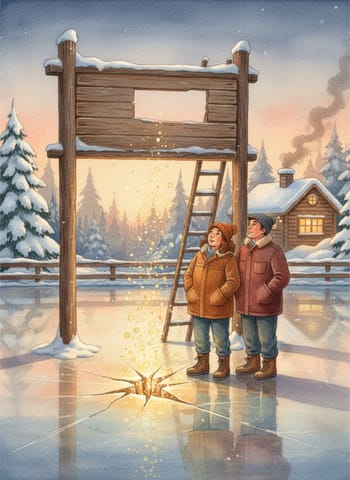
The sign said NO WI HING ON THE ICE. Spoken aloud, it sounded like "No wi-hing on the ice", because the S of WISHING was gone.
El letrero decía NO WI HING ON THE ICE. Dicho en voz alta, sonaba como «No wi-hing on the ice», porque faltaba la S de WISHING.
In the gap, a pale square of beam showed where the letter had been. A thin line of frost was creeping out of the hole, spreading across the wood like a crack in a window. Beneath the sign, a coat lay in a heap on the tiles, its hanging loop torn.
En el hueco, un cuadrado pálido de viga mostraba dónde había estado la letra. Una fina línea de escarcha se iba arrastrando fuera del agujero, extendiéndose por la madera como una grieta en una ventana. Debajo del letrero, un abrigo yacía en un montón sobre las baldosas, con la presilla para colgar rota.
"Ula!" Osman shouted.
«¡Ula!», gritó Osman.
Ula appeared from the back office, rubbing her eyes with one hand and holding half a sandwich in the other. She worked the night shift, driving the machine that smoothed the ice after closing. She lived on sandwiches and silence, and she was rarely seen before noon.
Ula apareció desde la oficina del fondo, frotándose los ojos con una mano y sosteniendo medio sándwich en la otra. Trabajaba el turno de noche, conduciendo la máquina que alisaba el hielo después del cierre. Vivía de sándwiches y silencio, y rara vez se la veía antes del mediodía.
"What is it?" she asked.
«¿Qué pasa?», preguntó.
Osman pointed. Ula followed his finger and chewed slowly, and the colour drained out of her face.
Osman señaló. Ula siguió su dedo y masticó despacio, y el color se le fue de la cara.
"Ah," she said.
«Ah», dijo.
"What does 'ah' mean?"
«¿Qué quiere decir "ah"?».
"It means that last night, when I was hanging up my coat…" She swallowed. "I used the S as a hook. It looked like a hook. I did not think."
«Quiere decir que anoche, cuando colgaba mi abrigo…». Tragó. «Usé la S como gancho. Parecía un gancho. No pensé».
"You hung your coat on the founder's sign."
«Colgaste tu abrigo del letrero del fundador».
"A sign that looked a lot like a coat hook," said Ula weakly.
«Un letrero que se parecía mucho a un gancho para abrigos», dijo Ula débilmente.
Osman closed his eyes and counted to five. When he opened them, two children were already standing in the doorway with their skates over their shoulders. A third was pointing at the frost on the beam. Behind them, in the rink, somebody laughed, and the sound had a strange echo to it, as though the ice was repeating it back.
Osman cerró los ojos y contó hasta cinco. Cuando los abrió, dos niños ya estaban en la puerta con los patines al hombro. Un tercero señalaba la escarcha de la viga. Detrás de ellos, en la pista, alguien se rio, y el sonido tenía un extraño eco, como si el hielo lo repitiera.
"We open at nine," Osman said. "It is ten to nine. Find that letter."
«Abrimos a las nueve», dijo Osman. «Son las nueve menos diez. Encuentra esa letra».
They searched the lobby, the coat room, and the floor around the sign. They searched the bucket where the cleaning cloths lived. Ula even climbed a ladder and checked the beam itself, running her hands along the dusty wood. All she found was a single iron bolt, still warm.
Buscaron en el vestíbulo, en el guardarropa y en el piso alrededor del letrero. Buscaron en el balde donde vivían los trapos de limpieza. Ula incluso subió por una escalera y revisó la viga misma, pasando las manos por la madera polvorienta. Lo único que encontró fue un solo perno de hierro, todavía tibio.
"It must have fallen into the rink," she said.
«Debe de haber caído en la pista», dijo.
"Then we will have to look on the ice."
«Entonces tendremos que buscar en el hielo».
"We cannot go on the ice right now. The wishes are already leaking." Ula pointed through the glass doors. "Look."
«No podemos entrar al hielo ahora. Los deseos ya se están filtrando». Ula señaló a través de las puertas de vidrio. «Mira».
A small shape was drifting across the rink, hanging a handspan above the surface. It was a boy of about eight, still wearing his hat. His arms were stretched wide, and his mouth was open in perfect delight. As Osman watched, the boy rose a little higher, turned a slow circle, and settled back down on his skates with a gentle bump.
Una pequeña silueta iba a la deriva por la pista, suspendida a un palmo de la superficie. Era un niño de unos ocho años, todavía con el gorro puesto. Tenía los brazos bien abiertos y la boca abierta de pura alegría. Mientras Osman miraba, el niño subió un poco más, giró despacio en un círculo y se posó de nuevo sobre sus patines con un suave golpecito.
"I only wished I could fly," the boy said happily. "Just a bit."
«Solo deseé poder volar», dijo el niño feliz. «Solo un poquito».
"That is exactly what we are afraid of," Osman muttered.
«Eso es exactamente lo que tememos», murmuró Osman.
Ula was already looking at the letters that remained. "The S is gone, and we cannot buy another," she said. "The founder cast them from the same iron as the rink's old skate blades. There is no foundry left in town that knows how."
Ula ya estaba mirando las letras que quedaban. «La S se fue, y no podemos comprar otra», dijo. «El fundador las coló con el mismo hierro de las viejas cuchillas de patín de la pista. No queda ninguna fundición en el pueblo que sepa cómo».
Osman thought about this. He looked at the blue letters, at the frost spreading along the beam, and at the gap in the sign.
Osman pensó en esto. Miró las letras azules, la escarcha que se extendía por la viga y el hueco en el letrero.
Then he looked at Ula's coat, lying crumpled beneath the gap, with the hanging loop torn in two.
Luego miró el abrigo de Ula, tirado y arrugado bajo el hueco, con la presilla rota en dos.
"Iron from skate blades," he said slowly.
«Hierro de cuchillas de patín», dijo despacio.
"Yes. What of it?"
«Sí. ¿Y qué?».
"Where do we keep the old blades?"
«¿Dónde guardamos las cuchillas viejas?».
Ula stared at him. Her eyes moved to the workshop door at the back of the lobby. Inside it stood a rusty barrel full of retired skates, left behind over the decades by people who had outgrown them.
Ula lo miró fijamente. Sus ojos se movieron hacia la puerta del taller al fondo del vestíbulo. Adentro había un barril oxidado lleno de patines jubilados, dejados atrás a lo largo de las décadas por personas a las que ya les quedaban chicos.
They worked fast. Ula dragged out the barrel while Osman cleared the workbench. From the pile, Osman chose a long, curved blade from a pair of figure skates. The steel was dark and already slightly bent, as if it remembered being an S in a former life. He clamped it in the vise. Ula took the heaviest hammer from the wall and began to tap it into shape. One patient blow after another, she rounded the top curve and flattened the lower tail.
Trabajaron rápido. Ula sacó arrastrando el barril mientras Osman despejaba la mesa de trabajo. Del montón, Osman eligió una cuchilla larga y curva de un par de patines artísticos. El acero era oscuro y ya estaba ligeramente doblado, como si recordara haber sido una S en una vida anterior. La sujetó en el tornillo de banco. Ula tomó el martillo más pesado de la pared y empezó a darle forma a golpecitos. Un golpe paciente tras otro, redondeó la curva de arriba y aplanó la cola de abajo.
"Watch the rivet holes," Osman said.
«Cuidado con los agujeros de los remaches», dijo Osman.
"I am watching."
«Estoy cuidando».
"You are talking to the hammer."
«Le estás hablando al martillo».
"The hammer understands me."
«El martillo me entiende».
At four minutes to nine, the new letter was done. It was not as pale as the others, and the curve was a little uneven. Still, when Osman held it up, it was unmistakably an S. They carried it back to the lobby on a folded cloth, as though it might spill. Ula climbed the ladder again, and Osman handed up the bolts one at a time.
A las nueve menos cuatro, la letra nueva estaba lista. No era tan pálida como las otras, y la curva era un poco desigual. Aun así, cuando Osman la levantó, era inconfundiblemente una S. La llevaron de vuelta al vestíbulo sobre un paño doblado, como si pudiera derramarse. Ula volvió a subir la escalera, y Osman le fue pasando los pernos de uno en uno.
It took three tries to hold the letter in place. On the third, Ula's hand shook, and the bolt rang against the iron with a clear, ringing note. The frost on the beam stopped. For a moment the whole lobby seemed to hold its breath.
Tomó tres intentos sostener la letra en su lugar. En el tercero, la mano de Ula tembló, y el perno resonó contra el hierro con una nota clara y sonora. La escarcha de la viga se detuvo. Por un momento todo el vestíbulo pareció contener el aliento.
Then the cold seeped slowly back out of the wood, and the blue letters glowed once, softly, and went dull.
Luego el frío se fue filtrando lentamente fuera de la madera, y las letras azules brillaron una vez, suavemente, y se apagaron.
Out on the rink, the boy settled onto his skates with a final, graceful bump.
En la pista, el niño se posó sobre sus patines con un último y grácil golpecito.
"I think it worked," Ula said from the ladder.
«Creo que funcionó», dijo Ula desde la escalera.
"I think so too." Osman took a step back to look at the sign. NO WISHING ON THE ICE, it said again, with one letter a little darker than the rest. Some people would notice. Most would not. He decided that was fair, and that the founder would have agreed.
«Yo también lo creo». Osman dio un paso atrás para mirar el letrero. NO WISHING ON THE ICE, decía otra vez, con una letra un poco más oscura que las demás. Algunos lo notarían. La mayoría no. Decidió que eso era justo, y que el fundador habría estado de acuerdo.
He glanced at his watch, and then at the doors, behind which a line of skaters was already growing. He pulled the keys from his pocket and handed them to Ula.
Miró su reloj, y luego las puertas, detrás de las cuales ya crecía una fila de patinadores. Sacó las llaves del bolsillo y se las dio a Ula.
"Open up," he said. "And next time, Ula, read the sign before you hang your coat on it."
«Abre», dijo. «Y la próxima vez, Ula, lee el letrero antes de colgar tu abrigo de él».