How the Camel Got His Hump
A free B2-level English story for language learners, readable online in 7 languages, with an option to listen via the free Storyteller app.
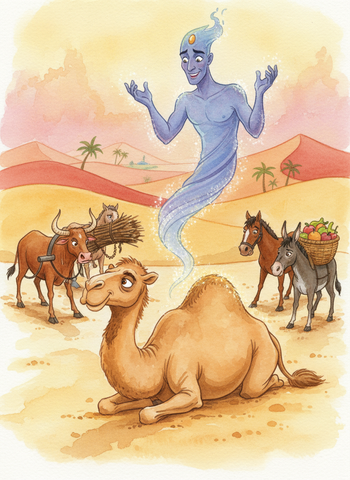
A lazy Camel refuses to lift a hoof while the other animals work — until a desert-dwelling Djinn decides to teach him an unforgettable lesson.
Now this is the next tale, and it tells how the Camel got his big hump.
Ahora bien, este es el siguiente cuento, y cuenta cómo el Camello consiguió su gran joroba.
In the beginning of years, when the world was so new and all, and the Animals were just beginning to work for Man, there was a Camel, and he lived in the middle of a Howling Desert because he did not want to work; and besides, he was a Howler himself. So he ate sticks and thorns and tamarisks and milkweed and prickles, most ‘scruciating idle; and when anybody spoke to him he said ‘Humph!’ Just ‘Humph!’ and no more.
Al principio de los tiempos, cuando el mundo era tan nuevo y todo eso, y los Animales apenas empezaban a trabajar para el Hombre, había un Camello, que vivía en medio de un Desierto Aullador porque no quería trabajar; y además, él mismo era un Aullador. Así que comía palos y espinos y tamariscos y algodoncillo y zarzas, de lo más atrozmente ocioso; y cuando alguien le hablaba, decía «¡Jum!». Solo «¡Jum!» y nada más.
Presently the Horse came to him on Monday morning, with a saddle on his back and a bit in his mouth, and said, ‘Camel, O Camel, come out and trot like the rest of us.’
Al poco llegó el Caballo hasta él un lunes por la mañana, con una silla en el lomo y un bocado en la boca, y dijo: «Camello, oh Camello, sal y trota como los demás».
‘Humph!’ said the Camel; and the Horse went away and told the Man.
«¡Jum!», dijo el Camello; y el Caballo se fue y se lo contó al Hombre.
Presently the Dog came to him, with a stick in his mouth, and said, ‘Camel, O Camel, come and fetch and carry like the rest of us.’
Al poco llegó el Perro hasta él, con un palo en la boca, y dijo: «Camello, oh Camello, ven a buscar y a llevar cosas como los demás».
‘Humph!’ said the Camel; and the Dog went away and told the Man.
«¡Jum!», dijo el Camello; y el Perro se fue y se lo contó al Hombre.
Presently the Ox came to him, with the yoke on his neck and said, ‘Camel, O Camel, come and plough like the rest of us.’
Al poco llegó el Buey hasta él, con el yugo al cuello, y dijo: «Camello, oh Camello, ven a arar como los demás».
‘Humph!’ said the Camel; and the Ox went away and told the Man.
«¡Jum!», dijo el Camello; y el Buey se fue y se lo contó al Hombre.
At the end of the day the Man called the Horse and the Dog and the Ox together, and said, ‘Three, O Three, I’m very sorry for you (with the world so new-and-all); but that Humph-thing in the Desert can’t work, or he would have been here by now, so I am going to leave him alone, and you must work double-time to make up for it.’
Al final del día, el Hombre llamó al Caballo, al Perro y al Buey, y les dijo: «Vosotros tres, lo siento mucho por vosotros (con el mundo tan nuevo y todo eso); pero esa cosa Jum del Desierto no puede trabajar, o ya estaría aquí, así que voy a dejarlo tranquilo, y vosotros tendréis que trabajar el doble para compensarlo».
That made the Three very angry (with the world so new-and-all), and they held a palaver, and an indaba, and a punchayet, and a pow-wow on the edge of the Desert; and the Camel came chewing on milkweed most ‘scruciating idle, and laughed at them. Then he said ‘Humph!’ and went away again.
Eso hizo enfadar mucho a los Tres (con el mundo tan nuevo y todo eso), y celebraron una palabrería, y una asamblea, y una junta, y un consejo al borde del Desierto; y el Camello llegó masticando algodoncillo, de lo más atrozmente ocioso, y se rió de ellos. Luego dijo «¡Jum!» y se fue de nuevo.
Presently there came along the Djinn in charge of All Deserts, rolling in a cloud of dust (Djinns always travel that way because it is Magic), and he stopped to palaver and pow-pow with the Three.
Al poco llegó rodando el Genio encargado de Todos los Desiertos, envuelto en una nube de polvo (los Genios siempre viajan así porque es Magia), y se detuvo a conversar y a departir con los Tres.
‘Djinn of All Deserts,’ said the Horse, ‘is it right for any one to be idle, with the world so new-and-all?’
«Genio de Todos los Desiertos», dijo el Caballo, «¿está bien que alguien sea ocioso, con el mundo tan nuevo y todo eso?».
‘Certainly not,’ said the Djinn.
«Claro que no», dijo el Genio.
‘Well,’ said the Horse, ‘there’s a thing in the middle of your Howling Desert (and he’s a Howler himself) with a long neck and long legs, and he hasn’t done a stroke of work since Monday morning. He won’t trot.’
«Pues bien», dijo el Caballo, «hay una cosa en medio de tu Desierto Aullador (y él mismo es un Aullador) con el cuello largo y las patas largas, y no ha dado golpe desde el lunes por la mañana. No quiere trotar».
‘Whew!’ said the Djinn, whistling, ‘that’s my Camel, for all the gold in Arabia! What does he say about it?’
«¡Vaya!», dijo el Genio, silbando, «¡ese es mi Camello, por todo el oro de Arabia! ¿Qué dice él al respecto?».
‘He says “Humph!”’ said the Dog; ‘and he won’t fetch and carry.’
«Dice "¡Jum!"», dijo el Perro; «y no quiere buscar ni llevar cosas».
‘Does he say anything else?’
«¿Dice algo más?».
‘Only “Humph!”; and he won’t plough,’ said the Ox.
«Solo "¡Jum!"; y no quiere arar», dijo el Buey.
‘Very good,’ said the Djinn. ‘I’ll humph him if you will kindly wait a minute.’
«Muy bien», dijo el Genio. «Le voy a hacer un jum si tenéis la bondad de esperar un minuto».
The Djinn rolled himself up in his dust-cloak, and took a bearing across the desert, and found the Camel most ‘scruciatingly idle, looking at his own reflection in a pool of water.
El Genio se envolvió en su capa de polvo, y tomó rumbo a través del desierto, y encontró al Camello de lo más atrozmente ocioso, mirando su propio reflejo en un charco de agua.
‘My long and bubbling friend,’ said the Djinn, ‘what’s this I hear of your doing no work, with the world so new-and-all?’
«Mi largo y burbujeante amigo», dijo el Genio, «¿qué es esto que oigo de que no haces ningún trabajo, con el mundo tan nuevo y todo eso?».
‘Humph!’ said the Camel.
«¡Jum!», dijo el Camello.
The Djinn sat down, with his chin in his hand, and began to think a Great Magic, while the Camel looked at his own reflection in the pool of water.
El Genio se sentó, con la barbilla en la mano, y se puso a pensar una Gran Magia, mientras el Camello miraba su propio reflejo en el charco de agua.
‘You’ve given the Three extra work ever since Monday morning, all on account of your ‘scruciating idleness,’ said the Djinn; and he went on thinking Magics, with his chin in his hand.
«Les has dado a los Tres trabajo extra desde el lunes por la mañana, todo por tu atroz ociosidad», dijo el Genio; y siguió pensando Magias, con la barbilla en la mano.
‘Humph!’ said the Camel.
«¡Jum!», dijo el Camello.
‘I shouldn’t say that again if I were you,’ said the Djinn; you might say it once too often. Bubbles, I want you to work.’
«Yo que tú no lo volvería a decir», dijo el Genio; «podrías decirlo una vez de más. Burbujas, quiero que trabajes».
And the Camel said ‘Humph!’ again; but no sooner had he said it than he saw his back, that he was so proud of, puffing up and puffing up into a great big lolloping humph.
Y el Camello volvió a decir «¡Jum!»; pero apenas lo había dicho cuando vio que su lomo, del que tan orgulloso estaba, se hinchaba y se hinchaba hasta formar una gran joroba bamboleante.
‘Do you see that?’ said the Djinn. ‘That’s your very own humph that you’ve brought upon your very own self by not working. To-day is Thursday, and you’ve done no work since Monday, when the work began. Now you are going to work.’
«¿Ves eso?», dijo el Genio. «Esa es tu propia joroba, que te has buscado tú solito por no trabajar. Hoy es jueves, y no has hecho nada desde el lunes, cuando empezó el trabajo. Ahora vas a trabajar».
‘How can I,’ said the Camel, ‘with this humph on my back?’
«¿Cómo voy a hacerlo», dijo el Camello, «con esta joroba en el lomo?».
‘That’s made a-purpose,’ said the Djinn, ‘all because you missed those three days. You will be able to work now for three days without eating, because you can live on your humph; and don’t you ever say I never did anything for you. Come out of the Desert and go to the Three, and behave. Humph yourself!’
«Eso está hecho a propósito», dijo el Genio, «todo por haberte perdido esos tres días. Ahora podrás trabajar durante tres días sin comer, porque podrás vivir de tu joroba; y no vayas a decir nunca que no hice nada por ti. Sal del Desierto y ve con los Tres, y pórtate bien. ¡Ajúmate a ti mismo!».
And the Camel humphed himself, humph and all, and went away to join the Three. And from that day to this the Camel always wears a humph (we call it ‘hump’ now, not to hurt his feelings); but he has never yet caught up with the three days that he missed at the beginning of the world, and he has never yet learned how to behave.
Y el Camello se ajumó a sí mismo, joroba y todo, y se fue a unirse a los Tres. Y desde ese día hasta hoy, el Camello siempre lleva una joroba (ahora la llamamos "chepa", para no herir sus sentimientos); pero todavía no ha logrado recuperar los tres días que perdió al principio del mundo, y todavía no ha aprendido a comportarse.
The Camel’s hump is an ugly lump Which well you may see at the Zoo; But uglier yet is the hump we get From having too little to do.
La joroba del Camello es un bulto feo Que bien puedes ver en el Zoo; Pero más fea aún es la chepa que sale De tener muy poco que hacer.
Kiddies and grown-ups too-oo-oo, If we haven’t enough to do-oo-oo, We get the hump— Cameelious hump— The hump that is black and blue!
Niños y adultos también, ohh-ohh-ohh, Si no tenemos bastante que hacer, ohh-ohh-ohh, Nos sale la chepa— La chepa camellúa— ¡La chepa que es negra y azul!
We climb out of bed with a frouzly head And a snarly-yarly voice. We shiver and scowl and we grunt and we growl At our bath and our boots and our toys;
Salimos de la cama con la cabeza revuelta Y una voz toda gruñona. Temblamos y fruncimos el ceño y refunfuñamos y rezongamos Ante nuestro baño y nuestras botas y nuestros juguetes;
And there ought to be a corner for me (And I know there is one for you) When we get the hump— Cameelious hump— The hump that is black and blue!
Y debería haber un rincón para mí (Y sé que hay uno para ti) Cuando nos sale la chepa— La chepa camellúa— ¡La chepa que es negra y azul!
The cure for this ill is not to sit still, Or frowst with a book by the fire; But to take a large hoe and a shovel also, And dig till you gently perspire;
El remedio para este mal no es quedarse quieto, Ni mustiarse con un libro junto al fuego; Sino tomar una buena azada y también una pala, Y cavar hasta sudar suavemente;
And then you will find that the sun and the wind. And the Djinn of the Garden too, Have lifted the hump— The horrible hump— The hump that is black and blue!
Y entonces descubrirás que el sol y el viento, Y el Genio del Jardín también, Han levantado la chepa— La horrible chepa— ¡La chepa que es negra y azul!
I get it as well as you-oo-oo— If I haven’t enough to do-oo-oo— We all get hump— Cameelious hump— Kiddies and grown-ups too!
A mí también me sale, ohh-ohh-ohh— Si no tengo bastante que hacer, ohh-ohh-ohh— A todos nos sale la chepa— La chepa camellúa— ¡Niños y adultos también!
