The Clock on the Post Box
Uma história gratuita em inglês de nível A2 para estudantes, para ler online em 7 idiomas, com opção de ouvir no app gratuito Storyteller.
A young mail collector presses a button on a chess clock for years until a new girl finally asks why.
Essa foi a prévia! Ouça a história completa no app gratuito Storyteller. Baixar o app
O áudio não está disponível no momento.
Every afternoon at four, Pria walks to the post box. It stands by the village well. She carries a bag and a small key. She is fifteen, and she is the village mail collector. Nobody else wants the job.
Todas as tardes, às quatro horas, Pria vai até a caixa de correio. Ela fica ao lado do poço da vila. Pria leva uma sacola e uma chavinha. Tem quinze anos e é a coletora de correspondência da vila. Ninguém mais quer o trabalho.
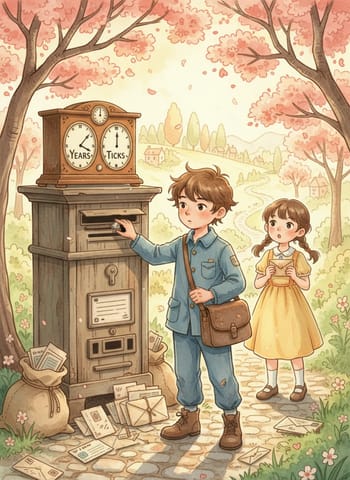
The post box is old and green. A chess clock sits on top of it. It has two faces and two big buttons. It is tied to the lid with wire.
A caixa de correio é velha e verde. Um relógio de xadrez fica em cima dela. Tem dois mostradores e dois botões grandes. Está preso à tampa com arame.
Every day, the same thing happens. Pria opens the box with her key. She empties the letters into her bag. Then she presses the button on the right side of the clock.
Todo dia acontece a mesma coisa. Pria abre a caixa com a chave. Despeja as cartas na sacola. Depois aperta o botão do lado direito do relógio.
Click.
Clique.
Nobody tells her why she does this. Pria does not know either. The last collector told her, "Always press the button. Never ask." Then he moved to the city.
Ninguém lhe diz por que ela faz isso. Pria também não sabe. O último coletor disse a ela: "Sempre aperte o botão. Nunca pergunte." Depois se mudou para a cidade.
So Pria presses the button. For three years, she does not ask.
Então Pria aperta o botão. Durante três anos, não pergunta.
On a bright Tuesday, a girl stops at the well. She has a suitcase with a broken wheel. She watches Pria for a while.
Numa terça-feira clara, uma menina para junto ao poço. Ela tem uma mala com uma rodinha quebrada. Observa Pria por um tempo.
"Hello," says the girl. "I am Neha. We just moved here."
"Oi", diz a menina. "Eu sou a Neha. A gente acabou de se mudar para cá."
"I am Pria," says Pria. "Welcome."
"Eu sou a Pria", diz Pria. "Bem-vinda."
Neha points at the post box. "Why does the box have a chess clock?"
Neha aponta para a caixa de correio. "Por que a caixa tem um relógio de xadrez?"
Pria opens her mouth. Then she closes it. Nobody ever asks her this. The question hangs in the air.
Pria abre a boca. Depois a fecha. Ninguém jamais lhe perguntou isso. A pergunta fica pairando no ar.
"I do not know," she says.
"Eu não sei", diz ela.
"But you press the button."
"Mas você aperta o botão."
"Yes. Every day."
"Sim. Todo dia."
"For how long?"
"Há quanto tempo?"
"Three years."
"Três anos."
Neha looks at her with wide eyes. "And you never asked?"
Neha olha para ela de olhos arregalados. "E você nunca perguntou?"
"The man who had the job said not to ask."
"O homem que tinha o trabalho disse para não perguntar."
"That is a strange rule," Neha says. "A good rule gives a reason."
"Que regra estranha", diz Neha. "Uma boa regra dá um motivo."
Pria laughs. It is a small, surprised laugh. For three years, she waits for someone to say this.
Pria ri. É uma risadinha curta e surpresa. Por três anos, ela esperou que alguém dissesse isso.
"Come with me," says Pria. "I finish my round at five. We can look for the answer."
"Venha comigo", diz Pria. "Termino minha ronda às cinco. A gente pode procurar a resposta."
Neha leaves her suitcase by the well. They walk together through the village. Pria stops at every gate and every door. She knows each family by their letters. There are blue ones, thin ones, and very fat ones with string.
Neha deixa a mala junto ao poço. Elas caminham juntas pela vila. Pria para em cada portão e em cada porta. Conhece cada família pelas cartas. Há as azuis, as finas e as muito gordas amarradas com barbante.
At the last house, a woman waits at the door. She is the village potter. Her hands are always gray with clay. Today, she holds a long white envelope.
Na última casa, uma mulher espera à porta. É a oleira da vila. Suas mãos estão sempre cinzentas de argila. Hoje, ela segura um longo envelope branco.
"One for the city, please," she says.
"Uma para a cidade, por favor", diz.
Pria takes it. On the front is a small drawing. It shows a horse on a square board.
Pria a pega. Na frente há um pequeno desenho. Mostra um cavalo num tabuleiro quadrado.
Neha leans closer. "That is a chess piece."
Neha se inclina para perto. "Isso é uma peça de xadrez."
"A knight," says the potter. She looks surprised. "You know chess?"
"Um cavalo", diz a oleira. Parece surpresa. "Você conhece xadrez?"
"A little," Neha says. "Do you play?"
"Um pouco", diz Neha. "A senhora joga?"
"I play one game. It is three years old now." The potter smiles. "My friend lives far away, in another country. We play by post."
"Jogo uma partida. Ela já tem três anos." A oleira sorri. "Meu amigo mora longe, em outro país. Nós jogamos pelo correio."
Pria stares at her. "By post?"
Pria olha fixamente para ela. "Pelo correio?"
"Each of us sends one move at a time, in a letter. I write mine, and it goes across the sea. Then I wait for his."
"Cada um envia uma jogada de cada vez, numa carta. Eu escrevo a minha, e ela cruza o mar. Depois espero pela dele."
"That sounds slow," says Neha.
"Parece lento", diz Neha.
"It is very slow," the potter agrees. "That is why I like it."
"É muito lento", concorda a oleira. "É por isso que eu gosto."
Pria cannot stop herself. "And the clock on the post box?"
Pria não consegue se segurar. "E o relógio na caixa de correio?"
The potter's face changes. She looks at Pria for a long moment, and then she laughs.
O rosto da oleira muda. Ela olha para Pria por um longo momento, e depois ri.
"Oh, dear. Nobody told you?"
"Ai, meu Deus. Ninguém te contou?"
"Nobody told me anything," Pria says.
"Ninguém me contou nada", diz Pria.
The potter wipes her hands on her dress. She sits down on her step and pats the stone beside her. The girls sit.
A oleira limpa as mãos no vestido. Senta-se no degrau e dá tapinhas na pedra ao lado. As meninas se sentam.
"Years ago, my friend and I made a rule," she says. "A letter takes many days to cross the sea. That time is not fair for either of us. So the clock must count only the time a person thinks."
"Anos atrás, meu amigo e eu fizemos uma regra", diz ela. "Uma carta leva muitos dias para atravessar o mar. Esse tempo não é justo para nenhum dos dois. Então o relógio deve contar só o tempo em que uma pessoa pensa."
"So how does the clock work?" asks Neha.
"Então como o relógio funciona?", pergunta Neha.
"When my letter goes into the bag, you press the right button. That stops my side. It starts his side. When his letter comes, you press the left button. That stops his side. It starts mine."
"Quando minha carta entra na sacola, você aperta o botão direito. Isso para o meu lado. E começa o lado dele. Quando a carta dele chega, você aperta o botão esquerdo. Isso para o lado dele. E começa o meu."
Pria thinks about the three years of clicks. "I only press the right one," she says. "Every day."
Pria pensa nos três anos de cliques. "Eu só aperto o da direita", diz. "Todo dia."
The potter's face goes soft. "Oh, Pria. The last collector knew the rule. He moved away before he told you about the left button."
O rosto da oleira se suaviza. "Ah, Pria. O último coletor sabia da regra. Ele se mudou antes de te falar do botão esquerdo."
"So for three years, his side runs and runs?"
"Então, por três anos, o lado dele corre e corre?"
"Yes, for three years." The potter laughs again, kindly now. "My poor friend thinks very slowly."
"Sim, por três anos." A oleira ri de novo, agora com gentileza. "Meu pobre amigo pensa muito devagar."
Neha puts both hands over her mouth. Pria tries not to smile, but she cannot stop.
Neha põe as duas mãos sobre a boca. Pria tenta não sorrir, mas não consegue evitar.
"I am so sorry," Pria says.
"Sinto muito", diz Pria.
"Do not be. I like it. Last month, my friend wrote to me. He said, 'Your clock says I thought for three years. I am proud of myself.'"
"Não sinta. Eu gosto. No mês passado, meu amigo me escreveu. Disse: 'Seu relógio diz que eu pensei por três anos. Estou orgulhoso de mim.'"
Now all three of them laugh together. The sound rolls down the village road. It passes the well and the green post box.
Agora as três riem juntas. O som rola pela estrada da vila. Passa pelo poço e pela caixa de correio verde.
At five, Pria and Neha walk back to the well. The clock is still on top of the box. The left face shows a small number. The right shows a bigger one.
Às cinco, Pria e Neha voltam ao poço. O relógio ainda está em cima da caixa. O mostrador esquerdo marca um número pequeno. O direito marca um maior.
"What do you do now?" asks Neha.
"O que você faz agora?", pergunta Neha.
Pria thinks. "Today the potter's letter went in. So I press the right button. When her friend writes back, I press the left one."
Pria pensa. "Hoje a carta da oleira entrou. Então eu aperto o botão direito. Quando o amigo dela responder, eu aperto o esquerdo."
"And you will ask her about the days?"
"E você vai perguntar a ela sobre os dias?"
"I will ask her. Every time." Pria turns to Neha. "Do you want to press it?"
"Vou perguntar. Toda vez." Pria se vira para Neha. "Quer apertar?"
Neha steps forward. She puts one finger on the big right button. For a moment, she looks at Pria, and Pria nods.
Neha dá um passo à frente. Coloca um dedo no botão direito grande. Por um instante, olha para Pria, e Pria assente.
She presses it. The small hand jumps forward. Both of them smile.
Ela aperta. O ponteiro pequeno salta para a frente. As duas sorriem.