The Clock on the Post Box
Una historia gratuita en inglés de nivel A2 para estudiantes, para leer en línea en 7 idiomas, con opción de escucharla en la app gratuita Storyteller.
A young mail collector presses a button on a chess clock for years until a new girl finally asks why.
¡Ese fue el avance! Escucha la historia completa en la app gratuita Storyteller. Descargar la app
El audio no está disponible en este momento.
Every afternoon at four, Pria walks to the post box. It stands by the village well. She carries a bag and a small key. She is fifteen, and she is the village mail collector. Nobody else wants the job.
Cada tarde a las cuatro, Pria camina hasta el buzón. Está junto al pozo del pueblo. Lleva una bolsa y una llavecita. Tiene quince años, y es la recolectora de correo del pueblo. Nadie más quiere el trabajo.
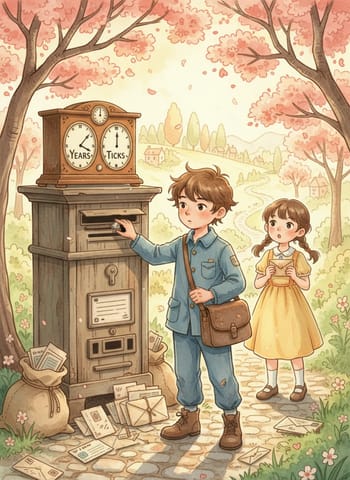
The post box is old and green. A chess clock sits on top of it. It has two faces and two big buttons. It is tied to the lid with wire.
El buzón es viejo y verde. Sobre él hay un reloj de ajedrez. Tiene dos esferas y dos botones grandes. Está atado a la tapa con alambre.
Every day, the same thing happens. Pria opens the box with her key. She empties the letters into her bag. Then she presses the button on the right side of the clock.
Todos los días pasa lo mismo. Pria abre el buzón con su llave. Vacía las cartas en su bolsa. Luego aprieta el botón del lado derecho del reloj.
Click.
Clic.
Nobody tells her why she does this. Pria does not know either. The last collector told her, "Always press the button. Never ask." Then he moved to the city.
Nadie le dice por qué hace esto. Pria tampoco lo sabe. El último recolector le dijo: «Siempre aprieta el botón. Nunca preguntes». Luego se mudó a la ciudad.
So Pria presses the button. For three years, she does not ask.
Así que Pria aprieta el botón. Durante tres años, no pregunta.
On a bright Tuesday, a girl stops at the well. She has a suitcase with a broken wheel. She watches Pria for a while.
Un martes soleado, una chica se detiene junto al pozo. Trae una maleta con una rueda rota. Observa a Pria un rato.
"Hello," says the girl. "I am Neha. We just moved here."
«Hola», dice la chica. «Soy Neha. Acabamos de mudarnos aquí».
"I am Pria," says Pria. "Welcome."
«Soy Pria», dice Pria. «Bienvenida».
Neha points at the post box. "Why does the box have a chess clock?"
Neha señala el buzón. «¿Por qué el buzón tiene un reloj de ajedrez?».
Pria opens her mouth. Then she closes it. Nobody ever asks her this. The question hangs in the air.
Pria abre la boca. Luego la cierra. Nadie le ha preguntado esto nunca. La pregunta queda flotando en el aire.
"I do not know," she says.
«No lo sé», dice.
"But you press the button."
«Pero aprietas el botón».
"Yes. Every day."
«Sí. Todos los días».
"For how long?"
«¿Desde hace cuánto?».
"Three years."
«Tres años».
Neha looks at her with wide eyes. "And you never asked?"
Neha la mira con los ojos muy abiertos. «¿Y nunca preguntaste?».
"The man who had the job said not to ask."
«El hombre que tenía el trabajo dijo que no preguntara».
"That is a strange rule," Neha says. "A good rule gives a reason."
«Esa es una regla rara», dice Neha. «Una buena regla da una razón».
Pria laughs. It is a small, surprised laugh. For three years, she waits for someone to say this.
Pria se ríe. Es una risa pequeña y sorprendida. Durante tres años, ha esperado que alguien dijera esto.
"Come with me," says Pria. "I finish my round at five. We can look for the answer."
«Ven conmigo», dice Pria. «Termino mi ronda a las cinco. Podemos buscar la respuesta».
Neha leaves her suitcase by the well. They walk together through the village. Pria stops at every gate and every door. She knows each family by their letters. There are blue ones, thin ones, and very fat ones with string.
Neha deja su maleta junto al pozo. Caminan juntas por el pueblo. Pria se detiene en cada portón y en cada puerta. Conoce a cada familia por sus cartas. Hay azules, delgadas y otras muy gordas con cordel.
At the last house, a woman waits at the door. She is the village potter. Her hands are always gray with clay. Today, she holds a long white envelope.
En la última casa, una mujer espera en la puerta. Es la alfarera del pueblo. Sus manos siempre están grises de arcilla. Hoy sostiene un sobre largo y blanco.
"One for the city, please," she says.
«Una para la ciudad, por favor», dice.
Pria takes it. On the front is a small drawing. It shows a horse on a square board.
Pria la toma. En el frente hay un pequeño dibujo. Muestra un caballo sobre un tablero cuadriculado.
Neha leans closer. "That is a chess piece."
Neha se inclina más cerca. «Eso es una pieza de ajedrez».
"A knight," says the potter. She looks surprised. "You know chess?"
«Un caballo», dice la alfarera. Parece sorprendida. «¿Sabes ajedrez?».
"A little," Neha says. "Do you play?"
«Un poco», dice Neha. «¿Usted juega?».
"I play one game. It is three years old now." The potter smiles. "My friend lives far away, in another country. We play by post."
«Juego una partida. Ya tiene tres años». La alfarera sonríe. «Mi amigo vive lejos, en otro país. Jugamos por correo».
Pria stares at her. "By post?"
Pria la mira fijamente. «¿Por correo?».
"Each of us sends one move at a time, in a letter. I write mine, and it goes across the sea. Then I wait for his."
«Cada uno envía una jugada a la vez, en una carta. Yo escribo la mía, y cruza el mar. Luego espero la suya».
"That sounds slow," says Neha.
«Eso suena lento», dice Neha.
"It is very slow," the potter agrees. "That is why I like it."
«Es muy lento», concuerda la alfarera. «Por eso me gusta».
Pria cannot stop herself. "And the clock on the post box?"
Pria no puede contenerse. «¿Y el reloj del buzón?».
The potter's face changes. She looks at Pria for a long moment, and then she laughs.
El rostro de la alfarera cambia. Mira a Pria un largo momento, y luego se ríe.
"Oh, dear. Nobody told you?"
«Ay, querida. ¿Nadie te lo explicó?».
"Nobody told me anything," Pria says.
«Nadie me explicó nada», dice Pria.
The potter wipes her hands on her dress. She sits down on her step and pats the stone beside her. The girls sit.
La alfarera se limpia las manos en el vestido. Se sienta en su escalón y da una palmadita en la piedra a su lado. Las chicas se sientan.
"Years ago, my friend and I made a rule," she says. "A letter takes many days to cross the sea. That time is not fair for either of us. So the clock must count only the time a person thinks."
«Hace años, mi amigo y yo hicimos una regla», dice. «Una carta tarda muchos días en cruzar el mar. Ese tiempo no es justo para ninguno de los dos. Así que el reloj debe contar solo el tiempo que una persona piensa».
"So how does the clock work?" asks Neha.
«¿Y cómo funciona el reloj?», pregunta Neha.
"When my letter goes into the bag, you press the right button. That stops my side. It starts his side. When his letter comes, you press the left button. That stops his side. It starts mine."
«Cuando mi carta entra en la bolsa, tú aprietas el botón derecho. Eso detiene mi lado. Empieza el lado de él. Cuando llega su carta, aprietas el botón izquierdo. Eso detiene su lado. Empieza el mío».
Pria thinks about the three years of clicks. "I only press the right one," she says. "Every day."
Pria piensa en los tres años de clics. «Yo solo aprieto el derecho», dice. «Todos los días».
The potter's face goes soft. "Oh, Pria. The last collector knew the rule. He moved away before he told you about the left button."
El rostro de la alfarera se suaviza. «Ay, Pria. El último recolector sabía la regla. Se mudó antes de contarte lo del botón izquierdo».
"So for three years, his side runs and runs?"
«¿Entonces durante tres años, su lado corre y corre?».
"Yes, for three years." The potter laughs again, kindly now. "My poor friend thinks very slowly."
«Sí, durante tres años». La alfarera vuelve a reír, ahora con ternura. «Mi pobre amigo piensa muy despacio».
Neha puts both hands over her mouth. Pria tries not to smile, but she cannot stop.
Neha se cubre la boca con ambas manos. Pria intenta no sonreír, pero no puede evitarlo.
"I am so sorry," Pria says.
«Lo siento muchísimo», dice Pria.
"Do not be. I like it. Last month, my friend wrote to me. He said, 'Your clock says I thought for three years. I am proud of myself.'"
«No lo sientas. Me gusta. El mes pasado, mi amigo me escribió. Dijo: "Tu reloj dice que pensé durante tres años. Estoy orgulloso de mí mismo"».
Now all three of them laugh together. The sound rolls down the village road. It passes the well and the green post box.
Ahora las tres se ríen juntas. El sonido rueda por el camino del pueblo. Pasa junto al pozo y el buzón verde.
At five, Pria and Neha walk back to the well. The clock is still on top of the box. The left face shows a small number. The right shows a bigger one.
A las cinco, Pria y Neha caminan de vuelta al pozo. El reloj sigue sobre el buzón. La esfera izquierda muestra un número pequeño. La derecha muestra uno más grande.
"What do you do now?" asks Neha.
«¿Qué haces ahora?», pregunta Neha.
Pria thinks. "Today the potter's letter went in. So I press the right button. When her friend writes back, I press the left one."
Pria piensa. «Hoy entró la carta de la alfarera. Así que aprieto el botón derecho. Cuando su amigo le responda, aprieto el izquierdo».
"And you will ask her about the days?"
«¿Y le preguntarás los días?».
"I will ask her. Every time." Pria turns to Neha. "Do you want to press it?"
«Se lo preguntaré. Cada vez». Pria se vuelve hacia Neha. «¿Quieres apretarlo tú?».
Neha steps forward. She puts one finger on the big right button. For a moment, she looks at Pria, and Pria nods.
Neha da un paso adelante. Pone un dedo en el gran botón derecho. Por un momento, mira a Pria, y Pria asiente.
She presses it. The small hand jumps forward. Both of them smile.
Lo aprieta. La manecilla pequeña salta hacia adelante. Las dos sonríen.