A Visitor in the Only Goal
Una historia gratuita en inglés de nivel A2 para estudiantes, para leer en línea en 7 idiomas, con opción de escucharla en la app gratuita Storyteller.
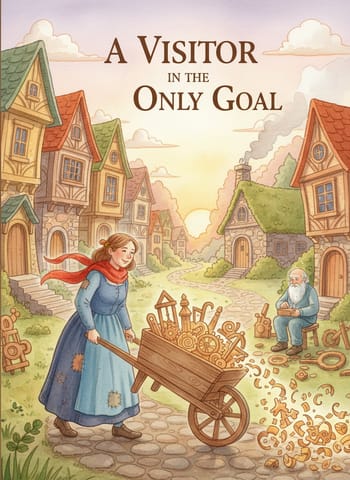
Gudrun pushes a mystery wheelbarrow from house to house until she finds the quiet man who made the wood inside it.
¡Ese fue el avance! Escucha la historia completa en la app gratuita Storyteller. Descargar la app
El audio no está disponible en este momento.
The village pitch has one goal. The other goal is gone. Nobody remembers when it went. The pitch is a long strip of grass behind the school. It leans a little to the left. Every game here is played at the same end.
La cancha del pueblo tiene una sola portería. La otra portería ya no está. Nadie recuerda cuándo desapareció. La cancha es una larga franja de pasto detrás de la escuela. Se inclina un poco hacia la izquierda. Todos los partidos se juegan en el mismo extremo.
Gudrun keeps the pitch. Nobody pays her, and nobody asked her to. She cuts the grass on Saturdays. She marks the lines with white powder. On Sunday mornings she walks the grass alone and picks up stones.
Gudrun cuida la cancha. Nadie le paga y nadie se lo pidió. Corta el pasto los sábados. Marca las líneas con polvo blanco. Los domingos por la mañana recorre el pasto sola y recoge piedras.
On Thursday, she comes early to fix a hole in the grass. It is just after six. The air is cool and the grass is wet. She stops at the edge of the pitch.
El jueves llega temprano para arreglar un hoyo en el pasto. Son poco más de las seis. El aire es fresco y el pasto está mojado. Se detiene en el borde de la cancha.
A wheelbarrow stands inside the goal.
Hay una carretilla dentro de la portería.
It is green, with a bent handle. The wheel looks new. A rope holds a sheet over the load. Nobody is near it. There are no footprints in the wet grass, except her own. A thin line of wheel marks runs back to the lane.
Es verde, con el mango doblado. La rueda parece nueva. Una cuerda sujeta una sábana sobre la carga. No hay nadie cerca. No hay huellas en el pasto mojado, salvo las suyas. Una delgada línea de marcas de rueda vuelve hacia el camino.
Gudrun walks around the wheelbarrow twice. Then she lifts the sheet. Under it lie three long pieces of pale wood. They are smooth and straight. Someone worked on them for hours.
Gudrun camina dos veces alrededor de la carretilla. Luego levanta la sábana. Debajo hay tres largas piezas de madera clara. Son lisas y derechas. Alguien trabajó en ellas durante horas.
"Somebody forgot you," she says to the wheelbarrow.
«Alguien te olvidó», le dice a la carretilla.
She cannot leave it there. The children come at four to play. They will climb on it, or push it down the hill. The wood looks too good for that. So Gudrun takes the handles. The load is heavier than it looks. She leans forward and pushes it up the lane.
No puede dejarla allí. Los niños vienen a las cuatro a jugar. Se subirán a ella, o la empujarán cuesta abajo. La madera es demasiado buena para eso. Así que Gudrun toma los mangos. La carga pesa más de lo que parece. Se inclina hacia adelante y la empuja camino arriba.
The first house on the lane belongs to a farmer. He stands at his gate with a bucket of seed. A few hens walk around his boots.
La primera casa del camino pertenece a un granjero. Está de pie en su portón con un balde de semillas. Unas gallinas caminan alrededor de sus botas.
"Is this yours?" Gudrun asks.
«¿Esto es suyo?», pregunta Gudrun.
The farmer puts down the bucket. He looks at the wheelbarrow for a long time. He taps the wheel with one finger.
El granjero deja el balde. Mira la carretilla durante mucho rato. Golpea la rueda con un dedo.
"No," he says. "Mine has a flat wheel and a hole in the floor. This one is too nice for a farm."
«No», dice. «La mía tiene la rueda ponchada y un agujero en el fondo. Esta es demasiado bonita para una granja».
He lifts the sheet and whistles at the wood. "That is not a farm job. That is a careful job. Ask the mason."
Levanta la sábana y silba al ver la madera. «Esto no es trabajo de granja. Es un trabajo cuidadoso. Pregúntale al albañil».
"Where is he?"
«¿Dónde está?».
"Down by the church. I will walk with you. I want to see his face."
«Abajo, junto a la iglesia. Camino contigo. Quiero ver su cara».
So the farmer leaves his bucket. He takes one handle, and Gudrun takes the other. They go down the lane together. The wheel makes a soft sound on the stones. A dog follows them for a while and then gives up.
Así que el granjero deja su balde. Toma un mango, y Gudrun toma el otro. Bajan juntos por el camino. La rueda hace un sonido suave sobre las piedras. Un perro los sigue un rato y luego se rinde.
The mason works in a yard behind the church. He cuts a stone step when they arrive. Dust covers his arms. He stops and takes off his gloves.
El albañil trabaja en un patio detrás de la iglesia. Está cortando un escalón de piedra cuando llegan. El polvo le cubre los brazos. Se detiene y se quita los guantes.
"A new wheelbarrow," he says. "Very nice."
«Una carretilla nueva», dice. «Muy bonita».
He walks around it as Gudrun did. "But it is not mine. I only use iron ones. Wood and green paint are not my kind of work."
Camina alrededor de ella como lo hizo Gudrun. «Pero no es mía. Yo solo uso las de hierro. La madera y la pintura verde no son mi tipo de trabajo».
He touches one of the long pieces. "Somebody cut this at home, with a hand saw. Look at the ends. They are square, but not too square."
Toca una de las piezas largas. «Alguien cortó esto en casa, con un serrucho. Mira los extremos. Están a escuadra, pero no demasiado a escuadra».
"What does that mean?" Gudrun says.
«¿Qué significa eso?», dice Gudrun.
"It means somebody was patient," the mason says. "And somebody who is patient with wood is usually patient with children. Try the school. They have a man who fixes everything."
«Significa que alguien fue paciente», dice el albañil. «Y quien es paciente con la madera suele serlo con los niños. Prueba en la escuela. Tienen a un hombre que arregla todo».
Gudrun knows who he means. She stops walking.
Gudrun sabe a quién se refiere. Deja de caminar.
"Come," says the farmer. "It is not far."
«Vamos», dice el granjero. «No está lejos».
The three of them go back toward the school. The sun is higher now. The school windows shine. A bell rings for the early class. At the side door, a man fixes the door. He wears a blue coat. His name is Alois. He keeps the school and its garden. He is also Gudrun's neighbor. Every day he says hello to her, very loudly, and nothing more.
Los tres vuelven hacia la escuela. El sol está más alto ahora. Las ventanas de la escuela brillan. Suena una campana para la clase temprana. En la puerta lateral, un hombre arregla la puerta. Lleva un abrigo azul. Se llama Alois. Cuida la escuela y su huerto. También es vecino de Gudrun. Todos los días la saluda, muy fuerte, y nada más.
Alois sees the wheelbarrow and goes very still. A small tool hangs from his hand.
Alois ve la carretilla y se queda muy quieto. Una pequeña herramienta cuelga de su mano.
"Is it yours?" asks the farmer.
«¿Es suya?», pregunta el granjero.
"It is mine," Alois says slowly.
«Es mía», dice Alois despacio.
"Then why is it standing in the only goal?" Gudrun asks.
«Entonces, ¿por qué está en la única portería?», pregunta Gudrun.
Alois looks at his boots. He tries to speak twice and stops. At last he laughs, a little shy.
Alois mira sus botas. Intenta hablar dos veces y se detiene. Por fin se ríe, un poco tímido.
"Nobody comes to that goal at night," he says. "I thought it was the safest place in the village."
«Nadie va a esa portería de noche», dice. «Pensé que era el lugar más seguro del pueblo».
The farmer laughs so hard that he must sit on the step. Even the mason smiles.
El granjero se ríe tanto que tiene que sentarse en el escalón. Hasta el albañil sonríe.
"You made these?" Gudrun asks. She lifts the sheet once more.
«¿Tú hiciste esto?», pregunta Gudrun. Levanta la sábana una vez más.
"I did. From the old tree behind the school. It fell in the spring." Alois rubs the back of his neck. "I cut it, and dried it, and made it smooth for months. Every evening, after work. I wanted to bring it on Saturday, before you came. I wanted to finish it first."
«Sí. Con el árbol viejo de detrás de la escuela. Se cayó en primavera». Alois se frota la nuca. «Lo corté, lo sequé y lo lijé durante meses. Todas las tardes, después del trabajo. Quería traerlo el sábado, antes de que vinieras. Quería terminarlo primero».
"Done?"
«¿Terminar qué?».
"A second goal," he says. "Everybody always shoots at the same end. The game only goes one way. I thought it needed two."
«Una segunda portería», dice. «Todos disparan siempre al mismo extremo. El juego solo va en una dirección. Pensé que necesitaba dos».
Gudrun says nothing. She looks at the wood. Then she looks at the hands that shaped it. They are rough and cracked. They are the hands of a person who works and says little.
Gudrun no dice nada. Mira la madera. Luego mira las manos que la moldearon. Son ásperas y agrietadas. Son las manos de una persona que trabaja y habla poco.
"I tried to tell you," Alois says. "Many times. Every time, I only said hello."
«Intenté decírtelo», dice Alois. «Muchas veces. Cada vez, solo dije hola».
"You said hello very loudly," Gudrun says.
«Dijiste hola muy fuerte», dice Gudrun.
"Yes. I am sorry about that."
«Sí. Perdón por eso».
The farmer clears his throat. "We have somewhere else to be," he says. Then he walks back toward his hens. The mason follows him, looking at the sky.
El granjero se aclara la garganta. «Tenemos otros lugares adonde ir», dice. Luego camina de vuelta hacia sus gallinas. El albañil lo sigue, mirando el cielo.
Alois and Gudrun stand by the side door. A child's voice comes from the classroom. Somebody counts out loud.
Alois y Gudrun se quedan junto a la puerta lateral. Desde el salón de clases llega la voz de un niño. Alguien cuenta en voz alta.
"We need a rope and a spade," Gudrun says at last.
«Necesitamos una cuerda y una pala», dice Gudrun por fin.
"I have both."
«Tengo las dos».
"And a measuring line."
«Y un cordel para medir».
"I have that too."
«Eso también lo tengo».
"Then bring them," she says. "I know where the other end of the pitch is."
«Entonces tráelas», dice ella. «Sé dónde está el otro extremo de la cancha».
They push the wheelbarrow together, one on each handle. It is easier now that there are two of them. They go back down the lane. They pass the church and reach the grass.
Empujan la carretilla juntos, uno en cada mango. Es más fácil ahora que son dos. Bajan de nuevo por el camino. Pasan junto a la iglesia y llegan al pasto.
All morning they work at the far end. Gudrun marks the ground with white powder. Alois digs two deep holes. They set the pale posts in the holes. They tie the crossbar with careful knots. By noon the second goal stands against the sky. It is straight, though the pitch leans to the left.
Toda la mañana trabajan en el extremo lejano. Gudrun marca el suelo con polvo blanco. Alois cava dos hoyos hondos. Colocan los postes claros en los hoyos. Atan el travesaño con nudos cuidadosos. Al mediodía la segunda portería se alza contra el cielo. Está derecha, aunque la cancha se inclina hacia la izquierda.
In the evening, the two of them sit on the grass. The sun is low, and the whole pitch turns gold. The old goal stands at one end. The new one stands at the other. On the halfway line, the green wheelbarrow rests with its wheel still.
Por la tarde, los dos se sientan en el pasto. El sol está bajo y toda la cancha se vuelve dorada. La portería vieja está en un extremo. La nueva está en el otro. En la línea media, la carretilla verde descansa con la rueda quieta.