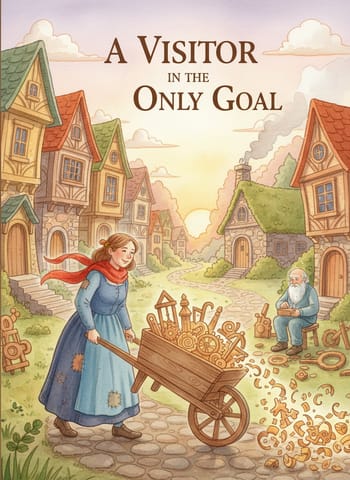
A Visitor in the Only Goal
Cerita bahasa Inggris gratis level A2 untuk pelajar, bisa dibaca online dalam 7 bahasa, dengan pilihan untuk mendengarkannya di aplikasi Storyteller gratis.
Gudrun pushes a mystery wheelbarrow from house to house until she finds the quiet man who made the wood inside it.
Itu cuplikannya! Dengarkan cerita lengkapnya di aplikasi Storyteller gratis. Unduh aplikasi
Audio belum tersedia saat ini.
The village pitch has one goal. The other goal is gone. Nobody remembers when it went. The pitch is a long strip of grass behind the school. It leans a little to the left. Every game here is played at the same end.
Lapangan desa itu hanya punya satu gawang. Gawang yang lain sudah hilang. Tak seorang pun ingat kapan hilangnya. Lapangan itu berupa hamparan rumput panjang di belakang sekolah. Sedikit miring ke kiri. Setiap pertandingan di sini dimainkan di ujung yang sama.
Gudrun keeps the pitch. Nobody pays her, and nobody asked her to. She cuts the grass on Saturdays. She marks the lines with white powder. On Sunday mornings she walks the grass alone and picks up stones.
Gudrun merawat lapangan itu. Tak ada yang membayarnya, dan tak ada yang memintanya. Ia memotong rumput pada hari Sabtu. Ia menandai garis-garisnya dengan bubuk putih. Pada Minggu pagi ia berjalan sendirian di atas rumput dan memungut batu-batu.
On Thursday, she comes early to fix a hole in the grass. It is just after six. The air is cool and the grass is wet. She stops at the edge of the pitch.
Pada hari Kamis, ia datang pagi-pagi untuk memperbaiki lubang di rumput. Baru lewat pukul enam. Udara sejuk dan rumput basah. Ia berhenti di tepi lapangan.
A wheelbarrow stands inside the goal.
Sebuah gerobak dorong berdiri di dalam gawang.
It is green, with a bent handle. The wheel looks new. A rope holds a sheet over the load. Nobody is near it. There are no footprints in the wet grass, except her own. A thin line of wheel marks runs back to the lane.
Gerobak itu hijau, dengan gagang yang bengkok. Rodanya tampak baru. Seutas tali menahan selembar kain di atas muatannya. Tak ada siapa pun di dekatnya. Tak ada jejak kaki di rumput yang basah, kecuali jejaknya sendiri. Sebaris tipis bekas roda menjalar kembali ke gang.
Gudrun walks around the wheelbarrow twice. Then she lifts the sheet. Under it lie three long pieces of pale wood. They are smooth and straight. Someone worked on them for hours.
Gudrun mengitari gerobak itu dua kali. Lalu ia mengangkat kainnya. Di bawahnya terbaring tiga potong kayu panjang yang pucat. Halus dan lurus. Seseorang mengerjakannya berjam-jam.
"Somebody forgot you," she says to the wheelbarrow.
"Seseorang melupakanmu," katanya kepada gerobak itu.
She cannot leave it there. The children come at four to play. They will climb on it, or push it down the hill. The wood looks too good for that. So Gudrun takes the handles. The load is heavier than it looks. She leans forward and pushes it up the lane.
Ia tidak bisa membiarkannya di sana. Anak-anak datang pukul empat untuk bermain. Mereka akan memanjatnya, atau mendorongnya menuruni bukit. Kayu itu terlalu bagus untuk itu. Maka Gudrun memegang gagangnya. Muatannya lebih berat daripada tampaknya. Ia mencondongkan badan ke depan dan mendorongnya menaiki gang.
The first house on the lane belongs to a farmer. He stands at his gate with a bucket of seed. A few hens walk around his boots.
Rumah pertama di gang itu milik seorang petani. Ia berdiri di gerbangnya dengan seember biji-bijian. Beberapa ekor ayam berjalan di sekitar sepatu botnya.
"Is this yours?" Gudrun asks.
"Ini punya Bapak?" tanya Gudrun.
The farmer puts down the bucket. He looks at the wheelbarrow for a long time. He taps the wheel with one finger.
Petani itu meletakkan embernya. Ia menatap gerobak itu lama sekali. Ia mengetuk roda itu dengan satu jari.
"No," he says. "Mine has a flat wheel and a hole in the floor. This one is too nice for a farm."
"Bukan," katanya. "Punyaku rodanya kempis dan lantainya berlubang. Yang ini terlalu bagus untuk dipakai di kebun."
He lifts the sheet and whistles at the wood. "That is not a farm job. That is a careful job. Ask the mason."
Ia mengangkat kain itu dan bersiul melihat kayunya. "Ini bukan pekerjaan kebun. Ini pekerjaan yang teliti. Tanya tukang batu."
"Where is he?"
"Di mana dia?"
"Down by the church. I will walk with you. I want to see his face."
"Di dekat gereja. Aku temani. Aku ingin melihat wajahnya."
So the farmer leaves his bucket. He takes one handle, and Gudrun takes the other. They go down the lane together. The wheel makes a soft sound on the stones. A dog follows them for a while and then gives up.
Maka petani itu meninggalkan embernya. Ia memegang satu gagang, dan Gudrun memegang yang lain. Mereka menyusuri gang bersama-sama. Roda itu mengeluarkan bunyi pelan di atas bebatuan. Seekor anjing mengikuti mereka sebentar lalu menyerah.
The mason works in a yard behind the church. He cuts a stone step when they arrive. Dust covers his arms. He stops and takes off his gloves.
Tukang batu itu bekerja di halaman belakang gereja. Ia sedang memahat sebuah anak tangga batu ketika mereka tiba. Debu menutupi lengannya. Ia berhenti dan melepas sarung tangannya.
"A new wheelbarrow," he says. "Very nice."
"Gerobak dorong baru," katanya. "Bagus sekali."
He walks around it as Gudrun did. "But it is not mine. I only use iron ones. Wood and green paint are not my kind of work."
Ia mengelilinginya seperti yang tadi dilakukan Gudrun. "Tapi ini bukan milikku. Aku hanya memakai yang dari besi. Kayu dan cat hijau bukan jenis pekerjaanku."
He touches one of the long pieces. "Somebody cut this at home, with a hand saw. Look at the ends. They are square, but not too square."
Ia menyentuh salah satu potongan kayu yang panjang itu. "Seseorang memotongnya di rumah, dengan gergaji tangan. Lihat ujung-ujungnya. Siku-siku, tapi tidak terlalu siku-siku."
"What does that mean?" Gudrun says.
"Apa artinya itu?" tanya Gudrun.
"It means somebody was patient," the mason says. "And somebody who is patient with wood is usually patient with children. Try the school. They have a man who fixes everything."
"Artinya orangnya sabar," kata tukang batu. "Dan orang yang sabar dengan kayu biasanya sabar dengan anak-anak. Coba tanya di sekolah. Mereka punya seorang pria yang memperbaiki segalanya."
Gudrun knows who he means. She stops walking.
Gudrun tahu siapa yang ia maksud. Ia berhenti berjalan.
"Come," says the farmer. "It is not far."
"Ayo," kata petani itu. "Tidak jauh."
The three of them go back toward the school. The sun is higher now. The school windows shine. A bell rings for the early class. At the side door, a man fixes the door. He wears a blue coat. His name is Alois. He keeps the school and its garden. He is also Gudrun's neighbor. Every day he says hello to her, very loudly, and nothing more.
Mereka bertiga kembali menuju sekolah. Matahari kini lebih tinggi. Jendela-jendela sekolah berkilau. Sebuah bel berbunyi untuk kelas pagi. Di pintu samping, seorang pria sedang memperbaiki pintu. Ia mengenakan mantel biru. Namanya Alois. Ia merawat sekolah dan kebunnya. Ia juga tetangga Gudrun. Setiap hari ia menyapanya dengan sangat keras, dan tidak lebih dari itu.
Alois sees the wheelbarrow and goes very still. A small tool hangs from his hand.
Alois melihat gerobak dorong itu dan mematung. Sebuah perkakas kecil menggantung di tangannya.
"Is it yours?" asks the farmer.
"Itu punya Anda?" tanya si petani.
"It is mine," Alois says slowly.
"Punyaku," kata Alois pelan.
"Then why is it standing in the only goal?" Gudrun asks.
"Lalu kenapa ia berdiri di satu-satunya gawang itu?" tanya Gudrun.
Alois looks at his boots. He tries to speak twice and stops. At last he laughs, a little shy.
Alois menunduk menatap sepatunya. Ia dua kali mencoba bicara dan berhenti. Akhirnya ia tertawa, agak malu-malu.
"Nobody comes to that goal at night," he says. "I thought it was the safest place in the village."
"Tak ada yang datang ke gawang itu pada malam hari," katanya. "Kupikir itu tempat paling aman di desa."
The farmer laughs so hard that he must sit on the step. Even the mason smiles.
Petani itu tertawa begitu keras sampai harus duduk di tangga. Bahkan tukang batu pun tersenyum.
"You made these?" Gudrun asks. She lifts the sheet once more.
"Kamu yang membuat ini?" tanya Gudrun. Ia mengangkat kain itu sekali lagi.
"I did. From the old tree behind the school. It fell in the spring." Alois rubs the back of his neck. "I cut it, and dried it, and made it smooth for months. Every evening, after work. I wanted to bring it on Saturday, before you came. I wanted to finish it first."
"Ya. Dari pohon tua di belakang sekolah. Pohon itu tumbang musim semi lalu." Alois menggosok tengkuknya. "Aku memotongnya, mengeringkannya, dan menghaluskannya selama berbulan-bulan. Setiap sore, sehabis kerja. Aku ingin membawanya hari Sabtu, sebelum kamu datang. Aku ingin menyelesaikannya dulu."
"Done?"
"Selesaikan apa?"
"A second goal," he says. "Everybody always shoots at the same end. The game only goes one way. I thought it needed two."
"Gawang kedua," katanya. "Semua orang selalu menembak ke ujung yang sama. Permainannya hanya berjalan satu arah. Kupikir permainan ini butuh dua."
Gudrun says nothing. She looks at the wood. Then she looks at the hands that shaped it. They are rough and cracked. They are the hands of a person who works and says little.
Gudrun tidak berkata apa-apa. Ia menatap kayu itu. Lalu ia menatap tangan yang membentuknya. Tangan itu kasar dan retak-retak. Tangan seseorang yang bekerja dan sedikit bicara.
"I tried to tell you," Alois says. "Many times. Every time, I only said hello."
"Aku sudah mencoba mengatakannya padamu," kata Alois. "Berkali-kali. Setiap kali, aku hanya bilang halo."
"You said hello very loudly," Gudrun says.
"Kamu bilang halo dengan sangat keras," kata Gudrun.
"Yes. I am sorry about that."
"Ya. Aku minta maaf soal itu."
The farmer clears his throat. "We have somewhere else to be," he says. Then he walks back toward his hens. The mason follows him, looking at the sky.
Petani itu berdeham. "Kami masih ada urusan lain," katanya. Lalu ia berjalan kembali ke ayam-ayamnya. Tukang batu mengikutinya, sambil memandangi langit.
Alois and Gudrun stand by the side door. A child's voice comes from the classroom. Somebody counts out loud.
Alois dan Gudrun berdiri di dekat pintu samping. Suara seorang anak terdengar dari ruang kelas. Seseorang berhitung dengan lantang.
"We need a rope and a spade," Gudrun says at last.
"Kita butuh tali dan sekop," kata Gudrun akhirnya.
"I have both."
"Aku punya keduanya."
"And a measuring line."
"Dan tali pengukur."
"I have that too."
"Itu juga ada."
"Then bring them," she says. "I know where the other end of the pitch is."
"Kalau begitu bawa," katanya. "Aku tahu di mana ujung lapangan yang satunya."
They push the wheelbarrow together, one on each handle. It is easier now that there are two of them. They go back down the lane. They pass the church and reach the grass.
Mereka mendorong gerobak itu bersama-sama, masing-masing memegang satu gagang. Jadi lebih mudah sekarang setelah ada dua orang. Mereka kembali menyusuri gang. Mereka melewati gereja dan sampai di rumput.
All morning they work at the far end. Gudrun marks the ground with white powder. Alois digs two deep holes. They set the pale posts in the holes. They tie the crossbar with careful knots. By noon the second goal stands against the sky. It is straight, though the pitch leans to the left.
Sepanjang pagi mereka bekerja di ujung yang jauh itu. Gudrun menandai tanah dengan bubuk putih. Alois menggali dua lubang yang dalam. Mereka menancapkan tiang-tiang pucat itu ke dalam lubang. Mereka mengikat palang atasnya dengan simpul yang rapi. Menjelang tengah hari, gawang kedua berdiri menantang langit. Gawang itu lurus, meski lapangannya miring ke kiri.
In the evening, the two of them sit on the grass. The sun is low, and the whole pitch turns gold. The old goal stands at one end. The new one stands at the other. On the halfway line, the green wheelbarrow rests with its wheel still.
Pada sore hari, mereka berdua duduk di rumput. Matahari rendah, dan seluruh lapangan berubah keemasan. Gawang yang lama berdiri di satu ujung. Yang baru berdiri di ujung lainnya. Di garis tengah, gerobak dorong hijau itu beristirahat dengan rodanya yang diam.