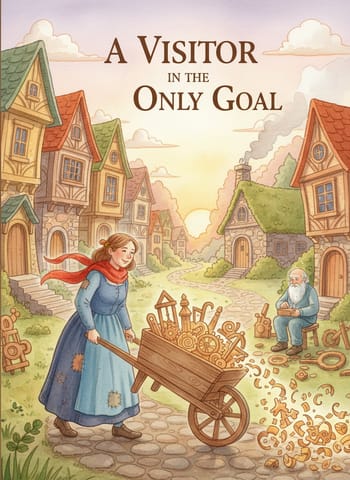
A Visitor in the Only Goal
A free A2-level English story for language learners, readable online in 7 languages, with an option to listen via the free Storyteller app.
Gudrun pushes a mystery wheelbarrow from house to house until she finds the quiet man who made the wood inside it.
That was the preview! Hear the full story in the free Storyteller app. Get the app
Audio isn't available right now.
The village pitch has one goal. The other goal is gone. Nobody remembers when it went. The pitch is a long strip of grass behind the school. It leans a little to the left. Every game here is played at the same end.
Gudrun keeps the pitch. Nobody pays her, and nobody asked her to. She cuts the grass on Saturdays. She marks the lines with white powder. On Sunday mornings she walks the grass alone and picks up stones.
On Thursday, she comes early to fix a hole in the grass. It is just after six. The air is cool and the grass is wet. She stops at the edge of the pitch.
A wheelbarrow stands inside the goal.
It is green, with a bent handle. The wheel looks new. A rope holds a sheet over the load. Nobody is near it. There are no footprints in the wet grass, except her own. A thin line of wheel marks runs back to the lane.
Gudrun walks around the wheelbarrow twice. Then she lifts the sheet. Under it lie three long pieces of pale wood. They are smooth and straight. Someone worked on them for hours.
"Somebody forgot you," she says to the wheelbarrow.
She cannot leave it there. The children come at four to play. They will climb on it, or push it down the hill. The wood looks too good for that. So Gudrun takes the handles. The load is heavier than it looks. She leans forward and pushes it up the lane.
The first house on the lane belongs to a farmer. He stands at his gate with a bucket of seed. A few hens walk around his boots.
"Is this yours?" Gudrun asks.
The farmer puts down the bucket. He looks at the wheelbarrow for a long time. He taps the wheel with one finger.
"No," he says. "Mine has a flat wheel and a hole in the floor. This one is too nice for a farm."
He lifts the sheet and whistles at the wood. "That is not a farm job. That is a careful job. Ask the mason."
"Where is he?"
"Down by the church. I will walk with you. I want to see his face."
So the farmer leaves his bucket. He takes one handle, and Gudrun takes the other. They go down the lane together. The wheel makes a soft sound on the stones. A dog follows them for a while and then gives up.
The mason works in a yard behind the church. He cuts a stone step when they arrive. Dust covers his arms. He stops and takes off his gloves.
"A new wheelbarrow," he says. "Very nice."
He walks around it as Gudrun did. "But it is not mine. I only use iron ones. Wood and green paint are not my kind of work."
He touches one of the long pieces. "Somebody cut this at home, with a hand saw. Look at the ends. They are square, but not too square."
"What does that mean?" Gudrun says.
"It means somebody was patient," the mason says. "And somebody who is patient with wood is usually patient with children. Try the school. They have a man who fixes everything."
Gudrun knows who he means. She stops walking.
"Come," says the farmer. "It is not far."
The three of them go back toward the school. The sun is higher now. The school windows shine. A bell rings for the early class. At the side door, a man fixes the door. He wears a blue coat. His name is Alois. He keeps the school and its garden. He is also Gudrun's neighbor. Every day he says hello to her, very loudly, and nothing more.
Alois sees the wheelbarrow and goes very still. A small tool hangs from his hand.
"Is it yours?" asks the farmer.
"It is mine," Alois says slowly.
"Then why is it standing in the only goal?" Gudrun asks.
Alois looks at his boots. He tries to speak twice and stops. At last he laughs, a little shy.
"Nobody comes to that goal at night," he says. "I thought it was the safest place in the village."
The farmer laughs so hard that he must sit on the step. Even the mason smiles.
"You made these?" Gudrun asks. She lifts the sheet once more.
"I did. From the old tree behind the school. It fell in the spring." Alois rubs the back of his neck. "I cut it, and dried it, and made it smooth for months. Every evening, after work. I wanted to bring it on Saturday, before you came. I wanted to finish it first."
"Done?"
"A second goal," he says. "Everybody always shoots at the same end. The game only goes one way. I thought it needed two."
Gudrun says nothing. She looks at the wood. Then she looks at the hands that shaped it. They are rough and cracked. They are the hands of a person who works and says little.
"I tried to tell you," Alois says. "Many times. Every time, I only said hello."
"You said hello very loudly," Gudrun says.
"Yes. I am sorry about that."
The farmer clears his throat. "We have somewhere else to be," he says. Then he walks back toward his hens. The mason follows him, looking at the sky.
Alois and Gudrun stand by the side door. A child's voice comes from the classroom. Somebody counts out loud.
"We need a rope and a spade," Gudrun says at last.
"I have both."
"And a measuring line."
"I have that too."
"Then bring them," she says. "I know where the other end of the pitch is."
They push the wheelbarrow together, one on each handle. It is easier now that there are two of them. They go back down the lane. They pass the church and reach the grass.
All morning they work at the far end. Gudrun marks the ground with white powder. Alois digs two deep holes. They set the pale posts in the holes. They tie the crossbar with careful knots. By noon the second goal stands against the sky. It is straight, though the pitch leans to the left.
In the evening, the two of them sit on the grass. The sun is low, and the whole pitch turns gold. The old goal stands at one end. The new one stands at the other. On the halfway line, the green wheelbarrow rests with its wheel still.