A Visitor in the Only Goal
Uma história gratuita em inglês de nível A2 para estudantes, para ler online em 7 idiomas, com opção de ouvir no app gratuito Storyteller.
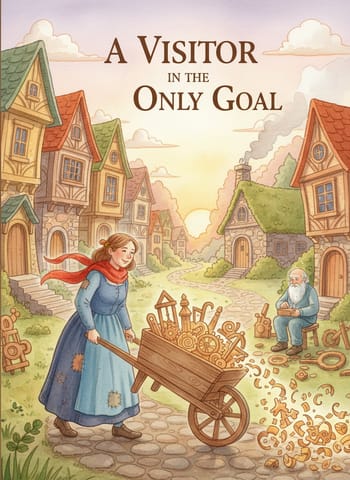
Gudrun pushes a mystery wheelbarrow from house to house until she finds the quiet man who made the wood inside it.
Essa foi a prévia! Ouça a história completa no app gratuito Storyteller. Baixar o app
O áudio não está disponível no momento.
The village pitch has one goal. The other goal is gone. Nobody remembers when it went. The pitch is a long strip of grass behind the school. It leans a little to the left. Every game here is played at the same end.
O campo da vila tem uma única trave. A outra trave sumiu. Ninguém se lembra de quando. O campo é uma faixa comprida de grama atrás da escola. Ele pende um pouco para a esquerda. Todo jogo aqui é jogado no mesmo lado.
Gudrun keeps the pitch. Nobody pays her, and nobody asked her to. She cuts the grass on Saturdays. She marks the lines with white powder. On Sunday mornings she walks the grass alone and picks up stones.
Gudrun cuida do campo. Ninguém lhe paga, e ninguém lhe pediu. Ela corta a grama aos sábados. Marca as linhas com pó branco. Nas manhãs de domingo, anda sozinha pela grama e recolhe pedras.
On Thursday, she comes early to fix a hole in the grass. It is just after six. The air is cool and the grass is wet. She stops at the edge of the pitch.
Na quinta-feira, ela chega cedo para consertar um buraco na grama. É logo depois das seis. O ar está fresco e a grama está molhada. Ela para na beira do campo.
A wheelbarrow stands inside the goal.
Um carrinho de mão está dentro do gol.
It is green, with a bent handle. The wheel looks new. A rope holds a sheet over the load. Nobody is near it. There are no footprints in the wet grass, except her own. A thin line of wheel marks runs back to the lane.
Ele é verde, com o cabo torto. A roda parece nova. Uma corda prende um lençol sobre a carga. Não há ninguém por perto. Não há pegadas na grama molhada, a não ser as dela. Uma linha fina de marcas de roda volta até a viela.
Gudrun walks around the wheelbarrow twice. Then she lifts the sheet. Under it lie three long pieces of pale wood. They are smooth and straight. Someone worked on them for hours.
Gudrun dá duas voltas em torno do carrinho. Então levanta o lençol. Embaixo estão três peças longas de madeira clara. São lisas e retas. Alguém trabalhou nelas por horas.
"Somebody forgot you," she says to the wheelbarrow.
"Alguém esqueceu você", diz ela ao carrinho.
She cannot leave it there. The children come at four to play. They will climb on it, or push it down the hill. The wood looks too good for that. So Gudrun takes the handles. The load is heavier than it looks. She leans forward and pushes it up the lane.
Ela não pode deixá-lo ali. As crianças vêm às quatro para jogar. Vão subir nele, ou empurrá-lo colina abaixo. A madeira é boa demais para isso. Então Gudrun pega os cabos. A carga é mais pesada do que parece. Ela se inclina para a frente e empurra o carrinho viela acima.
The first house on the lane belongs to a farmer. He stands at his gate with a bucket of seed. A few hens walk around his boots.
A primeira casa da viela pertence a um fazendeiro. Ele está parado no portão, com um balde de sementes. Algumas galinhas andam em volta das botas dele.
"Is this yours?" Gudrun asks.
"Isto é seu?", pergunta Gudrun.
The farmer puts down the bucket. He looks at the wheelbarrow for a long time. He taps the wheel with one finger.
O fazendeiro põe o balde no chão. Olha para o carrinho por muito tempo. Bate na roda com um dedo.
"No," he says. "Mine has a flat wheel and a hole in the floor. This one is too nice for a farm."
"Não", diz ele. "O meu tem a roda furada e um buraco no fundo. Este é bonito demais para uma fazenda."
He lifts the sheet and whistles at the wood. "That is not a farm job. That is a careful job. Ask the mason."
Ele levanta o lençol e assobia para a madeira. "Isso não é serviço de fazenda. É serviço caprichado. Pergunte ao pedreiro."
"Where is he?"
"Onde ele está?"
"Down by the church. I will walk with you. I want to see his face."
"Lá perto da igreja. Eu vou com você. Quero ver a cara dele."
So the farmer leaves his bucket. He takes one handle, and Gudrun takes the other. They go down the lane together. The wheel makes a soft sound on the stones. A dog follows them for a while and then gives up.
Então o fazendeiro deixa o balde. Ele pega um cabo, e Gudrun pega o outro. Descem a viela juntos. A roda faz um som suave nas pedras. Um cachorro os segue por um tempo e depois desiste.
The mason works in a yard behind the church. He cuts a stone step when they arrive. Dust covers his arms. He stops and takes off his gloves.
O pedreiro trabalha num pátio atrás da igreja. Está cortando um degrau de pedra quando eles chegam. O pó cobre seus braços. Ele para e tira as luvas.
"A new wheelbarrow," he says. "Very nice."
"Um carrinho novo", diz ele. "Muito bonito."
He walks around it as Gudrun did. "But it is not mine. I only use iron ones. Wood and green paint are not my kind of work."
Ele anda em volta dele como Gudrun fez. "Mas não é meu. Eu só uso os de ferro. Madeira e tinta verde não são o meu tipo de trabalho."
He touches one of the long pieces. "Somebody cut this at home, with a hand saw. Look at the ends. They are square, but not too square."
Ele toca uma das peças compridas. "Alguém cortou isto em casa, com um serrote. Olhe as pontas. São esquadradas, mas não esquadradas demais."
"What does that mean?" Gudrun says.
"O que isso quer dizer?", pergunta Gudrun.
"It means somebody was patient," the mason says. "And somebody who is patient with wood is usually patient with children. Try the school. They have a man who fixes everything."
"Quer dizer que alguém teve paciência", diz o pedreiro. "E quem tem paciência com madeira geralmente tem paciência com crianças. Tente a escola. Eles têm um homem que conserta tudo."
Gudrun knows who he means. She stops walking.
Gudrun sabe de quem ele fala. Ela para de andar.
"Come," says the farmer. "It is not far."
"Venha", diz o fazendeiro. "Não é longe."
The three of them go back toward the school. The sun is higher now. The school windows shine. A bell rings for the early class. At the side door, a man fixes the door. He wears a blue coat. His name is Alois. He keeps the school and its garden. He is also Gudrun's neighbor. Every day he says hello to her, very loudly, and nothing more.
Os três voltam em direção à escola. O sol já está mais alto. As janelas da escola brilham. Um sino toca para a aula da manhã. Na porta lateral, um homem conserta a porta. Ele veste um casaco azul. O nome dele é Alois. Ele cuida da escola e do jardim. É também vizinho de Gudrun. Todo dia ele a cumprimenta, bem alto, e nada mais.
Alois sees the wheelbarrow and goes very still. A small tool hangs from his hand.
Alois vê o carrinho e fica completamente imóvel. Uma ferramenta pequena pende da mão dele.
"Is it yours?" asks the farmer.
"É seu?", pergunta o fazendeiro.
"It is mine," Alois says slowly.
"É meu", diz Alois devagar.
"Then why is it standing in the only goal?" Gudrun asks.
"Então por que ele estava parado na única trave?", pergunta Gudrun.
Alois looks at his boots. He tries to speak twice and stops. At last he laughs, a little shy.
Alois olha para as botas. Tenta falar duas vezes e para. Por fim, ri, um pouco tímido.
"Nobody comes to that goal at night," he says. "I thought it was the safest place in the village."
"Ninguém vai àquela trave à noite", diz ele. "Achei que era o lugar mais seguro da vila."
The farmer laughs so hard that he must sit on the step. Even the mason smiles.
O fazendeiro ri tanto que precisa se sentar no degrau. Até o pedreiro sorri.
"You made these?" Gudrun asks. She lifts the sheet once more.
"Foi você quem fez isto?", pergunta Gudrun. Ela levanta o lençol mais uma vez.
"I did. From the old tree behind the school. It fell in the spring." Alois rubs the back of his neck. "I cut it, and dried it, and made it smooth for months. Every evening, after work. I wanted to bring it on Saturday, before you came. I wanted to finish it first."
"Fui. Da árvore velha atrás da escola. Ela caiu na primavera." Alois esfrega a nuca. "Eu a cortei, a deixei secar e a lixei durante meses. Toda tarde, depois do trabalho. Queria trazê-la no sábado, antes de você chegar. Queria terminá-la primeiro."
"Done?"
"Terminar o quê?"
"A second goal," he says. "Everybody always shoots at the same end. The game only goes one way. I thought it needed two."
"Uma segunda trave", diz ele. "Todo mundo sempre chuta para o mesmo lado. O jogo só vai para um lado. Achei que precisava de dois."
Gudrun says nothing. She looks at the wood. Then she looks at the hands that shaped it. They are rough and cracked. They are the hands of a person who works and says little.
Gudrun não diz nada. Ela olha para a madeira. Depois olha para as mãos que lhe deram forma. São ásperas e rachadas. São as mãos de alguém que trabalha e fala pouco.
"I tried to tell you," Alois says. "Many times. Every time, I only said hello."
"Eu tentei te contar", diz Alois. "Muitas vezes. Toda vez, só disse bom dia."
"You said hello very loudly," Gudrun says.
"Você disse bom dia muito alto", diz Gudrun.
"Yes. I am sorry about that."
"Sim. Peço desculpas por isso."
The farmer clears his throat. "We have somewhere else to be," he says. Then he walks back toward his hens. The mason follows him, looking at the sky.
O fazendeiro pigarreia. "Temos outro lugar para ir", diz ele. Então volta em direção às suas galinhas. O pedreiro o segue, olhando para o céu.
Alois and Gudrun stand by the side door. A child's voice comes from the classroom. Somebody counts out loud.
Alois e Gudrun ficam junto à porta lateral. Uma voz de criança vem da sala de aula. Alguém conta em voz alta.
"We need a rope and a spade," Gudrun says at last.
"Precisamos de uma corda e de uma pá", diz Gudrun por fim.
"I have both."
"Tenho as duas."
"And a measuring line."
"E de uma linha de medir."
"I have that too."
"Também tenho."
"Then bring them," she says. "I know where the other end of the pitch is."
"Então traga", diz ela. "Eu sei onde fica o outro lado do campo."
They push the wheelbarrow together, one on each handle. It is easier now that there are two of them. They go back down the lane. They pass the church and reach the grass.
Eles empurram o carrinho juntos, cada um num cabo. Fica mais fácil agora que são dois. Descem a viela de volta. Passam pela igreja e chegam à grama.
All morning they work at the far end. Gudrun marks the ground with white powder. Alois digs two deep holes. They set the pale posts in the holes. They tie the crossbar with careful knots. By noon the second goal stands against the sky. It is straight, though the pitch leans to the left.
A manhã inteira eles trabalham na outra ponta. Gudrun marca o chão com pó branco. Alois cava dois buracos fundos. Eles fixam os postes claros nos buracos. Amarram o travessão com nós cuidadosos. Ao meio-dia, a segunda trave está de pé contra o céu. Ela é reta, embora o campo penda para a esquerda.
In the evening, the two of them sit on the grass. The sun is low, and the whole pitch turns gold. The old goal stands at one end. The new one stands at the other. On the halfway line, the green wheelbarrow rests with its wheel still.
À tarde, os dois se sentam na grama. O sol está baixo, e o campo inteiro fica dourado. A trave velha está numa ponta. A nova está na outra. Na linha do meio, o carrinho verde descansa, com a roda parada.