Do Not Walk Here
Una historia gratuita en inglés de nivel A2 para estudiantes, para leer en línea en 7 idiomas, con opción de escucharla en la app gratuita Storyteller.
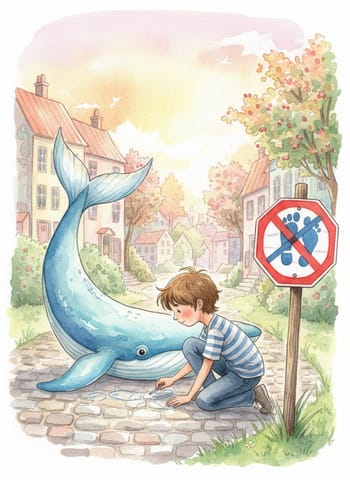
Arvid draws a giant whale in chalk, then finds a warning sign beside it.
¡Ese fue el avance! Escucha la historia completa en la app gratuita Storyteller. Descargar la app
El audio no está disponible en este momento.
Arvid sits in the bus shelter at six in the morning. The village is on a hill. The shelter has the best view. The first bus does not come until eight. That is why Arvid likes it. Nobody is here.
Arvid está sentado en la parada de autobús a las seis de la mañana. El pueblo está en una colina. La parada tiene la mejor vista. El primer autobús no llega hasta las ocho. Por eso le gusta a Arvid. Aquí no hay nadie.
He keeps a box of chalk in his bag. Every morning he takes it out. Every morning he puts it back.
Guarda una caja de tizas en su bolso. Todas las mañanas la saca. Todas las mañanas la vuelve a guardar.
Arvid is twenty-four, and he draws very well. His drawings fill four notebooks under his bed. Nobody sees them. Sometimes a friend asks. He says, "Oh, I only play with a pencil."
Arvid tiene veinticuatro años y dibuja muy bien. Sus dibujos llenan cuatro cuadernos debajo de su cama. Nadie los ve. A veces un amigo le pregunta. Él dice: «Ah, solo juego con un lápiz».
Today he looks at the pavement in front of the shelter. It is wide and smooth and clean. It looks like a giant sheet of grey paper. His hands feel strange. They want to move.
Hoy mira la acera frente a la parada. Es ancha, lisa y limpia. Parece una hoja gigante de papel gris. Sus manos se sienten raras. Quieren moverse.
"Just one line," he says to himself.
«Solo una línea», se dice a sí mismo.
He takes a white chalk and kneels down. He draws one long curve. Then he draws another. His heart beats fast, but his hand knows what to do.
Toma una tiza blanca y se arrodilla. Dibuja una larga curva. Luego dibuja otra. Le late rápido el corazón, pero su mano sabe qué hacer.
By seven o'clock, a whale lies on the pavement. It is as long as the whole shelter. It has a round, kind eye and a wide smile. Blue lines run around it like waves. A small gull sits on its back.
A las siete en punto, una ballena yace sobre la acera. Es tan larga como toda la parada. Tiene un ojo redondo y amable y una amplia sonrisa. Líneas azules la rodean como olas. Una pequeña gaviota está posada en su lomo.
Arvid stands up and looks at it. His knees hurt, and his fingers are white. He feels happy and scared at the same time.
Arvid se pone de pie y la mira. Le duelen las rodillas y tiene los dedos blancos. Se siente feliz y asustado a la vez.
A woman with a shopping bag walks past. She stops. She does not say a word. She only looks at the whale for a long moment and smiles. Then she goes on.
Pasa una mujer con una bolsa de compras. Se detiene. No dice ni una palabra. Solo mira la ballena un largo momento y sonríe. Luego sigue su camino.
Arvid does not wait for anyone else. He puts the chalk in his bag. He walks home very fast.
Arvid no espera a nadie más. Guarda la tiza en su bolso. Camina a casa muy rápido.
The next morning, he comes back early. He feels shy, like a boy on his first day of school. Maybe the whale is gone. Maybe someone washes it away in the night.
A la mañana siguiente vuelve temprano. Se siente tímido, como un niño en su primer día de escuela. Quizás la ballena ya no esté. Quizás alguien la lavó durante la noche.
The whale is still there. It has a few shoe marks on its tail. And something new is there too.
La ballena sigue ahí. Tiene unas cuantas huellas de zapatos en la cola. Y también hay algo nuevo.
Four orange cones stand around the drawing. Yellow tape runs from cone to cone. A white card hangs on the tape. Big black letters cover it.
Cuatro conos naranjas rodean el dibujo. Una cinta amarilla va de cono en cono. De la cinta cuelga una tarjeta blanca. Está cubierta de grandes letras negras.
DO NOT WALK HERE. REMOVE BY FRIDAY.
NO PISAR AQUÍ. RETIRAR ANTES DEL VIERNES.
Under the words, someone writes a short name. It says "B. Village Roads."
Debajo de las palabras, alguien ha escrito un nombre corto. Dice «B. Caminos del Pueblo».
Arvid reads the card three times. He feels cold inside. Someone in the village does not want the whale. The village office knows about it. They even give him a day.
Arvid lee la tarjeta tres veces. Siente frío por dentro. Alguien del pueblo no quiere la ballena. La oficina del pueblo lo sabe. Hasta le dan un día.
"Of course," he whispers. "You cannot draw on a public street."
«Claro», susurra. «No se puede dibujar en una calle pública».
He wants to run away, but he does not. He thinks, I made this mess, so I will clean it. That seems fair. At least he can do it before anyone sees him.
Quiere salir corriendo, pero no lo hace. Piensa: yo hice este desastre, así que lo limpiaré. Eso parece justo. Al menos puede hacerlo antes de que alguien lo vea.
He walks to the fountain by the church. He fills a bucket with water. He finds a hard brush behind the shelter. His hands shake as he comes back to the whale.
Camina hasta la fuente que está junto a la iglesia. Llena un balde de agua. Encuentra un cepillo duro detrás de la parada. Le tiemblan las manos al volver donde está la ballena.
He kneels at the tail. The brush is wet. He lifts it.
Se arrodilla junto a la cola. El cepillo está mojado. Lo levanta.
"Stop!"
«¡Alto!».
A man in an orange vest runs up the hill. A small white van stands behind him with its door open. He is about Arvid's age, with messy hair and a loud voice.
Un hombre con chaleco naranja sube corriendo la colina. Detrás de él hay una camioneta blanca pequeña con la puerta abierta. Tiene más o menos la edad de Arvid, el pelo desordenado y una voz fuerte.
"What are you doing?" the man says. He is out of breath. "Please do not touch it!"
«¿Qué haces?», dice el hombre. Está sin aliento. «¡Por favor, no lo toques!».
"I am sorry," Arvid says. "I know it is not allowed. I will clean it now. Then nobody needs to be angry."
«Lo siento», dice Arvid. «Sé que no está permitido. Lo limpiaré ahora mismo. Así nadie tendrá que enojarse».
The man stares at him. "Angry? Who is angry?"
El hombre lo mira fijamente. «¿Enojarse? ¿Quién está enojado?».
"You are. The card says to remove it by Friday."
«Usted. La tarjeta dice que lo retire antes del viernes».
The man looks at the card. Then he looks at the whale. Then he looks at Arvid, and he starts to laugh. It is a big, helpless laugh.
El hombre mira la tarjeta. Luego mira la ballena. Luego mira a Arvid, y empieza a reírse. Es una risa grande e impotente.
"No, no, no," he says. "I wrote that card. The cones belong to the road office. I must take them away by Friday, or my boss gets angry. That is the thing to remove. Not the whale!"
«No, no, no», dice. «Yo escribí esa tarjeta. Los conos son de la oficina de vialidad. Tengo que llevármelos antes del viernes, o mi jefe se enoja. Eso es lo que hay que retirar. ¡No la ballena!».
Arvid feels the bucket slip in his hand. "The cones?"
A Arvid se le resbala el balde de la mano. «¿Los conos?».
"Yes! Look." The man points at the pavement. "Yesterday, school children walked all over the tail. A boy jumped on the gull. A girl cried. So I put up the tape. I want to keep it safe."
«¡Sí! Mira». El hombre señala la acera. «Ayer unos escolares pisotearon toda la cola. Un niño saltó sobre la gaviota. Una niña lloró. Así que puse la cinta. Quiero que esté a salvo».
"You want to keep it safe?"
«¿Quiere que esté a salvo?».
"Of course. It is the best thing in this village." The man puts his hand on his chest. "My name is Bastien. I drive past this shelter every day, and it is always grey. Yesterday it was a whale. Do you know how that feels?"
«Claro. Es lo mejor de este pueblo». El hombre se pone la mano en el pecho. «Me llamo Bastien. Paso frente a esta parada todos los días, y siempre estaba gris. Ayer era una ballena. ¿Sabes lo que se siente?».
Arvid does not answer. His throat is tight.
Arvid no responde. Tiene la garganta apretada.
"Do you know who made it?" Bastien asks. "I want to thank him. Maybe I want to ask him for a favour too."
«¿Sabes quién la hizo?», pregunta Bastien. «Quiero darle las gracias. Quizás también quiera pedirle un favor».
Arvid looks at the brush in his hand. He looks at the white chalk dust on his fingers. Bastien looks at them too, and his eyes grow wide.
Arvid mira el cepillo que tiene en la mano. Mira el polvo blanco de tiza en sus dedos. Bastien también los mira, y abre mucho los ojos.
For a long moment, nobody speaks.
Durante un largo momento nadie habla.
"I did," Arvid says. The words feel big in his mouth. It is the first time he says them aloud. "I drew it."
«Yo», dice Arvid. Las palabras le pesan en la boca. Es la primera vez que las dice en voz alta. «Yo la dibujé».
"I thought so!" Bastien says. "You sit here every morning, do you not? I see you from my van."
«¡Lo sabía!», dice Bastien. «Te sientas aquí todas las mañanas, ¿no es cierto? Te veo desde mi camioneta».
"You see me?"
«¿Me ve?».
"Every day. You sit here with your bag. I always think, he looks like a man with a story."
«Todos los días. Te sientas aquí con tu bolso. Siempre pienso: se ve como un hombre con una historia».
Arvid laughs. It comes out shaky and loud. He puts the brush down in the bucket.
Arvid se ríe. Le sale temblorosa y fuerte. Deja el cepillo en el balde.
"I have a lot of stories," he says. "They are in four notebooks."
«Tengo muchas historias», dice. «Están en cuatro cuadernos».
"Then you must bring them here," says Bastien. "The pavement is big. I can find more tape."
«Entonces tienes que traerlas aquí», dice Bastien. «La acera es grande. Puedo conseguir más cinta».
Arvid looks at the whale. Its kind eye looks back at him. For the first time, the drawing looks finished. It also looks like the start of something.
Arvid mira la ballena. Su ojo amable le devuelve la mirada. Por primera vez, el dibujo parece terminado. También parece el comienzo de algo.
Bastien reaches into his vest pocket. He takes out a short blue chalk, the kind that children use. He holds it out without a word.
Bastien mete la mano en el bolsillo del chaleco. Saca una tiza azul corta, de las que usan los niños. La extiende sin decir palabra.
Arvid does not take it yet. He looks at the empty grey space beside the whale. It is as wide as a second whale. Bastien keeps his hand open, and the blue chalk waits between them.
Arvid todavía no la toma. Mira el espacio gris vacío junto a la ballena. Es tan ancho como una segunda ballena. Bastien mantiene la mano abierta, y la tiza azul espera entre los dos.