The Sea Cloth
Una historia gratuita en inglés de nivel A2 para estudiantes, para leer en línea en 7 idiomas, con opción de escucharla en la app gratuita Storyteller.
Isolde loses the strange coin her puppet show needs, and her friend Umar finds a new way to bring it to the stage.
¡Ese fue el avance! Escucha la historia completa en la app gratuita Storyteller. Descargar la app
El audio no está disponible en este momento.
The puppet workshop smelled of glue and wet paint. Wooden heads hung from hooks on every wall. Isolde loved the room. In it, nobody asked her to talk.
El taller de marionetas olía a pegamento y a pintura fresca. Cabezas de madera colgaban de ganchos en todas las paredes. A Isolde le encantaba ese cuarto. Allí, nadie le pedía que hablara.
She came every day after school. She made small hands and sewed tiny coats. Her mother ran the theatre next door. Isolde liked the workshop better. The puppets did not ask questions. They only waited.
Iba todos los días después de la escuela. Hacía manitas y cosía abriguitos diminutos. Su madre dirigía el teatro de al lado. Isolde prefería el taller. Las marionetas no hacían preguntas. Solo esperaban.
Umar came too. He was fifteen, like Isolde, and he built the stage sets. He talked all the time. He talked to the saw, to the paint and to the cat. Isolde never minded. His voice filled the silence for both of them.
Umar también iba. Tenía quince años, igual que Isolde, y construía los decorados. Hablaba todo el tiempo. Le hablaba a la sierra, a la pintura y al gato. A Isolde nunca le molestaba. Su voz llenaba el silencio de los dos.
On Friday, a school group came to the theatre at four o'clock. It was Isolde's first show as a puppet player. She had to move the old fisherman. He sat in a boat on a cloth sea. He fished for a long time. At the end, he pulled up an old coin.
El viernes, un grupo de la escuela llegó al teatro a las cuatro. Era la primera función de Isolde como titiritera. Tenía que mover al viejo pescador. Estaba sentado en un bote sobre un mar de tela. Pescaba durante mucho rato. Al final, sacaba una moneda antigua.
"The coin is the best part," said Umar. "Everybody wants it to be real."
«La moneda es lo mejor», dijo Umar. «Todos quieren que sea de verdad».
The coin was real. That was Isolde's idea. She found it in the bottom of a drawer last spring. It was heavy and dark. On one side was a bird with long wings. On the other were curly letters that nobody could read. Isolde asked every visitor about it. Nobody knew the country.
La moneda era de verdad. Esa fue idea de Isolde. La encontró en el fondo de un cajón la primavera pasada. Era pesada y oscura. De un lado tenía un pájaro de alas largas. Del otro había letras curvas que nadie podía leer. Isolde le preguntó a cada visitante por ella. Nadie conocía el país.
"It is not from here," her mother said once. "But it is a lovely thing."
«No es de aquí», dijo su madre una vez. «Pero es una cosa preciosa».
Isolde understood that very well. People often asked her where she was from. She never had a short answer.
Isolde lo entendía muy bien. La gente a menudo le preguntaba de dónde era. Nunca tenía una respuesta corta.
The plan was simple. A thin thread held the coin above the stage. At the end, Isolde pulled a string. The thread slid, and the coin dropped into the fisherman's net. It shone in the lamp light. In their last practice, it worked three times.
El plan era sencillo. Un hilo delgado sostenía la moneda sobre el escenario. Al final, Isolde tiraba de una cuerda. El hilo se deslizaba, y la moneda caía en la red del pescador. Brillaba a la luz de la lámpara. En su último ensayo, funcionó tres veces.
At half past three, Isolde checked the thread one more time. She pulled it gently. It snapped.
A las tres y media, Isolde revisó el hilo una vez más. Tiró de él con suavidad. Se rompió.
The coin hit the stage with a loud clink. It rolled across the boards. It stopped for one second at the edge of the boat. Then it fell into a crack between two boards and was gone.
La moneda golpeó el escenario con un fuerte tintineo. Rodó por las tablas. Se detuvo un segundo en el borde del bote. Luego cayó en una rendija entre dos tablas y desapareció.
"No," said Isolde. "No, no, no."
«No», dijo Isolde. «No, no, no».
They both dropped to the floor. Umar put his eye to the crack. "I can see it," he said. "It is under the stage. It is on the dirt, next to a box."
Los dos se tiraron al suelo. Umar puso el ojo en la rendija. «La veo», dijo. «Está debajo del escenario. Está sobre la tierra, junto a una caja».
"Can we lift the boards?"
«¿Podemos levantar las tablas?».
Umar pressed on the wood with both hands. "They are nailed down. But there is a little door at the side. I can crawl under and get the coin."
Umar presionó la madera con las dos manos. «Están clavadas. Pero hay una puertita al costado. Puedo gatear por debajo y sacar la moneda».
"Then we are fine!"
«¡Entonces estamos bien!».
"No. The thread is broken, and the hook is high above the stage. We cannot fix it in thirty minutes. The coin cannot fall again."
«No. El hilo está roto, y el gancho está muy alto sobre el escenario. No podemos arreglarlo en treinta minutos. La moneda no puede caer otra vez».
Isolde felt cold. Through the wall, she heard children laughing in the hall. The first bus was early.
Isolde sintió frío. A través de la pared, oyó a niños riendo en el salón. El primer autobús había llegado temprano.
Isolde sat back on her feet. She wanted to run away. She wanted to go to the workshop and hide under the table. This was her one chance, and the coin was gone.
Isolde se sentó sobre los talones. Quería salir corriendo. Quería ir al taller y esconderse debajo de la mesa. Esta era su única oportunidad, y la moneda se había perdido.
"We can use a fake coin," said Umar. "A button. A piece of paper."
«Podemos usar una moneda falsa», dijo Umar. «Un botón. Un pedazo de papel».
"It will not shine," said Isolde. "They will see."
«No brillará», dijo Isolde. «Lo van a notar».
"Then we cut the ending."
«Entonces cortamos el final».
"No." She said it so fast that she surprised herself. "The ending is the point. A thing from far away arrives, and everyone looks at it. I do not want to cut that."
«No». Lo dijo tan rápido que se sorprendió a sí misma. «El final es lo importante. Algo de muy lejos llega, y todos lo miran. No quiero cortar eso».
Umar looked at her for a moment. Then he smiled. "You talk when it matters," he said. "Good. Now I have an idea."
Umar la miró un momento. Luego sonrió. «Hablas cuando importa», dijo. «Bien. Ahora tengo una idea».
He pointed at the floor. "I go under the stage. I crawl to the coin. You use the sea cloth, the blue one. It has a slit for the waves. I push the coin up through the slit at the right moment. The fisherman does not catch it from the sky. He catches it from the sea."
Señaló el suelo. «Yo me meto debajo del escenario. Gateo hasta la moneda. Tú usas la tela del mar, la azul. Tiene un corte para las olas. Yo empujo la moneda hacia arriba por el corte en el momento justo. El pescador no la atrapa del cielo. La atrapa del mar».
Isolde thought about it. It was strange, and it was perfect. A man on a boat pulls a coin out of the water. Of course it comes from below.
Isolde lo pensó. Era extraño, y era perfecto. Un hombre en un bote saca una moneda del agua. Por supuesto que viene de abajo.
"What if the children see your hand?" she asked.
«¿Y si los niños ven tu mano?», preguntó.
"The cloth is thick. They only see a light." He grinned. "Besides, I am quick."
«La tela es gruesa. Solo verán una luz». Sonrió de oreja a oreja. «Además, soy rápido».
"How do I know when you are ready?"
«¿Cómo sabré cuándo estás listo?».
"Three taps," said Umar. "I knock three times on the floor. After the third one, you lift the net."
«Tres golpecitos», dijo Umar. «Golpeo tres veces el piso. Después del tercero, levantas la red».
He opened the little door at the side of the stage. It was dark and small inside, and it smelled of dust. Umar took a torch. He went down on his knees and crawled in. The door closed behind him, and Isolde was alone on the stage.
Abrió la puertita del costado del escenario. Adentro estaba oscuro y apretado, y olía a polvo. Umar tomó una linterna. Se puso de rodillas y entró gateando. La puerta se cerró detrás de él, y Isolde se quedó sola en el escenario.
At four o'clock, the lamps came on. The children sat on the floor in rows. Some of them were very small. A girl in the front row held a toy rabbit. Behind the curtain, Isolde held the fisherman's two sticks. Her hands were wet.
A las cuatro, se encendieron las lámparas. Los niños se sentaron en el suelo en filas. Algunos eran muy pequeños. Una niña de la primera fila sostenía un conejo de peluche. Detrás de la cortina, Isolde sostenía las dos varillas del pescador. Tenía las manos mojadas.
She moved the old man a little. He lifted his arm. He dropped his line into the blue cloth. A child laughed. The fisherman waited. He sighed. He waited some more.
Movió un poco al anciano. Él levantó el brazo. Echó su sedal en la tela azul. Un niño se rio. El pescador esperó. Suspiró. Esperó un poco más.
In the show, this part took four minutes. Isolde counted every one. The fisherman fell asleep. He woke up. He looked at the sky and shook his head. Then she heard it, under her feet. Tap. Tap. Tap.
En la función, esta parte duraba cuatro minutos. Isolde contó cada uno. El pescador se quedó dormido. Despertó. Miró el cielo y negó con la cabeza. Entonces lo oyó, bajo sus pies. Toc. Toc. Toc.
Isolde lifted the net.
Isolde levantó la red.
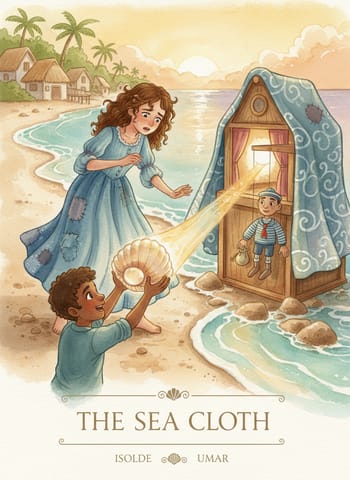
Something rose from the sea cloth. It was small and bright, and it came up very slowly. The lamp touched it, and it turned from dark to gold. The coin climbed out of the blue like a little moon. The fisherman bent his head and looked at it.
Algo se elevó desde la tela del mar. Era pequeño y brillante, y subió muy despacio. La lámpara lo tocó, y pasó de oscuro a dorado. La moneda salió del azul como una lunita. El pescador inclinó la cabeza y la miró.
Nobody in the hall made a sound. Then the girl with the rabbit spoke in a clear voice. "Where is it from?"
Nadie en el salón hizo ruido. Entonces la niña del conejo habló con voz clara. «¿De dónde es?».
Isolde did not answer from behind the curtain. The fisherman only held the coin up high. He showed it to the whole room. The children clapped and clapped.
Isolde no respondió desde detrás de la cortina. El pescador solo sostuvo la moneda en alto. La mostró a toda la sala. Los niños aplaudieron y aplaudieron.
After the show, the hall was empty. Umar came out of the little door. He had dust on his knees and his face. He held out his hand. The coin lay in his palm.
Después de la función, el salón estaba vacío. Umar salió de la puertita. Tenía polvo en las rodillas y en la cara. Extendió la mano. La moneda estaba en su palma.
"My arm is asleep," he said. "But it worked."
«Tengo el brazo dormido», dijo. «Pero funcionó».
Isolde took the coin. It was warm now. She walked to the workshop and found the small wooden box. She put the coin inside and picked up a pencil. On the lid, in her smallest writing, she wrote: Not from here. Still ours.
Isolde tomó la moneda. Ahora estaba tibia. Caminó al taller y encontró la cajita de madera. Puso la moneda adentro y tomó un lápiz. En la tapa, con su letra más pequeña, escribió: No es de aquí. Aun así es nuestra.