The Bell That Lifted
Una historia gratuita en inglés de nivel A2 para estudiantes, para leer en línea en 7 idiomas, con opción de escucharla en la app gratuita Storyteller.
A new shop helper rings the wrong bell and floats away on her bicycle.
¡Ese fue el avance! Escucha la historia completa en la app gratuita Storyteller. Descargar la app
El audio no está disponible en este momento.
The gift shop sits at the foot of the old white lighthouse. It has a blue door and a creaky floor. Dalila owns it. She sells postcards, shell boxes and tiny lighthouse magnets. Most of all, she sells bicycle bells.
La tienda de regalos está al pie del viejo faro blanco. Tiene una puerta azul y un piso que cruje. Es de Dalila. Vende postales, cajitas de conchas e imanes diminutos con forma de faro. Sobre todo, vende timbres de bicicleta.
The bells are her best idea. Hundreds of people cycle along the sea path every summer. They stop at the lighthouse to look at the water. Many of them buy a bell shaped like a little tower. It goes ting when you press it.
Los timbres son su mejor idea. Cientos de personas recorren en bicicleta el sendero del mar cada verano. Se detienen en el faro a mirar el agua. Muchas compran un timbre con forma de torrecita. Hace tin cuando lo aprietas.
Today is Zahra's first week. She is young and quick, and she asks a lot of questions. Dalila likes that. She does not like one kind of question. It starts with, "What happens if I press this?"
Hoy es la primera semana de Zahra. Es joven y rápida, y hace muchas preguntas. A Dalila eso le gusta. No le gusta un tipo de pregunta. Empieza con: «¿Qué pasa si aprieto esto?».
"Rule one," says Dalila. She points at the glass cupboard behind the counter. "Do not touch the cupboard."
«Regla número uno», dice Dalila. Señala la vitrina de vidrio detrás del mostrador. «No toques la vitrina».
"Why not?"
«¿Por qué no?».
"Because I say so. Rule two. Do not open the bottom drawer under the counter."
«Porque lo digo yo. Regla número dos. No abras el cajón de abajo del mostrador».
"Why not?"
«¿Por qué no?».
"Because I say so, again." Dalila puts on her coat. "I must go to the post office. I will be back in twenty minutes. Please count the shell boxes."
«Porque lo digo yo, otra vez». Dalila se pone el abrigo. «Tengo que ir al correo. Volveré en veinte minutos. Por favor, cuenta las cajitas de conchas».
She leaves with a parcel under her arm. The door closes with a soft bang.
Sale con un paquete bajo el brazo. La puerta se cierra con un golpe suave.
Zahra counts the shell boxes. There are twenty-four. She counts the magnets. She counts the postcards. It takes six minutes. She looks at the cupboard. She looks at the bottom drawer.
Zahra cuenta las cajitas de conchas. Hay veinticuatro. Cuenta los imanes. Cuenta las postales. Le toma seis minutos. Mira la vitrina. Mira el cajón de abajo.
"I do not open it," she says to the empty shop. "I only look at the handle."
«No lo abro», le dice a la tienda vacía. «Solo miro la manija».
She stops. That is a bad idea, and she knows it. She walks away and dusts a shelf instead.
Se detiene. Es una mala idea, y lo sabe. Se aleja y se pone a sacudir el polvo de un estante.
But the drawer has a small gap at the top. Something shines in it. Zahra tells herself not to look. Then she looks.
Pero el cajón tiene una pequeña rendija arriba. Algo brilla ahí dentro. Zahra se dice a sí misma que no mire. Entonces mira.
It is a bicycle bell. It is old and brass, and its shape is plain and round. It is much more beautiful than the little tower bells. It shines like a coin.
Es un timbre de bicicleta. Es viejo y de bronce, y su forma es sencilla y redonda. Es mucho más hermoso que los timbres de torrecita. Brilla como una moneda.
"I only look," says Zahra. "I do not touch."
«Solo miro», dice Zahra. «No toco».
She touches it. The brass is warm. She lifts the bell out of the drawer. For a moment, it hums in her hand.
Lo toca. El bronce está tibio. Saca el timbre del cajón. Por un momento, vibra en su mano.
Zahra's own bicycle stands by the door. Its old bell is flat and grey. It makes a sad noise. She looks at it. Then she looks at the shining brass bell.
La bicicleta de la propia Zahra está junto a la puerta. Su viejo timbre es plano y gris. Hace un ruido triste. Lo mira. Luego mira el brillante timbre de bronce.
"Just for a lunch ride," she says. "I will bring it back before she comes."
«Solo para un paseo a la hora del almuerzo», dice. «Lo traeré de vuelta antes de que ella llegue».
It takes one minute to change the bells. Zahra wheels the bike outside and sits on the seat. The sea path stretches along the cliff. A gull sits on the wall and watches her.
Cambiar los timbres toma un minuto. Zahra saca la bici afuera y se sienta en el asiento. El sendero del mar se extiende a lo largo del acantilado. Una gaviota está sobre el muro y la observa.
"Hello, gull," says Zahra. She presses the bell with her thumb.
«Hola, gaviota», dice Zahra. Aprieta el timbre con el pulgar.
The bell does not go ting. It goes dong, deep and slow, like a clock. The sound rolls out across the sea.
El timbre no hace tin. Hace dong, grave y lento, como un reloj. El sonido se extiende sobre el mar.
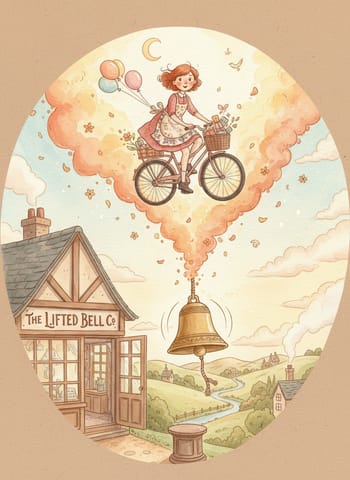
Then the wheels leave the ground.
Entonces las ruedas se despegan del suelo.
Zahra holds on tight. The bike rises one hand above the path. Then it rises two hands, then a whole arm. It does not wobble. It floats as smoothly as a boat on water. The wheels turn in the air, and her feet fly.
Zahra se agarra fuerte. La bici se eleva una mano por encima del sendero. Luego se eleva dos manos, luego un brazo entero. No se tambalea. Flota con la suavidad de un bote en el agua. Las ruedas giran en el aire, y sus pies vuelan.
"Oh!" she says. "Oh, oh, oh!"
«¡Oh!», dice. «¡Oh, oh, oh!».
The gull looks at her. It flies off with an angry cry.
La gaviota la mira. Se va volando con un graznido enojado.
Inside the shop, Dalila comes back from the post office. She sees the open drawer first. Then she sees the empty cloth inside it. Then she looks out of the window. She sees the bicycle high above the path.
Dentro de la tienda, Dalila vuelve del correo. Ve primero el cajón abierto. Luego ve la tela vacía que hay dentro. Entonces mira por la ventana. Ve la bicicleta muy por encima del sendero.
She runs outside. Zahra and her bicycle float over the wall. They are as high as a door. They drift toward the cliff edge. The bike turns slowly around in the air.
Sale corriendo. Zahra y su bicicleta flotan sobre el muro. Están tan altas como una puerta. Se van a la deriva hacia el borde del acantilado. La bici gira lentamente en el aire.
"Dalila!" calls Zahra. "I made a mistake!"
«¡Dalila!», llama Zahra. «¡Cometí un error!».
"I know!" shouts Dalila. "Do not press the bell again!"
«¡Ya lo sé!», grita Dalila. «¡No vuelvas a apretar el timbre!».
"I will not!"
«¡No lo haré!».
"Good! Never press it!"
«¡Bien! ¡Nunca lo aprietes!».
Dalila knows exactly what to do. She runs to the lighthouse door. On the wall hangs a big iron bell with a heavy rope. It is the small bell's twin. Together they make a pair.
Dalila sabe exactamente qué hacer. Corre a la puerta del faro. En la pared cuelga una gran campana de hierro con una cuerda pesada. Es la gemela del timbre pequeño. Juntos forman un par.
She takes the rope in both hands. She pulls it twice.
Toma la cuerda con las dos manos. Tira de ella dos veces.
The big bell goes dong, deep and low. The sound rolls over the sea. It meets the small bell's sound halfway. For a moment, the air hums. Then it goes quiet.
La campana grande hace dong, grave y profundo. El sonido rueda sobre el mar. Se encuentra con el sonido del timbre pequeño a medio camino. Por un momento, el aire vibra. Luego queda en silencio.
Zahra and her bicycle slide down through the air like a leaf. The wheels touch the path. The bike rolls three metres and stops against the wall. Zahra sits still with her eyes wide open.
Zahra y su bicicleta descienden por el aire como una hoja. Las ruedas tocan el sendero. La bici rueda tres metros y se detiene contra el muro. Zahra se queda quieta con los ojos muy abiertos.
Dalila runs to her. "Are you hurt?"
Dalila corre hacia ella. «¿Estás herida?».
"No." Zahra's voice is very small. "I am sorry. I did not touch the cupboard."
«No». La voz de Zahra es muy pequeña. «Lo siento. No toqué la vitrina».
"No. You touched the drawer."
«No. Tocaste el cajón».
"Yes. I am sorry."
«Sí. Lo siento».
Dalila looks at the brass bell on the handlebar. Then she looks at Zahra's pale face. Slowly, she begins to smile.
Dalila mira el timbre de bronce en el manubrio. Luego mira el rostro pálido de Zahra. Poco a poco, empieza a sonreír.
"At your age, I rang it too," she says. "My father's hat flew into the sea. He never found it."
«A tu edad, yo también lo toqué», dice. «El sombrero de mi padre salió volando al mar. Nunca lo encontró».
Zahra laughs so hard that she nearly falls off her bike. Then she gets off and unscrews the brass bell. She holds it out.
Zahra se ríe tanto que casi se cae de la bici. Luego se baja y desatornilla el timbre de bronce. Se lo ofrece.
"I will fix this," she says. "I will fix everything."
«Lo arreglaré», dice. «Arreglaré todo».
"You did enough for one day." Dalila takes the bell and wraps it in a soft cloth. She carries it back to the shop. She puts it in the bottom drawer. She turns the key twice. Then she puts the key in Zahra's hand.
«Ya hiciste suficiente por un día». Dalila toma el timbre y lo envuelve en un paño suave. Lo lleva de vuelta a la tienda. Lo pone en el cajón de abajo. Gira la llave dos veces. Luego pone la llave en la mano de Zahra.
"Your job," she says. "You know the danger now. So you keep the key."
«Tu trabajo», dice. «Ahora conoces el peligro. Así que tú guardas la llave».
Zahra hangs the key around her neck. She goes back outside. She screws her old grey bell onto the handlebar. She presses it once.
Zahra se cuelga la llave del cuello. Sale otra vez. Atornilla su viejo timbre gris en el manubrio. Lo aprieta una vez.
Ting.
Tin.
Her wheels stay on the ground.
Sus ruedas se quedan en el suelo.