The Heron Lantern and the Oar
Una historia gratuita en inglés de nivel A2 para estudiantes, para leer en línea en 7 idiomas, con opción de escucharla en la app gratuita Storyteller.
A lantern maker and her friend must decide whether their only oar becomes a pole or steers a boat on the river.
¡Ese fue el avance! Escucha la historia completa en la app gratuita Storyteller. Descargar la app
El audio no está disponible en este momento.
It is the last afternoon before the Festival of Lights. Ximena's workshop is full of paper, glue and thin bamboo. Many lanterns hang from the roof. They glow in blue and gold and green.
Es la última tarde antes del Festival de las Luces. El taller de Ximena está lleno de papel, pegamento y delgadas cañas de bambú. Muchos faroles cuelgan del techo. Brillan en azul, dorado y verde.
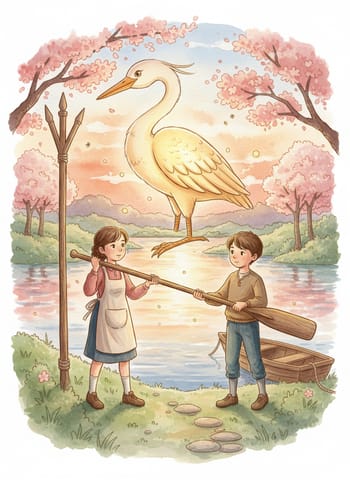
In the middle of the room stands the biggest lantern of all. It is a heron, taller than two people. Its wings are white silk. Its eyes are two small round lamps.
En medio de la sala se alza el farol más grande de todos. Es una garza, más alta que dos personas. Sus alas son de seda blanca. Sus ojos son dos pequeñas lámparas redondas.
Ximena makes one great lantern every year. Tonight, the town will see it.
Ximena hace un gran farol cada año. Esta noche, el pueblo lo verá.
Egon walks in with a long wooden shape on his shoulder. It is an oar. The blade is pale and worn. One side has a deep scratch.
Egon entra con una larga forma de madera sobre el hombro. Es un remo. La pala es pálida y está gastada. Uno de sus lados tiene un rasguño profundo.
"I found it behind the boat shed," he says. "It is the only spare oar left."
«Lo encontré detrás del cobertizo de los botes», dice. «Es el único remo de repuesto que queda».
"Why an oar?" asks Ximena.
«¿Por qué un remo?», pregunta Ximena.
"You need something. The heron has no pole, and no steering stick."
«Necesitas algo. La garza no tiene vara, ni palo para guiarla».
She looks at the heron. He is right. The lantern has a place for a pole under its feet. The old pole broke last week. The wood for a new one is not dry.
Ella mira la garza. Él tiene razón. El farol tiene un lugar para una vara debajo de las patas. La vieja vara se rompió la semana pasada. La madera para una nueva todavía no está seca.
"So the oar must be the pole," she says.
«Entonces el remo tiene que ser la vara», dice ella.
"Or the oar must be an oar," says Egon.
«O el remo tiene que ser un remo», dice Egon.
Ximena frowns. "What do you mean?"
Ximena frunce el ceño. «¿Qué quieres decir?».
"The festival has two ways to end," says Egon. "Some people march the great lantern through the streets. Some people float it down the river in a boat. We have to choose one."
«El festival tiene dos maneras de terminar», dice Egon. «Algunos pasean el gran farol por las calles. Otros lo hacen flotar río abajo en un bote. Tenemos que elegir una».
Ximena knows this already. Each way is good. Neither way is wrong. She has only one oar. She can prepare only one of them.
Ximena ya lo sabe. Las dos maneras son buenas. Ninguna está mal. Solo tiene un remo. Solo puede preparar una de las dos.
"If we march," she says, "the oar becomes the pole. Four people carry the heron on the pole. Everyone in town can see it."
«Si desfilamos», dice ella, «el remo se vuelve la vara. Cuatro personas llevan la garza en la vara. Todos en el pueblo pueden verla».
"If we float," says Egon, "the oar steers the boat. The heron shines on the water. The river carries the light away."
«Si la hacemos flotar», dice Egon, «el remo guía el bote. La garza brilla sobre el agua. El río se lleva la luz».
"Which do you like?"
«¿Cuál prefieres?».
"I like the streets," says Egon. "I want to hear the children shout when it passes."
«Yo prefiero las calles», dice Egon. «Quiero oír a los niños gritar cuando pase».
"I like the river," says Ximena. "But I do not know why."
«Yo prefiero el río», dice Ximena. «Pero no sé por qué».
They both go quiet. The lanterns move above them.
Los dos se quedan callados. Los faroles se mueven sobre ellos.
Then Ximena has an idea. She lifts the oar. She carries it to the washing trough at the back. It is a long tub of water for her brushes.
Entonces a Ximena se le ocurre una idea. Levanta el remo. Lo lleva a la artesa de lavado del fondo. Es una larga tina de agua para sus pinceles.
"What are you doing?" asks Egon.
«¿Qué haces?», pregunta Egon.
"A test," says Ximena. "A small test with a big answer."
«Una prueba», dice Ximena. «Una prueba pequeña con una respuesta grande».
She puts the blade of the oar into the water. For a moment nothing happens. Then a soft light begins at the end of the wood. It is a faint silver glow, like the moon on a pond.
Mete la pala del remo en el agua. Por un momento no pasa nada. Luego una luz suave comienza en la punta de la madera. Es un tenue resplandor plateado, como la luna sobre un estanque.
Egon steps closer. The glow runs up the oar to Ximena's hands. It does not hurt. It feels cool and quick, like a fish.
Egon se acerca. El resplandor sube por el remo hasta las manos de Ximena. No duele. Se siente fresco y veloz, como un pez.
"It knows the water," Ximena whispers.
«Conoce el agua», susurra Ximena.
"It is an oar," says Egon. "Of course it knows the water."
«Es un remo», dice Egon. «Claro que conoce el agua».
"No. Look."
«No. Mira».
Ximena lifts the oar out of the trough. The glow fades at once. She puts a bamboo pole in the tub instead. Nothing happens. The pole is only a pole.
Ximena saca el remo de la artesa. El resplandor se apaga de inmediato. En su lugar mete una vara de bambú en la tina. No pasa nada. La vara es solo una vara.
"The oar likes the river," says Egon slowly.
«Al remo le gusta el río», dice Egon despacio.
"And the heron likes it too." Ximena points to the lantern. Its wing lamps blink, one by one. They shine brighter when the oar is near the water.
«Y a la garza también». Ximena señala el farol. Las lámparas de sus alas parpadean, una por una. Brillan más cuando el remo está cerca del agua.
"But the streets," says Egon. He sounds sad. "The children will miss it."
«Pero las calles», dice Egon. Suena triste. «Los niños la van a extrañar».
"I know," says Ximena. "A new pole needs a week. We do not have a week."
«Lo sé», dice Ximena. «Una vara nueva necesita una semana. No tenemos una semana».
"Then the oar must choose," says Egon.
«Entonces el remo debe elegir», dice Egon.
"It did," she says. "The oar is special. I cannot use it as a stick."
«Ya lo hizo», dice ella. «El remo es especial. No puedo usarlo como un palo».
Egon laughs. He puts the oar down on the table and sits beside it.
Egon se ríe. Deja el remo sobre la mesa y se sienta a su lado.
"All right," he says. "The river. But I have one wish."
«Está bien», dice. «El río. Pero tengo un deseo».
"Tell me."
«Dime».
"Four friends carry the heron down one street. It is a short walk. The children can still see it."
«Cuatro amigos llevan la garza por una sola calle. Es un paseo corto. Los niños todavía podrán verla».
Ximena thinks about it. This is a good idea. It is not both choices, but it is a kind plan. The heron will pass the school, the market and the old gate. Then it will reach the water.
Ximena lo piensa. Es una buena idea. No son las dos opciones, pero es un plan amable. La garza pasará frente a la escuela, el mercado y la vieja puerta. Luego llegará al agua.
"One street," she says. "Not the whole town."
«Una calle», dice ella. «No todo el pueblo».
"One street is enough."
«Una calle es suficiente».
They shake hands over the oar. It is heavy and smooth. The light inside it glows once, like a heartbeat.
Se dan la mano sobre el remo. Es pesado y liso. La luz de su interior brilla una vez, como un latido.
They work until the sun goes down. Egon fixes the heron's wings with new thread. Ximena paints a thin line of gold along the oar's blade. She covers the scratch with silver paint. When she finishes, the oar looks like a piece of the river.
Trabajan hasta que se pone el sol. Egon arregla las alas de la garza con hilo nuevo. Ximena pinta una delgada línea dorada a lo largo de la pala del remo. Cubre el rasguño con pintura plateada. Cuando termina, el remo parece un pedazo del río.
At dusk, the first drums sound outside. The town begins to gather. Voices rise in the street, and children laugh.
Al anochecer, suenan afuera los primeros tambores. El pueblo empieza a reunirse. Las voces se elevan en la calle y los niños ríen.
Ximena holds the oar in both hands. Egon and three friends lift the heron by its base. The wings catch the light of every lantern on the wall.
Ximena sostiene el remo con ambas manos. Egon y tres amigos levantan la garza por la base. Las alas atrapan la luz de cada farol de la pared.
At the workshop door, Ximena stops. The river waits at the end of the road. It is dark and quiet and wide. She feels the oar warm in her palms.
En la puerta del taller, Ximena se detiene. El río espera al final del camino. Es oscuro, callado y ancho. Siente el remo tibio en las palmas.
"Egon," she says. "Do you want to steer, or do I?"
«Egon», dice. «¿Quieres guiar tú, o guío yo?».