The Bell on Plank Nine
Una historia gratuita en inglés de nivel A2 para estudiantes, para leer en línea en 7 idiomas, con opción de escucharla en la app gratuita Storyteller.
Gus wishes his old bridge could tell him when it is hurt, and a loud new doorbell begins to ring for every weak plank.
¡Ese fue el avance! Escucha la historia completa en la app gratuita Storyteller. Descargar la app
El audio no está disponible en este momento.
Gus fixed the old footbridge at the end of his street. It crossed a deep ravine. The wood was grey and soft. The ropes were older than Gus.
Gus arreglaba la vieja pasarela al final de su calle. Cruzaba un barranco profundo. La madera estaba gris y blanda. Las cuerdas eran más viejas que Gus.
Every morning he walked along it with a hammer. He pushed each plank with his boot. He listened for a bad sound. Some planks were safe. Some planks were not.
Cada mañana la recorría con un martillo. Empujaba cada tabla con la bota. Escuchaba por si había un mal sonido. Algunas tablas eran seguras. Otras no.
"One day a plank will break," he told his cat. "And I will not be there."
«Un día se romperá una tabla», le dijo a su gato. «Y yo no estaré ahí».
The cat looked at him and said nothing.
El gato lo miró y no dijo nada.
The bridge had forty-two planks. Gus could not check them all every hour. He had a bad knee. He also worked at the mill on the far side. The mill took most of his day.
El puente tenía cuarenta y dos tablas. Gus no podía revisarlas todas cada hora. Tenía una rodilla mala. Además trabajaba en el molino del otro lado. El molino le quitaba casi todo el día.
On Tuesday, Rumi came across with her cart. She sold soap, nails and pots to the farms on the hill. She came every week. Her donkey walked slowly, and the wheels made the whole bridge shake.
El martes, Rumi cruzó con su carreta. Vendía jabón, clavos y ollas a las granjas de la colina. Venía todas las semanas. Su burro caminaba despacio, y las ruedas hacían temblar todo el puente.
"Your bridge sings when I cross it," said Rumi.
«Tu puente canta cuando lo cruzo», dijo Rumi.
"It is not a song," said Gus. "It is a warning."
«No es una canción», dijo Gus. «Es una advertencia».
"Then it needs a better voice," said Rumi. She laughed and pulled the donkey on.
«Entonces necesita una voz mejor», dijo Rumi. Se rio y tiró del burro para seguir.
That evening Gus sat on the bridge. His feet hung over the edge. The ravine was dark and very deep. A small stone fell from his hand. He did not hear it land.
Esa tarde Gus se sentó en el puente. Tenía los pies colgando sobre el borde. El barranco estaba oscuro y era muy profundo. Una piedrita se le cayó de la mano. No la oyó llegar al fondo.
"I wish you could talk," he said to the bridge. "I wish you could tell me when you are hurt."
«Ojalá pudieras hablar», le dijo al puente. «Ojalá pudieras decirme cuándo estás herido».
Nothing answered. Of course not. It was only wood. Gus went home to bed.
Nada respondió. Claro que no. Era solo madera. Gus se fue a casa a dormir.
That week he also bought a new doorbell. It was in a box on his kitchen table. His last doorbell was a toy bird. It shouted "Visitor!" at midnight, and Gus hated it.
Esa semana también compró un timbre nuevo. Estaba en una caja sobre la mesa de su cocina. Su último timbre era un pájaro de juguete. Gritaba «¡Visita!» a medianoche, y Gus lo odiaba.
"This one has no parrot inside," the shop owner told him. "It does not talk. It only rings. It is the loudest bell I sell."
«Este no tiene ningún loro adentro», le dijo el dueño de la tienda. «No habla. Solo suena. Es la campana más fuerte que vendo».
"Good," said Gus.
«Bien», dijo Gus.
In the morning, the box on his table was empty. Gus looked under the table. He looked in the garden. Then a sound came from the bridge.
Por la mañana, la caja sobre su mesa estaba vacía. Gus miró debajo de la mesa. Miró en el jardín. Entonces llegó un sonido desde el puente.
DING-DONG!
¡DING-DONG!
It was so loud that the birds left the trees. Gus ran out of the house. His knee hurt, but he did not stop.
Fue tan fuerte que los pájaros abandonaron los árboles. Gus salió corriendo de la casa. Le dolía la rodilla, pero no se detuvo.
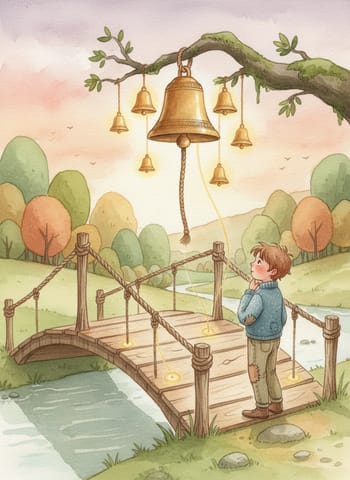
The new bell sat on the first post of the bridge. A thin silver wire went from the bell along the rope. It looked like a vine, but it was not a plant. Gus did not know that wire.
La campana nueva estaba en el primer poste del puente. Un fino alambre plateado iba de la campana a lo largo de la cuerda. Parecía una enredadera, pero no era una planta. Gus no conocía ese alambre.
Rumi stood on the bridge with her hand on her chest. Her donkey stood far behind her with stiff legs.
Rumi estaba en el puente con la mano en el pecho. Su burro estaba muy atrás, con las patas rígidas.
"I did nothing," said Rumi. "I took one step, and the whole world screamed."
«Yo no hice nada», dijo Rumi. «Di un paso, y el mundo entero gritó».
"Which step?" asked Gus.
«¿Qué paso?», preguntó Gus.
"The ninth plank."
«La novena tabla».
Gus knelt down and pushed plank nine with his thumb. The wood was soft like old cheese. He stood on plank ten. Nothing happened. He stepped back onto plank nine.
Gus se arrodilló y empujó la tabla nueve con el pulgar. La madera estaba blanda como queso viejo. Se paró en la tabla diez. No pasó nada. Volvió a pisar la tabla nueve.
DING-DONG!
¡DING-DONG!
It was louder this time. Gus began to laugh.
Esta vez sonó más fuerte. Gus empezó a reírse.
"I asked the bridge to talk," he said. "It gave me a bell."
«Le pedí al puente que hablara», dijo. «Me dio una campana».
"A bell is better," said Rumi. "A bridge with words never stops talking."
«Una campana es mejor», dijo Rumi. «Un puente con palabras nunca deja de hablar».
They walked over the bridge together, one plank at a time. Gus counted out loud. Most planks stayed quiet. Plank seventeen made a small ding, like a spoon on a cup. Plank twenty-three made a bigger one. Plank nine was still the loudest.
Cruzaron el puente juntos, una tabla a la vez. Gus contaba en voz alta. La mayoría de las tablas permanecieron en silencio. La tabla diecisiete hizo un dingcito, como una cuchara contra una taza. La tabla veintitrés hizo uno más grande. La tabla nueve seguía siendo la más ruidosa.
"The worse the plank, the louder the bell," said Rumi.
«Cuanto peor la tabla, más fuerte la campana», dijo Rumi.
"Yes," said Gus. "And I did not know about twenty-three."
«Sí», dijo Gus. «Y yo no sabía lo de la veintitrés».
He wrote the numbers on his hand with a pencil. His hand shook a little. He walked here for years, and he missed one.
Se anotó los números en la mano con un lápiz. La mano le temblaba un poco. Llevaba años caminando por ahí, y se le había escapado una.
That night the bell woke him up. DING-DONG, DING-DONG, DING-DONG! The noise was terrible. Gus jumped out of bed. He took his lamp and ran to the bridge.
Esa noche la campana lo despertó. ¡DING-DONG, DING-DONG, DING-DONG! El ruido era terrible. Gus saltó de la cama. Tomó su lámpara y corrió al puente.
A white goat stood in the middle of the bridge. It stood on plank thirty-one. It chewed a rope and looked very happy.
Una cabra blanca estaba en medio del puente. Estaba parada en la tabla treinta y uno. Masticaba una cuerda y parecía muy contenta.
Gus did not shout. He walked slowly and held out his hand. "Come here, you fool," he said. "Come to me."
Gus no gritó. Caminó despacio y extendió la mano. «Ven acá, tontita», dijo. «Ven conmigo».
The goat came. It was heavy, and the plank under it cracked. A long, dark line ran across the wood. Gus pulled the goat to safety. The plank broke behind them and fell into the ravine.
La cabra vino. Era pesada, y la tabla bajo ella crujió. Una larga línea oscura cruzó la madera. Gus llevó a la cabra a un lugar seguro. La tabla se rompió detrás de ellos y cayó al barranco.
For a long time, Gus did not move. He sat on the ground with the goat's head on his knee. The bell was quiet now.
Durante un largo rato, Gus no se movió. Se sentó en el suelo con la cabeza de la cabra sobre la rodilla. La campana estaba callada ahora.
"You rang," he told the post. "Now I know."
«Tú sonaste», le dijo al poste. «Ahora ya lo sé».
In the morning, the whole village came to look. They stood at the end of the bridge. Their hands covered their ears.
Por la mañana, todo el pueblo vino a mirar. Se quedaron al final del puente. Se cubrían los oídos con las manos.
"The bell is too loud," said a man with a basket.
«La campana suena demasiado fuerte», dijo un hombre con una canasta.
"It is not loud enough," said Gus. "It woke me. It saved a goat."
«No suena lo bastante fuerte», dijo Gus. «Me despertó. Salvó a una cabra».
"It saved my goat!" shouted a woman at the back. "I looked for him all night."
«¡Salvó a mi cabra!», gritó una mujer desde atrás. «La busqué toda la noche».
The man with the basket said nothing more.
El hombre de la canasta no dijo nada más.
Rumi came with her cart. It was full of new wood and long nails. She did not ask for money. She only said, "I cross this bridge every week. I want to keep crossing it."
Rumi llegó con su carreta. Venía llena de madera nueva y clavos largos. No pidió dinero. Solo dijo: «Cruzo este puente todas las semanas. Quiero seguir cruzándolo».
They worked all day. Gus put a new plank in the gap at thirty-one. Rumi held the wood. The village children brought water and sat on the ground to watch. Every time a new plank went in, Gus stepped on it. Every time, the bell stayed quiet. The children cheered.
Trabajaron todo el día. Gus puso una tabla nueva en el hueco de la treinta y uno. Rumi sostenía la madera. Los niños del pueblo trajeron agua y se sentaron en el suelo a mirar. Cada vez que entraba una tabla nueva, Gus la pisaba. Cada vez, la campana permanecía callada. Los niños aplaudían.
By evening only three planks were left. Plank seventeen was easy. Plank twenty-three took a long time. The wood under it was bad too.
Al caer la tarde solo quedaban tres tablas. La diecisiete fue fácil. La veintitrés tomó mucho tiempo. La madera de debajo también estaba mala.
At last Rumi stood next to plank nine. It was the worst of all.
Por fin Rumi se paró junto a la tabla nueve. Era la peor de todas.
"Do you want to step on it one more time?" she asked. "For the sound?"
«¿Quieres pisarla una vez más?», preguntó. «¿Por el sonido?».
Gus shook his head. "I know that sound now," he said. "I will not forget it."
Gus negó con la cabeza. «Ya conozco ese sonido», dijo. «No lo olvidaré».
He knelt on his sore knee. He took a long nail from his pocket. The bell hung over his head, ready and silent. Gus lifted the hammer and hit the first nail.
Se arrodilló sobre su rodilla dolorida. Sacó un clavo largo del bolsillo. La campana colgaba sobre su cabeza, lista y silenciosa. Gus levantó el martillo y golpeó el primer clavo.