The Bell on Plank Nine
A free A2-level English story for language learners, readable online in 7 languages, with an option to listen via the free Storyteller app.
Gus wishes his old bridge could tell him when it is hurt, and a loud new doorbell begins to ring for every weak plank.
That was the preview! Hear the full story in the free Storyteller app. Get the app
Audio isn't available right now.
Gus fixed the old footbridge at the end of his street. It crossed a deep ravine. The wood was grey and soft. The ropes were older than Gus.
Every morning he walked along it with a hammer. He pushed each plank with his boot. He listened for a bad sound. Some planks were safe. Some planks were not.
"One day a plank will break," he told his cat. "And I will not be there."
The cat looked at him and said nothing.
The bridge had forty-two planks. Gus could not check them all every hour. He had a bad knee. He also worked at the mill on the far side. The mill took most of his day.
On Tuesday, Rumi came across with her cart. She sold soap, nails and pots to the farms on the hill. She came every week. Her donkey walked slowly, and the wheels made the whole bridge shake.
"Your bridge sings when I cross it," said Rumi.
"It is not a song," said Gus. "It is a warning."
"Then it needs a better voice," said Rumi. She laughed and pulled the donkey on.
That evening Gus sat on the bridge. His feet hung over the edge. The ravine was dark and very deep. A small stone fell from his hand. He did not hear it land.
"I wish you could talk," he said to the bridge. "I wish you could tell me when you are hurt."
Nothing answered. Of course not. It was only wood. Gus went home to bed.
That week he also bought a new doorbell. It was in a box on his kitchen table. His last doorbell was a toy bird. It shouted "Visitor!" at midnight, and Gus hated it.
"This one has no parrot inside," the shop owner told him. "It does not talk. It only rings. It is the loudest bell I sell."
"Good," said Gus.
In the morning, the box on his table was empty. Gus looked under the table. He looked in the garden. Then a sound came from the bridge.
DING-DONG!
It was so loud that the birds left the trees. Gus ran out of the house. His knee hurt, but he did not stop.
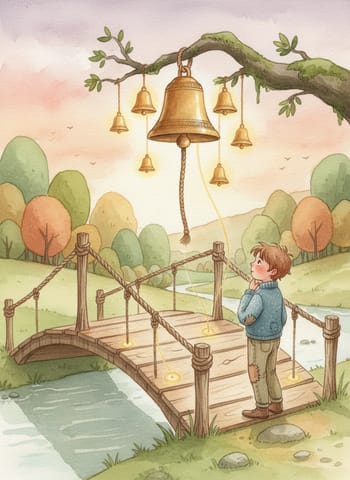
The new bell sat on the first post of the bridge. A thin silver wire went from the bell along the rope. It looked like a vine, but it was not a plant. Gus did not know that wire.
Rumi stood on the bridge with her hand on her chest. Her donkey stood far behind her with stiff legs.
"I did nothing," said Rumi. "I took one step, and the whole world screamed."
"Which step?" asked Gus.
"The ninth plank."
Gus knelt down and pushed plank nine with his thumb. The wood was soft like old cheese. He stood on plank ten. Nothing happened. He stepped back onto plank nine.
DING-DONG!
It was louder this time. Gus began to laugh.
"I asked the bridge to talk," he said. "It gave me a bell."
"A bell is better," said Rumi. "A bridge with words never stops talking."
They walked over the bridge together, one plank at a time. Gus counted out loud. Most planks stayed quiet. Plank seventeen made a small ding, like a spoon on a cup. Plank twenty-three made a bigger one. Plank nine was still the loudest.
"The worse the plank, the louder the bell," said Rumi.
"Yes," said Gus. "And I did not know about twenty-three."
He wrote the numbers on his hand with a pencil. His hand shook a little. He walked here for years, and he missed one.
That night the bell woke him up. DING-DONG, DING-DONG, DING-DONG! The noise was terrible. Gus jumped out of bed. He took his lamp and ran to the bridge.
A white goat stood in the middle of the bridge. It stood on plank thirty-one. It chewed a rope and looked very happy.
Gus did not shout. He walked slowly and held out his hand. "Come here, you fool," he said. "Come to me."
The goat came. It was heavy, and the plank under it cracked. A long, dark line ran across the wood. Gus pulled the goat to safety. The plank broke behind them and fell into the ravine.
For a long time, Gus did not move. He sat on the ground with the goat's head on his knee. The bell was quiet now.
"You rang," he told the post. "Now I know."
In the morning, the whole village came to look. They stood at the end of the bridge. Their hands covered their ears.
"The bell is too loud," said a man with a basket.
"It is not loud enough," said Gus. "It woke me. It saved a goat."
"It saved my goat!" shouted a woman at the back. "I looked for him all night."
The man with the basket said nothing more.
Rumi came with her cart. It was full of new wood and long nails. She did not ask for money. She only said, "I cross this bridge every week. I want to keep crossing it."
They worked all day. Gus put a new plank in the gap at thirty-one. Rumi held the wood. The village children brought water and sat on the ground to watch. Every time a new plank went in, Gus stepped on it. Every time, the bell stayed quiet. The children cheered.
By evening only three planks were left. Plank seventeen was easy. Plank twenty-three took a long time. The wood under it was bad too.
At last Rumi stood next to plank nine. It was the worst of all.
"Do you want to step on it one more time?" she asked. "For the sound?"
Gus shook his head. "I know that sound now," he said. "I will not forget it."
He knelt on his sore knee. He took a long nail from his pocket. The bell hung over his head, ready and silent. Gus lifted the hammer and hit the first nail.