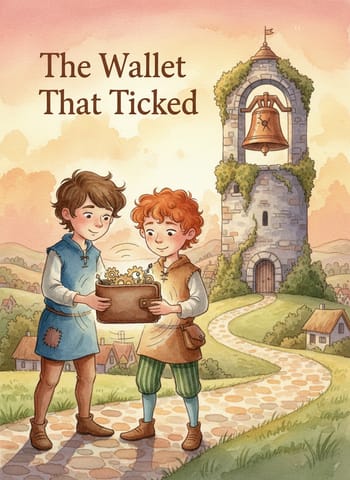
The Wallet That Ticked
Una historia gratuita en inglés de nivel A2 para estudiantes, para leer en línea en 7 idiomas, con opción de escucharla en la app gratuita Storyteller.
Ferran and Esteban try to return a strange wallet, and the answer lies in the old tower bell.
¡Ese fue el avance! Escucha la historia completa en la app gratuita Storyteller. Descargar la app
El audio no está disponible en este momento.
Ferran worked in the workshop inside the clock tower. It was a small room full of gears. Some were as big as plates. Some were as small as coins. They hung on hooks and shone with oil.
Ferran trabajaba en el taller dentro de la torre del reloj. Era un cuarto pequeño lleno de engranajes. Algunos eran tan grandes como platos. Otros eran tan pequeños como monedas. Colgaban de ganchos y brillaban de aceite.
He was seventeen. Every morning he climbed ninety steps to get there. His job was to clean the gears. He also fixed the clock when it was wrong. The town clockmaker was away for a week. Today Ferran was alone.
Tenía diecisiete años. Todas las mañanas subía noventa escalones para llegar allí. Su trabajo era limpiar los engranajes. También arreglaba el reloj cuando marcaba mal la hora. El relojero del pueblo estaba fuera por una semana. Hoy Ferran estaba solo.
At noon, the big bell rang twelve times. The floor shook a little. Ferran liked that part.
Al mediodía, la gran campana sonó doce veces. El piso tembló un poco. A Ferran le gustaba esa parte.
Soon after, he heard feet on the stairs. His friend Esteban came in, out of breath. Esteban took food to people on a bicycle. He had a brown leather wallet in his hand.
Poco después, oyó pasos en la escalera. Su amigo Esteban entró, sin aliento. Esteban llevaba comida a la gente en bicicleta. Tenía en la mano una cartera de cuero marrón.
"I found it on the bench by the tower door," Esteban said. "Someone left it there."
«La encontré en la banca junto a la puerta de la torre», dijo Esteban. «Alguien la dejó ahí».
"So take it to the police."
«Entonces llévala a la policía».
"I want to look inside first. Then we know whose it is."
«Primero quiero mirar adentro. Así sabremos de quién es».
Ferran sighed. He made space on the table. Esteban opened the wallet.
Ferran suspiró. Hizo espacio en la mesa. Esteban abrió la cartera.
There was no money. There were no cards. There was no name. Inside lay only a flat brass coin and a small white card. The card said, "If found, bring my hour home."
No había dinero. No había tarjetas. No había ningún nombre. Adentro solo había una moneda plana de latón y una tarjeta blanca pequeña. La tarjeta decía: «Si la encuentra, lleve mi hora a casa».
"Bring my hour home?" Esteban said. "What does that mean?"
«¿Lleve mi hora a casa?», dijo Esteban. «¿Qué significa eso?».
"I don't know." Ferran picked up the coin. It was warm. On its face there was a tiny clock with thin gold hands. "Look at this."
«No lo sé». Ferran tomó la moneda. Estaba tibia. En su cara había un reloj diminuto con manecillas doradas y finas. «Mira esto».
Esteban looked. "It has too many numbers."
Esteban miró. «Tiene demasiados números».
Ferran counted. He counted again. "Thirteen," he said. "There are thirteen numbers on this clock."
Ferran contó. Volvió a contar. «Trece», dijo. «Hay trece números en este reloj».
"That is not possible."
«Eso no es posible».
"And listen." Ferran held it near his ear. It ticked, but the sound was strange. It was slow, then fast, then slow again. The little hands turned the wrong way.
«Y escucha». Ferran se la acercó al oído. Hacía tic-tac, pero el sonido era extraño. Era lento, luego rápido, luego lento otra vez. Las manecillas giraban al revés.
"A broken toy," Esteban said.
«Un juguete descompuesto», dijo Esteban.
"Maybe." But Ferran did not think so. His arms felt cold.
«Quizás». Pero Ferran no lo creía. Sentía los brazos fríos.
They made a plan. First, they were going to find the owner in the normal way. Esteban wrote a sign on the back of a delivery bag. It said, "Wallet found. Ask at the clock tower." They put it on the bench by the door.
Hicieron un plan. Primero, iban a buscar al dueño de la manera normal. Esteban escribió un cartel en el reverso de una bolsa de reparto. Decía: «Cartera encontrada. Pregunten en la torre del reloj». Lo pusieron en la banca junto a la puerta.
Then Esteban jumped on his bicycle. He rode to every shop around the square. He asked the florist and the shoe shop. He asked the man at the news stand. He asked a girl who sold ice cream. He asked two police officers.
Luego Esteban saltó a su bicicleta. Recorrió todas las tiendas alrededor de la plaza. Le preguntó a la florista y a la zapatería. Le preguntó al hombre del puesto de periódicos. Le preguntó a una chica que vendía helados. Les preguntó a dos policías.
Nobody had lost a wallet. Nobody knew the coin.
Nadie había perdido una cartera. Nadie conocía la moneda.
At three o'clock, Esteban climbed the stairs again. His shirt was wet, and his face was sad.
A las tres, Esteban volvió a subir la escalera. Tenía la camisa mojada y la cara triste.
"Nothing," he said. "Not one person."
«Nada», dijo. «Ni una sola persona».
"Nobody came to the sign, either." Ferran looked out of the small window. The bench was empty.
«Tampoco vino nadie al cartel». Ferran miró por la ventana pequeña. La banca estaba vacía.
The wallet sat on the table. It was hot now. The coin ticked faster and faster. Ferran could hear it from across the room.
La cartera estaba sobre la mesa. Ahora quemaba. La moneda hacía tic-tac cada vez más rápido. Ferran podía oírla desde el otro lado del cuarto.
"It gets worse," Esteban said. "It wants something."
«Esto empeora», dijo Esteban. «Quiere algo».
"It wants to go home."
«Quiere volver a casa».
"Then why doesn't it just go?"
«Entonces, ¿por qué no se va sin más?».
Ferran did not answer. He took the card and read it again. "If found, bring my hour home." He read it slowly, word by word. Then he looked up at the great brass wheel on the wall.
Ferran no respondió. Tomó la tarjeta y la leyó otra vez. «Si la encuentra, lleve mi hora a casa». La leyó despacio, palabra por palabra. Luego levantó la vista hacia la gran rueda de latón de la pared.
"Hour," he said.
«Hora», dijo.
"Yes, hour. So?"
«Sí, hora. ¿Y qué?».
Ferran's voice shook a little. "An hour is a bell. Esteban, this tower rings twelve times at noon. It never rings thirteen. But this coin has thirteen numbers."
A Ferran le tembló un poco la voz. «Una hora es una campanada. Esteban, esta torre suena doce veces al mediodía. Nunca suena trece. Pero esta moneda tiene trece números».
Esteban looked at him. "You think the owner lives at the thirteenth hour?"
Esteban lo miró. «¿Crees que el dueño vive en la hora trece?».
"I think the hour between twelve and one is very small. Maybe somebody lives there. And maybe that person lost the wallet on a walk."
«Creo que la hora entre las doce y la una es muy pequeña. Tal vez alguien vive ahí. Y tal vez esa persona perdió la cartera durante un paseo».
It sounded crazy, but they had no better idea.
Sonaba a locura, pero no tenían una idea mejor.
The striking wheel was a thick brass circle. It had twelve notches on its edge. Each notch told the bell how many times to ring. Ferran put his finger on the last one.
La rueda de las campanadas era un grueso círculo de latón. Tenía doce muescas en el borde. Cada muesca le decía a la campana cuántas veces sonar. Ferran puso el dedo sobre la última.
"I can cut a new notch," he said. "Then at four o'clock, I turn the wheel to it. The bell rings thirteen times, not four."
«Puedo cortar una muesca nueva», dijo. «Entonces, a las cuatro, giro la rueda hasta ella. La campana sonará trece veces, no cuatro».
"Can you do it fast? It is half past three."
«¿Puedes hacerlo rápido? Son las tres y media».
"Hold the lamp."
«Sostén la lámpara».
Ferran took a small file from the wall. The work was hard. The brass was thick, and his hands shook. He filed a little. He stopped and looked. He filed again.
Ferran tomó una lima pequeña de la pared. El trabajo era duro. El latón era grueso y le temblaban las manos. Limó un poco. Se detuvo y miró. Limó otra vez.
Esteban held the lamp very still. He did not even sneeze.
Esteban sostuvo la lámpara muy quieta. Ni siquiera estornudó.
At ten to four, the notch was ready. It was not pretty, but it was deep and clean. Ferran put the wheel back and closed the little door. Then he turned a small key.
A diez para las cuatro, la muesca estaba lista. No era bonita, pero era honda y limpia. Ferran volvió a poner la rueda y cerró la puertecita. Luego giró una llave pequeña.
"Now we wait," he said.
«Ahora esperamos», dijo.
They stood side by side, and the minutes went slowly. The gears turned. The wallet lay on the table and hummed like a kettle.
Se quedaron uno al lado del otro, y los minutos pasaron despacio. Los engranajes giraban. La cartera yacía sobre la mesa y zumbaba como una tetera.
At four o'clock, the bell began.
A las cuatro en punto, la campana comenzó.
One. Two. Three. The floor shook under their feet. Four. Five. Six. Ferran held the table with both hands. Seven. Eight. Nine. Ten. Eleven. Twelve.
Una. Dos. Tres. El piso temblaba bajo sus pies. Cuatro. Cinco. Seis. Ferran se agarró de la mesa con ambas manos. Siete. Ocho. Nueve. Diez. Once. Doce.
There was a short silence.
Hubo un breve silencio.
Then the bell rang again. It was a deep sound, deeper than the others. It felt like the whole tower breathed.
Entonces la campana sonó otra vez. Fue un sonido profundo, más profundo que los demás. Parecía que la torre entera respiraba.
Thirteen.
Trece.
The air near the big clock face moved. It bent like water. A tall woman stepped out of the glass. She wore a long grey coat and carried a small lamp. Her hair was silver, and her eyes were very bright.
El aire junto a la gran carátula del reloj se movió. Se curvó como el agua. Una mujer alta salió del cristal. Llevaba un abrigo largo y gris y una lámpara pequeña. Su cabello era plateado y sus ojos eran muy brillantes.
"Oh," she said, "there you are!"
«¡Ah!», dijo. «¡Aquí estás!».
She did not look at the boys. She looked at the wallet. She took it in both hands and held it against her chest.
No miró a los chicos. Miró la cartera. La tomó con ambas manos y se la apretó contra el pecho.
"I lost this on my walk," she said. "I sat on a bench for one minute. I looked up at the birds. When I stood up, the way back was closed. Nobody made the hour sound."
«La perdí durante mi paseo», dijo. «Me senté en una banca por un minuto. Miré a los pájaros. Cuando me levanté, el camino de regreso estaba cerrado. Nadie hizo sonar la hora».
"We are sorry it took so long," Ferran said.
«Lamentamos que haya tardado tanto», dijo Ferran.
"You made a new hour for me." She smiled. "Nobody did that for a very long time."
«Ustedes hicieron una hora nueva para mí». Sonrió. «Hacía muchísimo tiempo que nadie hacía eso».
She opened the wallet and took out the brass coin. She pressed it into Esteban's hand.
Abrió la cartera y sacó la moneda de latón. La puso en la mano de Esteban.
"One extra minute," she said. "Use it well. It is a small gift from the thirteenth hour."
«Un minuto extra», dijo. «Úsenlo bien. Es un pequeño regalo de la hora trece».
Then she turned and walked back into the clock face. The air closed behind her. The room was quiet.
Luego se dio la vuelta y volvió a entrar en la carátula del reloj. El aire se cerró tras ella. El cuarto quedó en silencio.
Esteban opened his hand. The coin was gone. He looked at his watch. It said ten past four. It seemed to him that he had a little more time.
Esteban abrió la mano. La moneda había desaparecido. Miró su reloj de pulsera. Marcaba las cuatro y diez. Le pareció que tenía un poco más de tiempo.
"That was one very big bell," he said.
«Esa fue una campana muy grande», dijo.
"Yes."
«Sí».
"The whole town will hear it."
«Todo el pueblo la va a oír».
Ferran looked at the new notch and the file in his hand. "I need to tell the clockmaker. Somehow."
Ferran miró la muesca nueva y la lima que tenía en la mano. «Tengo que avisarle al relojero. De alguna manera».
Esteban took a deep breath. He walked to the stairs and stopped at the top step.
Esteban respiró hondo. Caminó hasta la escalera y se detuvo en el último escalón.
"Ferran," he said. "Next time, I take the wallet to the police."
«Ferran», dijo. «La próxima vez, llevo la cartera a la policía».