The Case on Shelf Nine
Una historia gratuita en inglés de nivel A2 para estudiantes, para leer en línea en 7 idiomas, con opción de escucharla en la app gratuita Storyteller.
A night clerk guards a strange telescope that always points at a plain little star, until one visitor wants exactly that star.
¡Ese fue el avance! Escucha la historia completa en la app gratuita Storyteller. Descargar la app
El audio no está disponible en este momento.
The bag room of the bus station is quiet at night. Olwen likes it that way. She sits behind the long counter and counts bags. The station has twelve gates, and all of them are dark.
La sala de equipaje de la estación de autobuses es tranquila de noche. A Olwen le gusta así. Se sienta tras el largo mostrador y cuenta maletas. La estación tiene doce andenes, y todos están a oscuras.
There are four hundred shelves. Each one holds a suitcase, a box or a sleeping bag. Every item has a paper ticket with a number.
Hay cuatrocientos estantes. Cada uno guarda una maleta, una caja o un saco de dormir. Cada objeto tiene un boleto de papel con un número.
Shelf nine is different. It has no ticket. A long brass case lies on it. A card hangs from the handle. The card says, "Aim at the star that waits."
El estante nueve es diferente. No tiene boleto. Sobre él yace un estuche largo de bronce. De la manija cuelga una tarjeta. La tarjeta dice: «Apunta a la estrella que espera».
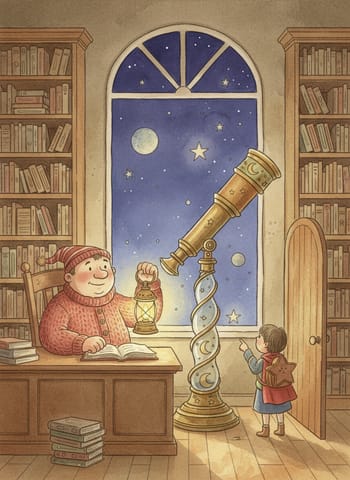
Olwen found the case on her first night, six years ago. She opened it. Inside lay a telescope. It was small and heavy and cold. It pointed up at the glass roof.
Olwen encontró el estuche en su primera noche, hace seis años. Lo abrió. Adentro había un telescopio. Era pequeño, pesado y frío. Apuntaba hacia el techo de vidrio.
Olwen put her eye to the small glass. She saw a very small star. It was not bright. It was not near the moon. It looked like a grain of salt on a black plate.
Olwen puso el ojo en el pequeño cristal. Vio una estrella muy pequeña. No era brillante. No estaba cerca de la luna. Parecía un grano de sal en un plato negro.
She checked her star chart, and the star was not on it. The chart showed a bright star close by. The telescope pointed away from it, at the wrong one.
Consultó su mapa de estrellas, y la estrella no estaba en él. El mapa mostraba una estrella brillante cerca. El telescopio apuntaba lejos de ella, a la equivocada.
Olwen turned the tube. The bright star slid into view for a second. Then the tube swung back slowly, like a hand. She let go, and it stayed on the grain of salt.
Olwen giró el tubo. La estrella brillante entró en el campo un segundo. Luego el tubo volvió lentamente, como una mano. Lo soltó, y se quedó en el grano de sal.
"Strange," she said to the empty room. Then she closed the case and went back to the counter. She told nobody. Nobody asked about shelf nine.
«Qué raro», le dijo a la sala vacía. Luego cerró el estuche y volvió al mostrador. No se lo dijo a nadie. Nadie preguntó por el estante nueve.
Tonight is different. At two o'clock, a bus driver comes in. He is tall and tired, and his coat smells of oil. He puts his lunch box on the counter. He wants to leave it for an hour.
Esta noche es distinta. A las dos de la madrugada, entra un conductor de autobús. Es alto y está cansado, y su abrigo huele a aceite. Pone su lonchera en el mostrador. Quiere dejarla una hora.
"What is in that case?" he asks. He points at shelf nine.
«¿Qué hay en ese estuche?», pregunta. Señala el estante nueve.
"A telescope."
«Un telescopio».
"Can I look?"
«¿Puedo mirar?».
Olwen waits. Then she shrugs. "Be careful. It is old."
Olwen espera. Luego se encoge de hombros. «Con cuidado. Es viejo».
The driver lifts the tube and puts it to his eye. He turns it left. He turns it right. He frowns.
El conductor levanta el tubo y se lo pone al ojo. Lo gira a la izquierda. Lo gira a la derecha. Frunce el ceño.
"I want to see the bright one," he says. "My wife says it is a lucky star."
«Quiero ver la brillante», dice. «Mi esposa dice que es una estrella de la suerte».
"Then turn it to the bright one."
«Entonces apúntalo a la brillante».
"I try. It does not stay." He tries again. The tube swings back by itself. "It is broken."
«Lo intento. No se queda». Lo intenta de nuevo. El tubo regresa solo. «Está roto».
"Maybe."
«Quizás».
The driver holds out the telescope. He looks at the clock. "I have to go. Someone else can try."
El conductor extiende el telescopio. Mira el reloj. «Tengo que irme. Que otro lo intente».
A young man sits on the bench near the counter. He has a folder on his knees. He reads the same page again and again. He looks up.
Un joven está sentado en la banca cerca del mostrador. Tiene una carpeta sobre las rodillas. Lee la misma página una y otra vez. Levanta la vista.
"Can I try?" he says.
«¿Puedo probar?», dice.
The driver hands him the telescope. "It does not work."
El conductor le pasa el telescopio. «No funciona».
The young man holds the tube in both hands. He looks. His shoulders go down.
El joven sostiene el tubo con las dos manos. Mira. Se le caen los hombros.
"I only see a small gray dot," he says. "I want a star with a name. A strong one. I have a job interview at nine tomorrow. I need luck."
«Solo veo un puntito gris», dice. «Quiero una estrella con nombre. Una fuerte. Mañana a las nueve tengo una entrevista de trabajo. Necesito suerte».
He pushes the tube toward the bright star. It slides back. He pushes harder, and it slides back again.
Empuja el tubo hacia la estrella brillante. Se desliza de vuelta. Empuja más fuerte, y se desliza de vuelta otra vez.
"Useless," he says. He is not angry. He only sounds tired. "Here."
«Inútil», dice. No está enojado. Solo suena cansado. «Tome».
He gives the telescope to a woman who walks past the bench. She has a mop. She cleans the floor of the station every night. Her cart is old and loud.
Le da el telescopio a una mujer que pasa junto a la banca. Lleva un trapeador. Limpia el piso de la estación todas las noches. Su carrito es viejo y ruidoso.
"Oh, I do not need that," she says. But she takes it anyway. She holds it up to the glass roof.
«Ay, yo no necesito eso», dice. Pero lo toma de todos modos. Lo levanta hacia el techo de vidrio.
She looks for a long time. Her lips move, and Olwen cannot hear the words.
Mira durante mucho rato. Mueve los labios, y Olwen no puede oír las palabras.
"The star is too small," the woman says at last. "I wish it was bigger. I wish it was gold."
«La estrella es demasiado pequeña», dice la mujer por fin. «Ojalá fuera más grande. Ojalá fuera dorada».
She hands the telescope back to Olwen. Then she goes on with her mop. The driver takes his lunch box and leaves. The young man follows him out.
Le devuelve el telescopio a Olwen. Luego sigue con su trapeador. El conductor toma su lonchera y se va. El joven sale tras él.
Olwen sits for a while with the tube across her knees. Three people look through it tonight. Each one wants something bright. Each one gets only a grain of salt.
Olwen se queda un rato con el tubo sobre las rodillas. Tres personas han mirado por él esta noche. Cada una quería algo brillante. Cada una consiguió solo un grano de sal.
"Maybe nobody wants you," she says to the telescope. "Maybe you wait for the wrong person."
«Quizás nadie te quiere», le dice al telescopio. «Quizás esperas a la persona equivocada».
The telescope does not answer. It only points at the roof.
El telescopio no responde. Solo apunta al techo.
At half past five, the sky begins to turn pale. The first buses leave. The doors of the station open and close. Olwen puts the telescope back in its case. She sets the case on shelf nine.
A las cinco y media, el cielo empieza a ponerse pálido. Salen los primeros autobuses. Las puertas de la estación se abren y se cierran. Olwen guarda el telescopio en su estuche. Pone el estuche en el estante nueve.
Then the street door opens, and a woman steps into the room.
Entonces se abre la puerta de la calle, y una mujer entra en la sala.
She is about Olwen's age. She wears a green coat. She has no bag and no ticket. She stands by the door for a moment. She seems unsure about the room.
Tiene más o menos la edad de Olwen. Lleva un abrigo verde. No tiene maleta ni boleto. Se queda junto a la puerta un momento. Parece insegura de la sala.
"Good morning," says Olwen. "Can I help you?"
«Buenos días», dice Olwen. «¿Puedo ayudarla?».
"My name is Dasha." The woman looks around. "I think I left something here. I do not know when."
«Me llamo Dasha». La mujer mira a su alrededor. «Creo que dejé algo aquí. No sé cuándo».
"What is it?"
«¿Qué es?».
"I do not know either." Dasha smiles. It is a shy smile. "But I think I will know it when I see it."
«Tampoco lo sé». Dasha sonríe. Es una sonrisa tímida. «Pero creo que lo sabré cuando lo vea».
She walks past the counter. She walks past the first shelf and the second. She does not look at the numbers. At shelf nine, she stops.
Camina frente al mostrador. Pasa el primer estante y el segundo. No mira los números. En el estante nueve, se detiene.
"There," says Dasha.
«Ahí», dice Dasha.
Olwen's heart beats fast. She lifts the brass case from the shelf. Dasha opens it with careful fingers.
El corazón de Olwen late rápido. Levanta el estuche de bronce del estante. Dasha lo abre con dedos cuidadosos.
"A telescope," she says. "It is a good one."
«Un telescopio», dice. «Es uno bueno».
"It points at the wrong star," says Olwen. "Three people try it tonight. They all want the bright one."
«Apunta a la estrella equivocada», dice Olwen. «Tres personas lo probaron esta noche. Todas querían la brillante».
"The bright one?" Dasha laughs softly. "Everyone wants that one."
«¿La brillante?». Dasha se ríe suavemente. «Todos quieren esa».
She does not turn the tube. She does not even try to move it. She lifts the small glass to her eye. She looks up at the glass roof.
No gira el tubo. Ni siquiera intenta moverlo. Se lleva el pequeño cristal al ojo. Mira hacia el techo de vidrio.
For a long moment, the room is silent. Olwen hears the clock on the wall. She hears a bus engine far outside.
Durante un largo momento, la sala está en silencio. Olwen oye el reloj de la pared. Oye el motor de un autobús lejos, afuera.
"Oh," Dasha says. "There you are."
«Ah», dice Dasha. «Ahí estás».
"Which star is it?"
«¿Qué estrella es?».
"The one nobody picks." Dasha does not take her eye from the glass. "It is small and it is plain. I always look at that one. It never asks for anything."
«La que nadie elige». Dasha no aparta el ojo del cristal. «Es pequeña y sencilla. Yo siempre miro esa. Nunca pide nada».
Then something happens. Olwen sees it from the counter. A small point of light blinks in the glass roof above them. It blinks once, and then once again.
Entonces ocurre algo. Olwen lo ve desde el mostrador. Un pequeño punto de luz parpadea en el techo de vidrio sobre ellas. Parpadea una vez, y luego otra vez.
Dasha lowers the telescope. Her eyes are wet, but she smiles.
Dasha baja el telescopio. Tiene los ojos húmedos, pero sonríe.
"Thank you for keeping it," she says. She closes the case and holds it against her coat.
«Gracias por guardarlo», dice. Cierra el estuche y lo sostiene contra su abrigo.
"Wait," Olwen says. "How do you know it is yours?"
«Espere», dice Olwen. «¿Cómo sabe que es suyo?».
Dasha looks at her for a long time. She does not answer. She nods at the street door.
Dasha la mira durante mucho rato. No responde. Señala con la cabeza la puerta de la calle.
Outside, at gate nine, a bus waits with its lights off. Olwen does not know the bus. It has no number on the front. Its doors are open, and the inside is dark and warm.
Afuera, en el andén nueve, un autobús espera con las luces apagadas. Olwen no conoce el autobús. No tiene número en el frente. Sus puertas están abiertas, y el interior está oscuro y cálido.
Dasha walks out with the case. Olwen watches the doors close.
Dasha sale con el estuche. Olwen observa cómo se cierran las puertas.