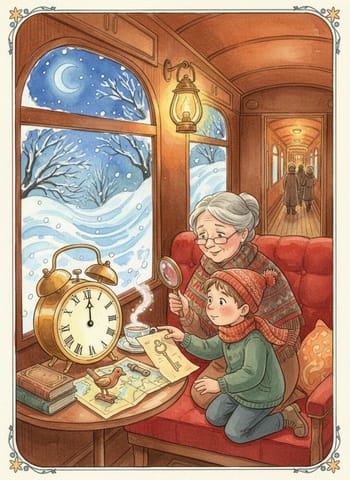
The Alarm Clock in Carriage Nine
Una historia gratuita en inglés de nivel A2 para estudiantes, para leer en línea en 7 idiomas, con opción de escucharla en la app gratuita Storyteller.
On a freezing night train, two strangers follow three clues to learn why a loud brass clock keeps ringing.
¡Ese fue el avance! Escucha la historia completa en la app gratuita Storyteller. Descargar la app
El audio no está disponible en este momento.
The night train left the city at ten. Carriage nine was almost empty. The heater under the seats was broken. It blew out cold, dusty air and nothing else.
El tren nocturno salió de la ciudad a las diez. El vagón nueve estaba casi vacío. La calefacción bajo los asientos estaba rota. Soplaba aire frío y polvoriento y nada más.
Imani sat by the window in her big coat. She pulled her scarf up to her nose. She could see her own breath in the air.
Imani estaba sentada junto a la ventana con su abrigo grande. Se subió la bufanda hasta la nariz. Podía ver su propio aliento en el aire.
One other passenger sat at the far end. He was a tall man with a toolbag on his knees. He wore two scarves and a wool hat. He looked as cold as she felt.
Otro pasajero estaba sentado al fondo. Era un hombre alto con una bolsa de herramientas sobre las rodillas. Llevaba dos bufandas y un gorro de lana. Parecía tener tanto frío como ella.
At twenty past ten, a loud bell rang. It was a harsh, shaking sound, like an old school bell. Imani jumped up from her seat. The noise came from her own bag. The bag stood on the floor under her seat.
A las diez y veinte, sonó una campana fuerte. Era un sonido áspero y vibrante, como una vieja campana de escuela. Imani se puso de pie de un salto. El ruido venía de su propio bolso. El bolso estaba en el suelo, bajo su asiento.
"Sorry!" she called. She pulled out a round brass alarm clock. She bought it that morning at a street market. The seller let her have it for almost nothing.
«¡Perdón!», gritó. Sacó un despertador redondo de latón. Lo había comprado esa mañana en un mercado callejero. El vendedor se lo dejó casi regalado.
"It's a little loud," the seller said. She thought that was funny then. She did not think so now.
«Es un poco fuerte», dijo el vendedor. A ella le había parecido gracioso entonces. Ahora no lo creía así.
She pressed the button on top. The bell stopped. The clock showed twenty past ten. She did not set any alarm. She was sure of that.
Apretó el botón de arriba. La campana se detuvo. El reloj marcaba las diez y veinte. No había puesto ninguna alarma. Estaba segura de eso.
The tall man came down the carriage. "May I look?" he asked. "I fix machines at work. My name is Xander."
El hombre alto bajó por el vagón. «¿Puedo mirarlo?», preguntó. «En mi trabajo arreglo máquinas. Me llamo Xander».
"Please do," said Imani. "I'm Imani. I only got it today."
«Por favor», dijo Imani. «Yo soy Imani. Lo tengo desde hoy».
Xander turned the clock over in his big hands. He looked at the back and the bottom. He touched the small lever at the side. "This is the test lever," he said. "Push it and the bell rings once. The alarm is off. It should be silent."
Xander dio vueltas al reloj entre sus grandes manos. Miró la parte de atrás y la de abajo. Tocó la palanquita del costado. «Esta es la palanca de prueba», dijo. «La empujas y la campana suena una vez. La alarma está apagada. Debería estar en silencio».
"But it rang," said Imani.
«Pero sonó», dijo Imani.
"Yes, it did." He gave the clock back. "Let's see if it does it again."
«Sí, sonó». Le devolvió el reloj. «Veamos si lo hace otra vez».
They sat together on the same bench. It was warmer with two people close. Xander took a pencil and an old ticket from his pocket. He wrote the time on the back. Twenty past ten.
Se sentaron juntos en la misma banca. Se estaba más cálido con dos personas cerca. Xander sacó de su bolsillo un lápiz y un boleto viejo. Anotó la hora en el reverso. Diez y veinte.
Nothing happened for a long time. The train rattled through dark fields. Lights from far houses flashed by and were gone. Imani put the clock on the floor. She watched it.
Durante mucho rato no pasó nada. El tren traqueteaba por campos oscuros. Las luces de casas lejanas pasaban destellando y desaparecían. Imani puso el reloj en el suelo. Lo observó.
At twenty to eleven, the bell rang again. Imani almost dropped the clock. Xander laughed and wrote down the time. "Twenty minutes," he said. "It rings every twenty minutes."
A las once menos veinte, la campana volvió a sonar. Imani casi dejó caer el reloj. Xander se rio y anotó la hora. «Veinte minutos», dijo. «Suena cada veinte minutos».
"But why?" asked Imani.
«¿Pero por qué?», preguntó Imani.
"That is the puzzle," said Xander. "We have eight hours and nowhere to go. Let's solve it."
«Ese es el rompecabezas», dijo Xander. «Tenemos ocho horas y ningún lugar adonde ir. Resolvámoslo».
Imani liked that. Her fingers were cold, but her mind woke up. "Clue one," she said. "Every twenty minutes."
A Imani le gustó eso. Tenía los dedos fríos, pero su mente se despertó. «Pista uno», dijo. «Cada veinte minutos».
"Good." Xander wrote it down. "Now we watch for clue two."
«Bien». Xander lo anotó. «Ahora vigilamos la pista dos».
At eleven, they both sat very still. The train hummed. A door banged far away. Then something knocked under the seat. It was a hard, short knock, like a hand on a drum. A moment later, the bell rang.
A las once, los dos se quedaron muy quietos. El tren zumbaba. Una puerta golpeó a lo lejos. Entonces algo golpeó bajo el asiento. Fue un golpe seco y corto, como una mano en un tambor. Un instante después, la campana sonó.
"Did you hear that?" whispered Imani. "First a knock. Then the bell."
«¿Oíste eso?», susurró Imani. «Primero un golpe. Luego la campana».
"Clue two," said Xander. He wrote the words "knock first". He looked pleased.
«Pista dos», dijo Xander. Escribió las palabras «primero el golpe». Parecía contento.
Imani looked at the clock on the floor. Xander put his hand under the seat. He waited with his eyes closed. After a few seconds, he smiled.
Imani miró el reloj en el suelo. Xander puso la mano bajo el asiento. Esperó con los ojos cerrados. Después de unos segundos, sonrió.
"Clue three," he said. "Warm air. It comes out of the heater after the bell. It stays for one minute. Then it goes cold again."
«Pista tres», dijo. «Aire tibio. Sale de la calefacción después de la campana. Dura un minuto. Luego se enfría de nuevo».
Imani felt the air with her own hand. It was true. A thin, warm breath touched her fingers and then went away.
Imani sintió el aire con su propia mano. Era cierto. Un soplo fino y tibio le tocó los dedos y luego se fue.
"A knock, a bell, and warm air," she said. "What does it mean?"
«Un golpe, una campana y aire tibio», dijo. «¿Qué significa?».
"I don't know yet," said Xander. "But the clock and the heater are friends. I am sure of that."
«Todavía no lo sé», dijo Xander. «Pero el reloj y la calefacción son amigos. De eso estoy seguro».
He opened his toolbag and took out a small lamp. Then he got down on the dirty floor. He looked under the seat for a long time. Imani held the lamp for him. Her arm began to shake, but she did not mind.
Abrió su bolsa de herramientas y sacó una pequeña lámpara. Luego se agachó en el suelo sucio. Miró bajo el asiento durante largo rato. Imani sostuvo la lámpara para él. Le empezó a temblar el brazo, pero no le importó.
At last, Xander started to laugh. He laughed so hard that he had to sit on the floor.
Por fin, Xander empezó a reírse. Se rio tan fuerte que tuvo que sentarse en el suelo.
"What is it?" said Imani.
«¿Qué pasa?», dijo Imani.
"Look," he said. He pointed with the lamp. "There is a pipe under your seat. The heater valve is stuck. Every twenty minutes, the pipe jumps and knocks. Your clock stood on the floor, right next to it."
«Mira», dijo. Señaló con la lámpara. «Hay una tubería bajo tu asiento. La válvula de la calefacción está atascada. Cada veinte minutos, la tubería da un salto y golpea. Tu reloj estaba en el suelo, justo al lado».
"The knock hit the clock," said Imani slowly.
«El golpe golpeó el reloj», dijo Imani despacio.
"It hit the little lever. The bell rang. Now watch the next part." He pointed again. "The bell is so loud that it shakes the pipe. The shaking opens the valve a little. The heater coughs out some warm air."
«Golpeó la palanquita. La campana sonó. Ahora mira la siguiente parte». Señaló otra vez. «La campana es tan fuerte que sacude la tubería. La sacudida abre un poco la válvula. La calefacción tose un poco de aire tibio».
Imani looked at the clock in her hands. Then she began to laugh too. "So my clock wakes up the heater."
Imani miró el reloj en sus manos. Luego ella también empezó a reírse. «O sea que mi reloj despierta a la calefacción».
"Yes!" said Xander. "The heater needs a loud noise to start. It is just like me in the morning."
«¡Sí!», dijo Xander. «La calefacción necesita un ruido fuerte para arrancar. Igualito que yo por las mañanas».
They laughed until their eyes were wet. The sound ran down the empty carriage. For a moment, it felt like a warm room.
Se rieron hasta que se les humedecieron los ojos. El sonido corrió por el vagón vacío. Por un momento, se sintió como una habitación cálida.
Then Xander stood up and took a metal tool from his bag. "Now we do it the quick way," he said. He gave the stuck valve three hard hits. It rang like a bell of its own.
Entonces Xander se puso de pie y sacó una herramienta de metal de su bolsa. «Ahora lo hacemos por la vía rápida», dijo. Le dio tres golpes fuertes a la válvula atascada. Sonó como una campana propia.
The heater made a long, deep noise. Then warm air poured out under every seat. It smelled a little like burning dust, but it was warm. It was lovely.
La calefacción hizo un ruido largo y profundo. Luego salió aire tibio bajo cada asiento. Olía un poco a polvo quemado, pero estaba tibio. Era una delicia.
Imani took off her scarf. Xander took off his hat and one of his scarves. They sat back and let the heat reach their feet.
Imani se quitó la bufanda. Xander se quitó el gorro y una de sus bufandas. Se recostaron y dejaron que el calor les llegara a los pies.
"Thank you," said Imani. "I think I'll keep the clock. It did a good job tonight."
«Gracias», dijo Imani. «Creo que me quedaré con el reloj. Hizo un buen trabajo esta noche».
"It did," said Xander. He took the clock from her hands again. He looked at it in the lamp light. His smile slowly changed. "Imani, look at the back."
«Sí que lo hizo», dijo Xander. Volvió a tomar el reloj de sus manos. Lo miró a la luz de la lámpara. Su sonrisa fue cambiando poco a poco. «Imani, mira la parte de atrás».
"I looked at it already. It's just brass."
«Ya la miré. Es solo latón».
"Exactly." He tapped the metal. "There is no door for a battery. There is no hole for a key." He held the clock up to his ear. The hands moved round, smooth and quiet.
«Exacto». Golpeteó el metal. «No hay tapa para una pila. No hay agujero para una llave». Acercó el reloj a su oído. Las manecillas giraban, suaves y silenciosas.
Imani stopped smiling too. The heater roared. The train rushed on into the dark.
Imani también dejó de sonreír. La calefacción rugía. El tren seguía a toda velocidad hacia la oscuridad.
"So," said Xander quietly, "what makes it go?"
«Entonces», dijo Xander en voz baja, «¿qué lo hace andar?».