Two Halves of the Lake
Una historia gratuita en inglés de nivel A2 para estudiantes, para leer en línea en 7 idiomas, con opción de escucharla en la app gratuita Storyteller.
Two rival boat renters each find half of a torn page and must row together to wake a bell under their lake.
¡Ese fue el avance! Escucha la historia completa en la app gratuita Storyteller. Descargar la app
El audio no está disponible en este momento.
Gaston rented boats at the north end of Lake Orrin. His hut was small and blue. It had a sign, a rack of oars, and six old boats.
Gaston alquilaba botes en el extremo norte del lago Orrin. Su cabaña era pequeña y azul. Tenía un letrero, un estante de remos y seis botes viejos.
Ivo rented boats at the south end. His hut was green. His sign was twice as big as Gaston's.
Ivo alquilaba botes en el extremo sur. Su cabaña era verde. Su letrero era el doble de grande que el de Gaston.
Every morning, the two men stood on their jetties. They called to the visitors on the path.
Todas las mañanas, los dos hombres se paraban en sus muelles. Llamaban a los visitantes del sendero.
"Cheap boats! Two coins an hour!" shouted Gaston.
«¡Botes baratos! ¡Dos monedas la hora!», gritaba Gaston.
"Dry seats! Strong oars! Come south!" shouted Ivo.
«¡Asientos secos! ¡Remos fuertes! ¡Vengan al sur!», gritaba Ivo.
They did this for eleven summers. They never talked about why. Neither man wanted to be the first to stop.
Lo hicieron durante once veranos. Nunca hablaron de por qué. Ninguno de los dos quería ser el primero en parar.
On a quiet Monday, Gaston turned over his oldest boat. He wanted to clean it. A loose board moved under his hand. Behind it lay a folded piece of paper. He opened it with care.
Un lunes tranquilo, Gaston volteó su bote más viejo. Quería limpiarlo. Una tabla suelta se movió bajo su mano. Detrás había un papel doblado. Lo abrió con cuidado.
It was only half a page. The edge was straight, as if someone cut it. The paper was yellow and soft, like old cloth. Brown handwriting covered it, but every line stopped halfway.
Era solo media página. El borde era recto, como si alguien lo hubiera cortado. El papel era amarillo y suave, como tela vieja. Una letra café lo cubría, pero cada línea se detenía a la mitad.
Gaston read the first line aloud. "Under the water sleeps…" The line ended there. He read the next. "Tie your boat beside the…" Again, nothing more.
Gaston leyó la primera línea en voz alta. «Bajo el agua duerme…». La línea terminaba ahí. Leyó la siguiente. «Amarra tu bote junto al…». Otra vez, nada más.
The paper grew warm in his hand. Then it pulled. It pulled toward the south, like a dog on a lead. Gaston took one step, and the paper pulled harder.
El papel se calentó en su mano. Luego tiró. Tiró hacia el sur, como un perro con correa. Gaston dio un paso, y el papel tiró con más fuerza.
"This is silly," Gaston said to the empty hut. He followed it anyway.
«Esto es tonto», le dijo Gaston a la cabaña vacía. Lo siguió de todos modos.
He walked along the shore path for a long time. The paper led him straight to the green hut. Ivo stood on his jetty. He held a piece of paper with both hands. It pulled toward the north like a kite.
Caminó por el sendero de la orilla durante mucho tiempo. El papel lo llevó directo a la cabaña verde. Ivo estaba en su muelle. Sostenía un papel con ambas manos. Tiraba hacia el norte como una cometa.
"Did you put that in my boat?" Ivo asked.
«¿Tú pusiste eso en mi bote?», preguntó Ivo.
"No," said Gaston. "I found mine under a board. Look at yours."
«No», dijo Gaston. «El mío lo encontré bajo una tabla. Mira el tuyo».
"I found mine in the roof of my hut," said Ivo.
«El mío lo encontré en el techo de mi cabaña», dijo Ivo.
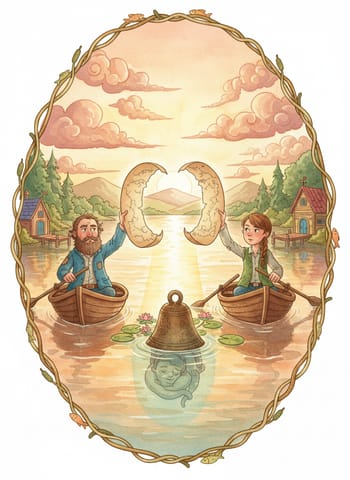
Ivo held out his piece. Gaston held out his. The two torn edges jumped together with a soft click. The page became whole. It glowed gold for a moment, and then it lay still.
Ivo extendió su pedazo. Gaston extendió el suyo. Los dos bordes rasgados saltaron juntos con un suave clic. La página quedó completa. Brilló dorada un momento, y luego quedó quieta.
Both men bent over it. Now the lines made sense.
Los dos hombres se inclinaron sobre ella. Ahora las líneas tenían sentido.
Ivo read slowly. "Under the water sleeps a bell. Tie your boat beside the boat of your neighbour at sunset. Row in step. Speak kindly. Then the bell will rise, and it will belong to both."
Ivo leyó despacio. «Bajo el agua duerme una campana. Amarra tu bote junto al bote de tu vecino al atardecer. Remen al mismo compás. Hablen con amabilidad. Entonces la campana se elevará, y será de ambos».
"Both what?" asked Gaston.
«¿De ambos qué?», preguntó Gaston.
"Both boatmen," said Ivo. "Both huts, I think."
«De ambos boteros», dijo Ivo. «De ambas cabañas, creo».
Gaston tried to take his half back. The paper did not come apart. It held together like glue. He pulled harder, and Ivo pulled the other way. The page did not tear. It only got warmer.
Gaston trató de llevarse su mitad. El papel no se separó. Se mantuvo unido como pegamento. Tiró más fuerte, e Ivo tiró para el otro lado. La página no se rasgó. Solo se calentó más.
"It wants us together," Ivo said. "That is clear."
«Nos quiere juntos», dijo Ivo. «Eso es claro».
"I do not need a bell," said Gaston. "But I will not let you have it alone."
«No necesito una campana», dijo Gaston. «Pero no dejaré que la tengas tú solo».
"Same to you," said Ivo.
«Igualmente», dijo Ivo.
They agreed to try at sunset. Each man was sure the bell was for him. Each man planned to do it his own way.
Acordaron intentarlo al atardecer. Cada hombre estaba seguro de que la campana era para él. Cada hombre planeaba hacerlo a su manera.
At sunset, the lake was flat and gold. The two men met in the middle of the water. Gaston brought his best boat. Ivo brought his best boat. They tied them side by side with a short rope.
Al atardecer, el lago estaba plano y dorado. Los dos hombres se encontraron en medio del agua. Gaston trajo su mejor bote. Ivo trajo su mejor bote. Los amarraron lado a lado con una cuerda corta.
"We use my oars," said Gaston. "They are newer."
«Usamos mis remos», dijo Gaston. «Son más nuevos».
"We use mine," said Ivo. "They are longer."
«Usamos los míos», dijo Ivo. «Son más largos».
"Mine!"
«¡Los míos!».
"Mine!"
«¡Los míos!».
In the end, each man took his own oars. Gaston rowed toward the north. Ivo rowed toward the south. The rope pulled tight, and the boats began to spin.
Al final, cada hombre tomó sus propios remos. Gaston remó hacia el norte. Ivo remó hacia el sur. La cuerda se tensó, y los botes empezaron a girar.
They turned in a slow circle. The water under them went dark and still. No bell rang, and no light shone. The lake stayed silent.
Dieron vueltas en un círculo lento. El agua bajo ellos se puso oscura y quieta. Ninguna campana sonó, ninguna luz brilló. El lago permaneció en silencio.
"Stop!" cried Ivo. "You are making us spin!"
«¡Para!», gritó Ivo. «¡Nos estás haciendo girar!».
"You are the one making us spin," said Gaston.
«Tú eres quien nos hace girar», dijo Gaston.
They stopped rowing at the same moment. The boats turned a little more and then lay quiet. The sky above them went pink. The page, in Gaston's pocket, felt cool.
Dejaron de remar en el mismo momento. Los botes giraron un poco más y luego quedaron quietos. El cielo sobre ellos se puso rosa. La página, en el bolsillo de Gaston, se sentía fresca.
For a while, neither man spoke. Gaston looked at his hands. Ivo looked at the water.
Durante un rato, ninguno habló. Gaston miró sus manos. Ivo miró el agua.
"I made my sign bigger on purpose," Ivo said at last. "In the first summer, you had more visitors. I was afraid of losing my hut."
«Hice mi letrero más grande a propósito», dijo Ivo por fin. «El primer verano, tú tenías más visitantes. Tenía miedo de perder mi cabaña».
Gaston laughed, but not in an unkind way. "I shouted first on purpose, too," he said. "I was afraid of the same thing."
Gaston se rio, pero no con maldad. «Yo también grité primero a propósito», dijo. «Tenía miedo de lo mismo».
"Eleven summers," said Ivo. "For nothing."
«Once veranos», dijo Ivo. «Para nada».
"Not for nothing," said Gaston. "We both learned to shout very well."
«No para nada», dijo Gaston. «Los dos aprendimos a gritar muy bien».
Ivo smiled. He took one oar from his own boat and held it out. "Take this one," he said. "Give me one of yours." Gaston took it. He gave Ivo one of his own oars.
Ivo sonrió. Tomó un remo de su propio bote y lo extendió. «Toma este», dijo. «Dame uno de los tuyos». Gaston lo tomó. Le dio a Ivo uno de sus propios remos.
"One stroke on the left, one on the right," said Ivo. "Together?"
«Una remada a la izquierda, una a la derecha», dijo Ivo. «¿Juntos?».
"Together," said Gaston. "I will count."
«Juntos», dijo Gaston. «Yo cuento».
"Count slowly," said Ivo. "My arms are not young."
«Cuenta despacio», dijo Ivo. «Mis brazos no son jóvenes».
Gaston counted. "One. Two. One. Two."
Gaston contó. «Uno. Dos. Uno. Dos».
They pulled in step. The boats moved forward in a straight line. The rope hung loose between them. The water began to shine. First there was one small light under the surface. Then there were ten. Then there were hundreds, like a town of lanterns far below.
Remaron al compás. Los botes avanzaron en línea recta. La cuerda colgaba floja entre ellos. El agua empezó a brillar. Primero hubo una lucecita bajo la superficie. Luego hubo diez. Luego hubo cientos, como un pueblo de faroles muy abajo.
"Keep rowing," Ivo whispered.
«Sigue remando», susurró Ivo.
"I am," Gaston whispered back. "Do not stop."
«Eso hago», susurró Gaston. «No pares».
The lights gathered in one place, right between the two boats. The water rose, and something broke the surface. It was a small bell made of green and gold metal. A chain of water-weed hung from it. It floated on the lake as if it weighed nothing.
Las luces se reunieron en un solo lugar, justo entre los dos botes. El agua se elevó, y algo rompió la superficie. Era una pequeña campana hecha de metal verde y dorado. Una cadena de algas colgaba de ella. Flotaba en el lago como si no pesara nada.
Gaston lifted it into his boat. Ivo leaned across the rope to look. Four short words ran along the side of the bell. They said, "For those who share."
Gaston la levantó a su bote. Ivo se inclinó sobre la cuerda para mirar. Cuatro palabras cortas recorrían el costado de la campana. Decían: «Para quienes comparten».
"It is not very big," Ivo said.
«No es muy grande», dijo Ivo.
"It is exactly big enough," said Gaston.
«Es exactamente lo bastante grande», dijo Gaston.
They rowed back together in the evening. The bell sat between the boats. On the jetty, they argued a little about where to hang it. At last they chose a post on the shore path. It stood just as near to one hut as to the other.
Remaron de regreso juntos al anochecer. La campana iba entre los botes. En el muelle, discutieron un poco sobre dónde colgarla. Al final eligieron un poste en el sendero de la orilla. Estaba tan cerca de una cabaña como de la otra.
The next morning, no one shouted from either jetty. Visitors came down the path and stopped, puzzled. They looked at the two men, who stood side by side.
A la mañana siguiente, nadie gritó desde ninguno de los muelles. Los visitantes bajaron por el sendero y se detuvieron, desconcertados. Miraron a los dos hombres, que estaban parados lado a lado.
Gaston reached out and touched the bell with one finger.
Gaston extendió la mano y tocó la campana con un dedo.
The bell rang once across the water, and both huts heard it.
La campana sonó una vez sobre el agua, y ambas cabañas la oyeron.