Gaston rented boats at the north end of Lake Orrin. His hut was small and blue. It had a sign, a rack of oars, and six old boats.
加斯东在奥林湖的北端出租小船。他的小屋又小又蓝,有一块招牌、一架船桨和六条旧船。
Ivo rented boats at the south end. His hut was green. His sign was twice as big as Gaston's.
伊沃在南端出租小船。他的小屋是绿色的,招牌比加斯东的大一倍。
Every morning, the two men stood on their jetties. They called to the visitors on the path.
每天早上,两个人都站在各自的栈桥上,向小路上的游客喊话。
"Cheap boats! Two coins an hour!" shouted Gaston.
“便宜的船!一小时两枚硬币!”加斯东喊道。
"Dry seats! Strong oars! Come south!" shouted Ivo.
“座位干爽!船桨结实!来南边!”伊沃喊道。
They did this for eleven summers. They never talked about why. Neither man wanted to be the first to stop.
他们这样已经喊了十一个夏天。他们从来不谈为什么。谁也不愿做先停下来的那一个。
On a quiet Monday, Gaston turned over his oldest boat. He wanted to clean it. A loose board moved under his hand. Behind it lay a folded piece of paper. He opened it with care.
一个安静的星期一,加斯东把他最旧的一条船翻过来,想把它洗干净。他的手底下,有一块松动的木板动了一下。木板后面有一张折起来的纸。他小心翼翼地把它打开。
It was only half a page. The edge was straight, as if someone cut it. The paper was yellow and soft, like old cloth. Brown handwriting covered it, but every line stopped halfway.
那只是半页纸。边缘笔直,像是有人裁过。纸张发黄,软得像旧布。上面写满了棕色的字迹,可每一行都写到一半就断了。
Gaston read the first line aloud. "Under the water sleeps…" The line ended there. He read the next. "Tie your boat beside the…" Again, nothing more.
加斯东大声念出第一行。“水下沉睡着……”这一行到此为止。他念下一行。“把你的船系在……旁边。”又是什么也没有了。
The paper grew warm in his hand. Then it pulled. It pulled toward the south, like a dog on a lead. Gaston took one step, and the paper pulled harder.
纸在他手里变热了。然后它拉扯起来,朝南边拉,像牵绳上的一条狗。加斯东迈出一步,纸拉得更用力了。
"This is silly," Gaston said to the empty hut. He followed it anyway.
“这太荒唐了,”加斯东对着空荡荡的小屋说。可他还是跟着走了。
He walked along the shore path for a long time. The paper led him straight to the green hut. Ivo stood on his jetty. He held a piece of paper with both hands. It pulled toward the north like a kite.
他沿着湖岸小路走了很久。纸把他一直领到了那间绿色小屋。伊沃站在他的栈桥上,双手捏着一张纸。那张纸朝北边拉,像一只风筝。
"Did you put that in my boat?" Ivo asked.
“是你把这个放进我船里的吗?”伊沃问。
"No," said Gaston. "I found mine under a board. Look at yours."
“不是,”加斯东说,“我的是在一块木板下面发现的。看看你的。”
"I found mine in the roof of my hut," said Ivo.
“我的是在我小屋的屋顶里找到的,”伊沃说。
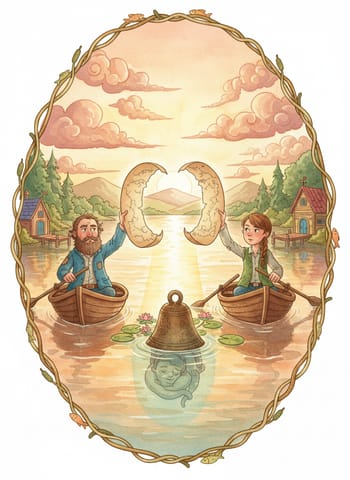
Ivo held out his piece. Gaston held out his. The two torn edges jumped together with a soft click. The page became whole. It glowed gold for a moment, and then it lay still.
伊沃伸出他的那一半,加斯东也伸出他的。两条撕开的边缘轻轻咔嗒一声跳到一起。纸页变得完整了。它金光闪了一下,然后静静地躺着。
Both men bent over it. Now the lines made sense.
两个人都俯身去看。现在,这些句子读得通了。
Ivo read slowly. "Under the water sleeps a bell. Tie your boat beside the boat of your neighbour at sunset. Row in step. Speak kindly. Then the bell will rise, and it will belong to both."
伊沃慢慢地念起来。“水下沉睡着一口钟。日落时,把你的船系在邻居的船旁边。同步划桨。说话要和气。那口钟就会升起,它将属于你们两个人。”
"Both what?" asked Gaston.
“两个什么人?”加斯东问。
"Both boatmen," said Ivo. "Both huts, I think."
“两个船夫,”伊沃说,“我想,也是两间小屋。”
Gaston tried to take his half back. The paper did not come apart. It held together like glue. He pulled harder, and Ivo pulled the other way. The page did not tear. It only got warmer.
加斯东想把自己那一半拿回来。纸没有分开,像胶水一样粘在一起。他更用力地拉,伊沃朝另一边拉。纸页没有撕破,只是变得更热了。
"It wants us together," Ivo said. "That is clear."
“它想让我们在一起,”伊沃说,“这很明显。”
"I do not need a bell," said Gaston. "But I will not let you have it alone."
“我不需要钟,”加斯东说,“但我不会让你一个人得到它。”
"Same to you," said Ivo.
“你也一样,”伊沃说。
They agreed to try at sunset. Each man was sure the bell was for him. Each man planned to do it his own way.
他们约好日落时试一试。两个人都确信钟是给自己的。两个人都打算按自己的办法来。
At sunset, the lake was flat and gold. The two men met in the middle of the water. Gaston brought his best boat. Ivo brought his best boat. They tied them side by side with a short rope.
日落时分,湖面平静,一片金色。两个人在水面中央碰了头。加斯东带来了他最好的船,伊沃也带来了他最好的船。他们用一根短绳把船并排系在一起。
"We use my oars," said Gaston. "They are newer."
“用我的桨,”加斯东说,“它们更新。”
"We use mine," said Ivo. "They are longer."
“用我的,”伊沃说,“它们更长。”
"Mine!"
“我的!”
"Mine!"
“我的!”
In the end, each man took his own oars. Gaston rowed toward the north. Ivo rowed toward the south. The rope pulled tight, and the boats began to spin.
最后,两个人各自拿了自己的桨。加斯东朝北划,伊沃朝南划。绳子绷紧了,两条船开始打转。
They turned in a slow circle. The water under them went dark and still. No bell rang, and no light shone. The lake stayed silent.
他们慢慢地转着圈。他们脚下的水变得又黑又静。没有钟声响起,也没有光亮出现。湖面一片沉寂。
"Stop!" cried Ivo. "You are making us spin!"
“停!”伊沃喊道,“你让我们在打转!”
"You are the one making us spin," said Gaston.
“让我们打转的是你,”加斯东说。
They stopped rowing at the same moment. The boats turned a little more and then lay quiet. The sky above them went pink. The page, in Gaston's pocket, felt cool.
他们同时停下了桨。船又转了一点点,然后静静地停住了。头顶的天空变成了粉红色。加斯东口袋里的那张纸,摸上去是凉的。
For a while, neither man spoke. Gaston looked at his hands. Ivo looked at the water.
有好一会儿,谁也没有说话。加斯东看着自己的双手。伊沃看着水面。
"I made my sign bigger on purpose," Ivo said at last. "In the first summer, you had more visitors. I was afraid of losing my hut."
“我把招牌做大,是故意的,”伊沃终于说道,“第一个夏天,你的游客比我多。我怕失去我的小屋。”
Gaston laughed, but not in an unkind way. "I shouted first on purpose, too," he said. "I was afraid of the same thing."
加斯东笑了,但并不带恶意。“我先开口喊,也是故意的,”他说,“我害怕的是同一件事。”
"Eleven summers," said Ivo. "For nothing."
“十一个夏天,”伊沃说,“白白浪费了。”
"Not for nothing," said Gaston. "We both learned to shout very well."
“不算白费,”加斯东说,“我们俩都学会了怎么大声吆喝。”
Ivo smiled. He took one oar from his own boat and held it out. "Take this one," he said. "Give me one of yours." Gaston took it. He gave Ivo one of his own oars.
伊沃笑了。他从自己的船上取下一支桨,递了过去。“拿这支,”他说,“给我你的一支。”加斯东接了过来,把自己的一支桨给了伊沃。
"One stroke on the left, one on the right," said Ivo. "Together?"
“左边一桨,右边一桨,”伊沃说,“一起?”
"Together," said Gaston. "I will count."
“一起,”加斯东说,“我来数。”
"Count slowly," said Ivo. "My arms are not young."
“数慢点,”伊沃说,“我的胳膊可不年轻了。”
Gaston counted. "One. Two. One. Two."
加斯东数了起来。“一,二。一,二。”
They pulled in step. The boats moved forward in a straight line. The rope hung loose between them. The water began to shine. First there was one small light under the surface. Then there were ten. Then there were hundreds, like a town of lanterns far below.
他们同步划桨。两条船笔直地向前行驶。绳子松松地垂在两船之间。水面开始发光。先是水面下一点小小的光亮,接着是十点,然后是几百点,就像远在水下的一座灯笼小镇。
"Keep rowing," Ivo whispered.
“继续划,”伊沃低声说。
"I am," Gaston whispered back. "Do not stop."
“我在划,”加斯东也低声回答,“别停。”
The lights gathered in one place, right between the two boats. The water rose, and something broke the surface. It was a small bell made of green and gold metal. A chain of water-weed hung from it. It floated on the lake as if it weighed nothing.
光点聚集到一个地方,正好在两条船中间。水面升高,有什么东西破水而出。那是一口小钟,由绿色和金色的金属制成。一串水草缠成的链子挂在上面。它浮在湖面上,仿佛没有一点重量。
Gaston lifted it into his boat. Ivo leaned across the rope to look. Four short words ran along the side of the bell. They said, "For those who share."
加斯东把它捞进自己的船里。伊沃越过绳子探身来看。钟的侧面刻着四个短词。上面写着:“献给分享的人”。
"It is not very big," Ivo said.
“它不是很大,”伊沃说。
"It is exactly big enough," said Gaston.
“刚好够大,”加斯东说。
They rowed back together in the evening. The bell sat between the boats. On the jetty, they argued a little about where to hang it. At last they chose a post on the shore path. It stood just as near to one hut as to the other.
他们傍晚一起划船回来。钟放在两条船之间。在栈桥上,他们为挂在哪里争论了一小会儿。最后,他们选定了湖岸小路上的一根柱子。它离哪间小屋都一样近。
The next morning, no one shouted from either jetty. Visitors came down the path and stopped, puzzled. They looked at the two men, who stood side by side.
第二天早上,两边的栈桥上都没有人吆喝。游客们沿着小路走来,困惑地停下脚步。他们看着那两个并肩站着的男人。
Gaston reached out and touched the bell with one finger.
加斯东伸出手,用一根手指碰了碰那口钟。
The bell rang once across the water, and both huts heard it.
钟声越过水面,响了一声,两间小屋都听见了。