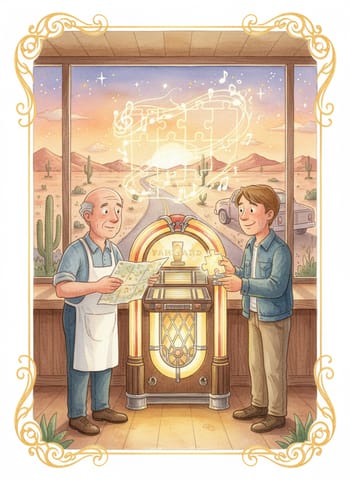
The Mile Ninety Diner stood alone on a long desert road. At night, it was the only light for miles.
九十英里餐馆孤零零地立在一条漫长的沙漠公路旁。到了夜里,它是方圆几英里内唯一的灯光。
Nasir owned the diner. Behind the counter, in the corner, stood his jukebox. It was very old and very strange.
纳西尔是这家餐馆的老板。柜台后面的角落里,立着他的点唱机。它非常老,也非常奇怪。
The jukebox never took coins. It played the song you needed, not the song you wanted. A sad driver heard a happy tune and smiled. A proud man heard a soft one. He went home to call his sister.
这台点唱机从不收硬币。它播放的是你需要的歌,而不是你想听的歌。一个忧伤的司机听到一支欢快的曲子,笑了。一个骄傲的男人听到一支轻柔的曲子,回家给他姐姐打了电话。
But tonight, the jukebox was silent.
可是今晚,点唱机一声不响。
Wes was the only customer. He was a truck driver with dusty boots and tired eyes. He sat at the counter with a cup of cold coffee.
韦斯是唯一的顾客。他是个卡车司机,靴子上满是灰尘,眼神疲惫。他坐在柜台前,面前一杯冷掉的咖啡。
"Your music box is dead," he said.
“你的音乐盒坏了。”他说。
"It is not dead," said Nasir. "It is locked."
“它没坏,”纳西尔说,“它是被锁住了。”
"Locked?"
“锁住了?”
"Once every two years, at midnight, it asks for the password. I must say it, or it stays quiet until sunrise." Nasir rubbed his face. "And I forgot it."
“每两年一次,在午夜,它会要密码。我必须说出来,否则它就会一直沉默到日出。”纳西尔揉了揉脸。“可是我忘了。”
The jukebox gave a small blink. Its lights were orange, and they moved in slow circles.
点唱机轻轻闪了一下。它的灯是橙色的,慢慢地转着圈。
"Why not write it down?" asked Wes.
“为什么不写下来?”韦斯问。
"I did. I wrote it on a sticky note and put it somewhere safe." Nasir looked sad. "That was two years ago."
“我写了。我把它写在便利贴上,放在一个安全的地方。”纳西尔看上去很难过。“那是两年前的事了。”
Wes put down his cup. He liked puzzles. On long roads, he did them in his head to stay awake.
韦斯放下杯子。他喜欢谜题。在漫长的路上,为了不犯困,他常常在脑子里解谜。
"Okay," he said. "Let us find it together. What do we know?"
“好吧,”他说,“我们一起来找。我们都知道些什么?”
"Nothing," said Nasir.
“什么都不知道。”纳西尔说。
"We know a lot. We know the jukebox is magic. We know you chose the word. And we know you hid a note." Wes stood up and smiled. "That is three things. Let us start with the first one."
“我们知道很多。我们知道这台点唱机有魔力。我们知道密码是你选的。我们还知道你藏了一张便条。”韦斯站起来,笑了笑。“这是三件事。我们从第一件开始吧。”
They looked at the jukebox. Its lights blinked again. This time, Wes counted. The light blinked nine times, then it went dark.
他们看着点唱机。它的灯又闪了。这一次,韦斯数了数。灯闪了九下,然后暗了下去。
"Nine," he said. "I think the word has nine letters."
“九,”他说,“我觉得这个词有九个字母。”
"Nine?" Nasir wrote the number on his hand. "Good. That is clue one."
“九个?”纳西尔把这个数字写在手上。“好。这是第一条线索。”
"Now clue two. The note." Wes walked slowly around the diner. "Where do you keep things you want to remember?"
“现在找第二条线索。便条。”韦斯在餐馆里慢慢地走动。“你把想记住的东西放在哪儿?”
"Here, on the wall. And there, on the fridge. And in the drawer."
“这儿的墙上。还有那边的冰箱上。还有抽屉里。”
They searched everywhere. Nasir opened the drawer and found forty pens and no paper. Wes looked behind the fridge. He found dust and one old fork. They searched under the counter and inside the salt boxes.
他们到处找。纳西尔拉开抽屉,里面有四十支笔,却没有一张纸。韦斯看了冰箱后面,只找到灰尘和一把旧叉子。他们找了柜台底下,也找了盐盒里面。
Nothing. The clock on the wall said half past midnight.
什么也没有。墙上的钟指着十二点半。
"This is hopeless," said Nasir.
“没希望了。”纳西尔说。
"Wait." Wes knelt in front of the jukebox. "Look here."
“等等。”韦斯跪在点唱机前。“看这儿。”
Near the floor was a small yellow square. It was not a note. It was a small print of glue. A few bits of paper still stuck to it.
靠近地板的地方有一小块黄色的方形痕迹。那不是便条,而是一小块胶印,上面还粘着几点碎纸。
"A sticky note was here once," said Wes. "It fell off a long time ago."
“这里曾经有一张便利贴,”韦斯说,“很久以前就掉了。”
"The cleaner threw it away," said Nasir.
“清洁工把它扔了。”纳西尔说。
"Maybe. But the glue is still here." Wes bent closer. "And the paper left a tiny shape. See? It looks like a letter F."
“也许吧。但胶还在这儿。”韦斯凑得更近。“而且纸在上面留下了一个小小的形状。你看,像不像字母F?”
Nasir looked. He saw a thin dark line, and a short line across it. "Is it an F?"
纳西尔看了看。他看到一条细细的深色竖线,上面横着一条短线。“是F吗?”
"It is a good guess. The word starts with F. That is clue two." Wes smiled. "Now we need clue three."
“这个猜测不错。这个词以F开头。这是第二条线索。”韦斯笑了。“现在我们需要第三条线索。”
"What is clue three?" asked Nasir.
“第三条线索是什么?”纳西尔问。
"I do not know yet. Tell me why you chose the word. What happened that day?"
“我还不知道。告诉我,你为什么选这个词?那天发生了什么事?”
Nasir sat down on a stool and thought. He remembered a hot afternoon, two years ago. The kitchen was a mess. A pipe broke, and a box of eggs fell on the floor. His keys were gone, and so was his phone.
纳西尔在凳子上坐下,想了想。他想起了两年前一个炎热的下午。厨房里乱成一团。一根水管爆了,一盒鸡蛋掉在地上。他的钥匙不见了,手机也不见了。
"I was very angry," he said. "I shouted at the walls. And I think I chose the password to joke about myself."
“我当时气坏了,”他说,“我对着墙壁大吼。我想我选这个密码,是为了拿自己开个玩笑。”
"A joke about yourself," Wes repeated. "That is helpful."
“拿自己开玩笑,”韦斯重复道,“这有帮助。”
"I always forget things."
“我总是忘事。”
"Do you say that a lot?"
“你常这么说吗?”
"All day," said Nasir. "I say it to the cook. I say it to the cat. Last week I said it to a man at the door."
“整天都说,”纳西尔说,“我对厨师说,对猫说。上周我还对门口的一个男人说过。”
Wes stared at him. Slowly, a smile grew on his face.
韦斯盯着他。慢慢地,他脸上露出了笑容。
"Nasir, what is the word you say all day?"
“纳西尔,你整天说的那个词是什么?”
"I always forget things," said Nasir. "I said it ten times today."
“我总是忘事,”纳西尔说,“我今天已经说了十遍了。”
"No, not a sentence. A word. What do you call a thing that you forgot?"
“不,不是一句话。是一个词。一件你忘掉的东西,你管它叫什么?”
Nasir opened his mouth. He closed it. He opened it again.
纳西尔张开嘴,又闭上,又张开。
"A forgotten thing," he whispered.
“一件被遗忘的东西。”他低声说。
"Nine letters," said Wes. "Starts with F."
“九个字母,”韦斯说,“以F开头。”
Nasir counted on his fingers. F, O, R, G, O, T, T, E, N. Nine. He jumped up so fast that the stool fell over.
纳西尔扳着手指数:F、O、R、G、O、T、T、E、N。九个。他蹦了起来,凳子都翻倒了。
"It is a joke!" he said. "I forgot the password, and the password is Forgotten!"
“这是个玩笑!”他说,“我忘了密码,而密码就是Forgotten(被遗忘)!”
"A smart choice," said Wes.
“选得很聪明。”韦斯说。
"A silly choice," said Nasir. "But it is mine."
“选得很傻,”纳西尔说,“不过是我自己的。”
He walked to the jukebox. He put both hands on its warm glass and said the word.
他走到点唱机前。他把双手放在温热的玻璃上,说出了那个词。
"Forgotten."
“Forgotten。”
For one moment, nothing happened. Then every light on the jukebox turned gold. It hummed, and the sound filled the whole diner. A soft guitar began to play, then a slow drum. It was the sound of an open road in the early morning.
有那么一刻,什么也没发生。接着,点唱机上所有的灯都变成了金色。它嗡嗡作响,声音充满了整个餐馆。一把柔和的吉他先响了起来,接着是缓缓的鼓点。那是清晨空旷公路的声音。
Wes put his hand on his chest. "That is my song," he said. "My father played it in his truck."
韦斯把手按在胸口。“这是我的歌,”他说,“我父亲在他的卡车里放过。”
Wes did not say more. Nasir poured him fresh coffee and asked nothing. The two men stood and listened until the song ended.
韦斯没有再多说。纳西尔给他倒了新煮的咖啡,什么也没问。两个男人站在那里听着,直到歌曲结束。
Then Nasir found a pen and a small yellow paper. He wrote the word in big letters. Then he stuck the note on the jukebox.
然后,纳西尔找来一支笔和一小张黄纸。他用大大的字母把那个词写了下来,又把便条贴在了点唱机上。
Wes looked at it and shook his head.
韦斯看了看,摇了摇头。
"Same place as last time," he said.
“和上次是同一个地方。”他说。