Nine Strokes at Noon
Una historia gratuita en inglés de nivel B1 para estudiantes, para leer en línea en 7 idiomas, con opción de escucharla en la app gratuita Storyteller.
Two friends try to fix a tower bell that rings the wrong number of strokes and discover what it really counts.
¡Ese fue el avance! Escucha la historia completa en la app gratuita Storyteller. Descargar la app
El audio no está disponible en este momento.
Every day at noon, the bell in the village tower rings nine times. Noon should have twelve strokes, and everybody knows it.
Todos los días a mediodía, la campana de la torre del pueblo suena nueve veces. El mediodía debería tener doce campanadas, y todos lo saben.
Calla sweeps the stairs of the tower on Saturdays, and she hates the sound. This morning she stands at the bottom with a broom and looks up at the dark wooden steps.
Calla barre las escaleras de la torre los sábados, y odia ese sonido. Esta mañana se queda al pie con una escoba y mira hacia arriba, a los oscuros escalones de madera.
"Today is the fair," she says to her friend Pilar. "The traders from the next valley are coming. They hear nine strokes, and they think they are early."
«Hoy es la feria», le dice a su amiga Pilar. «Vienen los comerciantes del valle vecino. Oyen nueve campanadas y piensan que llegaron temprano».
"They are not the only ones," Pilar says. "Last week the miller's clock and the bell disagreed for a whole hour."
«No son los únicos», dice Pilar. «La semana pasada el reloj del molinero y la campana discreparon durante una hora entera».
Calla laughs. "You know what my brother says. He says the bell is alive and it does this on purpose."
Calla se ríe. «Ya sabes lo que dice mi hermano. Dice que la campana está viva y que lo hace a propósito».
"I say the bell is old and nobody has looked at it for fifty years." Pilar pulls a leather strap and a wooden wheel out of her bag. "So I made a plan. We climb up before noon. We tie the clapper with this strap. Then I turn the wheel by hand, one click for each stroke, and the bell stops at twelve."
«Yo digo que la campana es vieja y que nadie la ha revisado en cincuenta años». Pilar saca de su bolso una correa de cuero y una rueda de madera. «Así que hice un plan. Subimos antes del mediodía. Amarramos el badajo con esta correa. Luego yo giro la rueda a mano, un clic por cada campanada, y la campana se detiene en doce».
"And if it does not stop?"
«¿Y si no se detiene?».
"Then we try again tomorrow. The ringer is away at a wedding until Monday, so nobody will tell us no."
«Entonces lo intentamos mañana. El campanero está en una boda hasta el lunes, así que nadie nos va a decir que no».
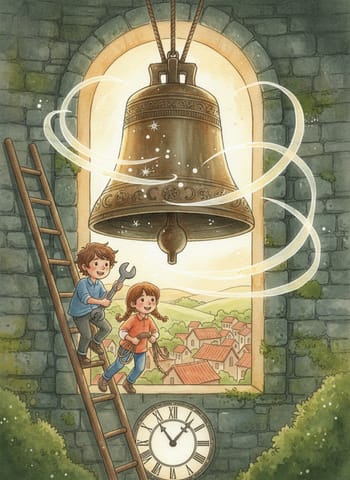
The tower has one hundred and twenty steps. By the time the girls reach the top, Calla's legs shake. A pigeon flies out of the window with an angry sound. The bell hangs in the middle of the room, large and black. A green stain runs around its edge.
La torre tiene ciento veinte escalones. Cuando las chicas llegan arriba, a Calla le tiemblan las piernas. Una paloma sale volando por la ventana con un sonido furioso. La campana cuelga en medio de la sala, grande y negra. Una mancha verde recorre su borde.
It does not look alive, but it hums very quietly. Calla feels the sound in her teeth.
No parece estar viva, pero zumba muy bajito. Calla siente el sonido en los dientes.
"It is eleven forty," Pilar says. "We have twenty minutes."
«Son las once y cuarenta», dice Pilar. «Tenemos veinte minutos».
They work fast. Calla holds the heavy clapper with both hands. Pilar ties the strap around it in a tight knot. Then Pilar holds the wooden wheel ready and checks it twice.
Trabajan rápido. Calla sostiene el pesado badajo con ambas manos. Pilar le ata la correa alrededor con un nudo apretado. Luego Pilar sostiene la rueda de madera lista y la revisa dos veces.
"If the strap holds, the bell will stay quiet until I let go," she says. "Then I count to twelve, and everything is perfect."
«Si la correa aguanta, la campana se quedará callada hasta que yo la suelte», dice. «Entonces cuento hasta doce, y todo es perfecto».
At eleven fifty-nine, the humming gets louder. The strap begins to tremble. Calla steps back and holds her breath.
A las once y cincuenta y nueve, el zumbido se hace más fuerte. La correa empieza a temblar. Calla da un paso atrás y contiene la respiración.
Pilar touches the wheel. At that moment, the strap snaps with a sharp crack, and the clapper swings free. The bell rings.
Pilar toca la rueda. En ese momento, la correa se rompe con un chasquido seco, y el badajo se libera oscilando. La campana suena.
One. Two. Three. The sound is so loud that the pigeons rise from every roof in the village. Pilar covers her ears and shouts something, but Calla cannot hear her. Four, five, six, seven, eight.
Una. Dos. Tres. El sonido es tan fuerte que las palomas se levantan de todos los techos del pueblo. Pilar se tapa los oídos y grita algo, pero Calla no la oye. Cuatro, cinco, seis, siete, ocho.
Nine.
Nueve.
Then the bell is silent again. The strap lies on the floor in two pieces, and the wheel spins slowly by itself.
Luego la campana vuelve a quedar en silencio. La correa yace en el suelo en dos pedazos, y la rueda gira despacio por sí sola.
"That did not work," Pilar says at last. Her voice sounds small in the quiet room. "I was so sure."
«Eso no funcionó», dice Pilar al fin. Su voz suena pequeña en la sala silenciosa. «Estaba tan segura».
Calla sits down on the dusty floor. "Maybe we are wrong about the bell. Maybe it does not make a mistake. Maybe it rings nine because it means nine."
Calla se sienta en el piso polvoriento. «Quizá nos equivocamos con la campana. Quizá no comete un error. Quizá suena nueve porque quiere decir nueve».
"Nine what?"
«¿Nueve qué?».
"I don't know yet." Calla thinks hard. "Last week, when the bell rang four times at noon, what happened?"
«Todavía no lo sé». Calla piensa con fuerza. «La semana pasada, cuando la campana sonó cuatro veces a mediodía, ¿qué pasó?».
Pilar frowns. "The mill door fell off, and four people carried it into the yard. I helped. We all complained that the bell was wrong again."
Pilar frunce el ceño. «Se cayó la puerta del molino, y cuatro personas la llevaron al patio. Yo ayudé. Todos nos quejamos de que la campana se había equivocado otra vez».
"And the week before, it rang six, and six of us pulled the goat out of the well." Calla jumps up. "It rings the number of helpers somebody needs. It rings the wrong time because it does not care about time."
«Y la semana anterior sonó seis, y seis de nosotros sacamos a la cabra del pozo». Calla se pone de pie de un salto. «Suena el número de ayudantes que alguien necesita. Suena a la hora equivocada porque no le importa la hora».
"That is a crazy idea." Pilar looks at her for a moment. Then she looks out of the window. "Calla. Come here."
«Esa es una idea loca». Pilar la mira un momento. Luego mira por la ventana. «Calla. Ven aquí».
From the top of the tower, they see the whole road to the stone bridge. A farmer's wagon stands in the middle of the bridge, full of heavy barrels. One wheel hangs over the edge, and the donkey sits on the stones and refuses to move. The farmer waves both arms at the empty fields.
Desde lo alto de la torre ven todo el camino hasta el puente de piedra. Una carreta de un granjero está detenida en medio del puente, llena de barriles pesados. Una rueda cuelga sobre el borde, y el burro se ha sentado sobre las piedras y se niega a moverse. El granjero agita ambos brazos hacia los campos vacíos.
"Nobody can hear him," Calla says. "The fair is on the other side of the village."
«Nadie puede oírlo», dice Calla. «La feria está al otro lado del pueblo».
"A wagon like that needs nine people to lift," Pilar says slowly. "Nine helpers."
«A una carreta así la levantan nueve personas», dice Pilar despacio. «Nueve ayudantes».
"Nine strokes." Calla grabs her friend's arm. "Our plan went wrong, but the bell did its job. Now we have to do ours."
«Nueve campanadas». Calla agarra a su amiga del brazo. «Nuestro plan salió mal, pero la campana hizo su trabajo. Ahora nos toca hacer el nuestro».
They run down the stairs two at a time. At the bottom, Calla stops and thinks. If they run to the bridge, they are only two. If they go to the fair, they will lose precious minutes.
Bajan corriendo las escaleras de dos en dos. Abajo, Calla se detiene y piensa. Si corren al puente, solo son dos. Si van a la feria, perderán minutos preciosos.
"We need seven more," she says. "Pilar, take the wheel. Turn it as fast as you can and make a loud noise at the market gate."
«Necesitamos siete más», dice. «Pilar, toma la rueda. Gírala lo más rápido que puedas y haz mucho ruido en la entrada del mercado».
"And you?"
«¿Y tú?».
"I am going to ask the whole fair for help."
«Yo voy a pedirle ayuda a toda la feria».
Pilar runs one way, spinning the wooden wheel like a rattle. The sound is dry and sharp across the square. Calla runs the other way and climbs onto the fountain at the edge of the market. The traders stop and look at her.
Pilar corre en una dirección, haciendo girar la rueda de madera como una matraca. El sonido es seco y agudo a través de la plaza. Calla corre en la otra y se sube a la fuente en el borde del mercado. Los comerciantes se detienen y la miran.
"Please listen!" she shouts. "The bell did not make a mistake. It rang nine because a wagon is stuck on the stone bridge, and the farmer needs nine helpers. We are only two. We need seven more!"
«¡Por favor, escuchen!», grita. «La campana no se equivocó. Sonó nueve porque una carreta está atascada en el puente de piedra, y el granjero necesita nueve ayudantes. Nosotras somos solo dos. ¡Necesitamos siete más!».
For a moment, nobody moves. A trader with a cart of apples laughs. Then a woman in a long coat puts down her basket and says, "Seven? That is easy." Three men from the fair follow her, and a boy runs ahead of them.
Por un momento, nadie se mueve. Un comerciante con un carrito de manzanas se ríe. Entonces una mujer con un abrigo largo deja su canasta y dice: «¿Siete? Eso es fácil». Tres hombres de la feria la siguen, y un niño corre delante de ellos.
By the time Calla reaches the bridge, five more people are running behind her. Pilar arrives with the wheel in her hand and a girl from the school. The farmer looks at them with wet eyes.
Cuando Calla llega al puente, otras cinco personas corren detrás de ella. Pilar llega con la rueda en la mano y una niña de la escuela. El granjero las mira con los ojos húmedos.
"Everybody take a place," Calla says. "On three, we lift."
«Todos ocupen un lugar», dice Calla. «A la cuenta de tres, levantamos».
They stand around the wagon in a circle. Calla counts the people with her finger. There are nine, with the farmer among them. She takes a breath.
Se paran alrededor de la carreta en círculo. Calla cuenta a las personas con el dedo. Son nueve, con el granjero entre ellos. Respira hondo.
"One, two, three!"
«¡Uno, dos, tres!».
The wagon lifts. The donkey stands up in surprise, and the wheel rolls back onto the bridge. The barrels do not lose a single drop. The farmer shakes everybody's hand twice.
La carreta se levanta. El burro se pone de pie sorprendido, y la rueda vuelve a rodar sobre el puente. Los barriles no pierden ni una gota. El granjero le estrecha la mano a todos dos veces.
"I have crossed this bridge for thirty years," he says. "No one has ever come this fast."
«He cruzado este puente durante treinta años», dice. «Nunca había venido nadie tan rápido».
On the way back, Pilar walks beside Calla and carries the broken strap. "I still want to fix the bell," she says. "Just not today."
De regreso, Pilar camina junto a Calla y lleva la correa rota. «Todavía quiero arreglar la campana», dice. «Pero hoy no».
"Maybe never," Calla answers. "Maybe a bell that tells the truth is better than a bell that tells the time."
«Quizá nunca», responde Calla. «Quizá una campana que dice la verdad es mejor que una campana que dice la hora».
Behind them, high in the tower, the bell gives one more stroke, soft and clear and short.
Detrás de ellas, en lo alto de la torre, la campana da una campanada más, suave, clara y breve.
Dong.
Dong.