Nine Strokes at Noon
A free B1-level English story for language learners, readable online in 7 languages, with an option to listen via the free Storyteller app.
Two friends try to fix a tower bell that rings the wrong number of strokes and discover what it really counts.
That was the preview! Hear the full story in the free Storyteller app. Get the app
Audio isn't available right now.
Every day at noon, the bell in the village tower rings nine times. Noon should have twelve strokes, and everybody knows it.
Calla sweeps the stairs of the tower on Saturdays, and she hates the sound. This morning she stands at the bottom with a broom and looks up at the dark wooden steps.
"Today is the fair," she says to her friend Pilar. "The traders from the next valley are coming. They hear nine strokes, and they think they are early."
"They are not the only ones," Pilar says. "Last week the miller's clock and the bell disagreed for a whole hour."
Calla laughs. "You know what my brother says. He says the bell is alive and it does this on purpose."
"I say the bell is old and nobody has looked at it for fifty years." Pilar pulls a leather strap and a wooden wheel out of her bag. "So I made a plan. We climb up before noon. We tie the clapper with this strap. Then I turn the wheel by hand, one click for each stroke, and the bell stops at twelve."
"And if it does not stop?"
"Then we try again tomorrow. The ringer is away at a wedding until Monday, so nobody will tell us no."
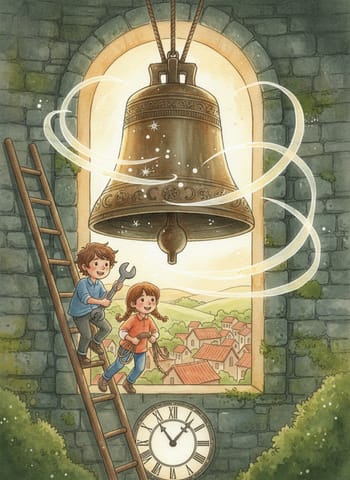
The tower has one hundred and twenty steps. By the time the girls reach the top, Calla's legs shake. A pigeon flies out of the window with an angry sound. The bell hangs in the middle of the room, large and black. A green stain runs around its edge.
It does not look alive, but it hums very quietly. Calla feels the sound in her teeth.
"It is eleven forty," Pilar says. "We have twenty minutes."
They work fast. Calla holds the heavy clapper with both hands. Pilar ties the strap around it in a tight knot. Then Pilar holds the wooden wheel ready and checks it twice.
"If the strap holds, the bell will stay quiet until I let go," she says. "Then I count to twelve, and everything is perfect."
At eleven fifty-nine, the humming gets louder. The strap begins to tremble. Calla steps back and holds her breath.
Pilar touches the wheel. At that moment, the strap snaps with a sharp crack, and the clapper swings free. The bell rings.
One. Two. Three. The sound is so loud that the pigeons rise from every roof in the village. Pilar covers her ears and shouts something, but Calla cannot hear her. Four, five, six, seven, eight.
Nine.
Then the bell is silent again. The strap lies on the floor in two pieces, and the wheel spins slowly by itself.
"That did not work," Pilar says at last. Her voice sounds small in the quiet room. "I was so sure."
Calla sits down on the dusty floor. "Maybe we are wrong about the bell. Maybe it does not make a mistake. Maybe it rings nine because it means nine."
"Nine what?"
"I don't know yet." Calla thinks hard. "Last week, when the bell rang four times at noon, what happened?"
Pilar frowns. "The mill door fell off, and four people carried it into the yard. I helped. We all complained that the bell was wrong again."
"And the week before, it rang six, and six of us pulled the goat out of the well." Calla jumps up. "It rings the number of helpers somebody needs. It rings the wrong time because it does not care about time."
"That is a crazy idea." Pilar looks at her for a moment. Then she looks out of the window. "Calla. Come here."
From the top of the tower, they see the whole road to the stone bridge. A farmer's wagon stands in the middle of the bridge, full of heavy barrels. One wheel hangs over the edge, and the donkey sits on the stones and refuses to move. The farmer waves both arms at the empty fields.
"Nobody can hear him," Calla says. "The fair is on the other side of the village."
"A wagon like that needs nine people to lift," Pilar says slowly. "Nine helpers."
"Nine strokes." Calla grabs her friend's arm. "Our plan went wrong, but the bell did its job. Now we have to do ours."
They run down the stairs two at a time. At the bottom, Calla stops and thinks. If they run to the bridge, they are only two. If they go to the fair, they will lose precious minutes.
"We need seven more," she says. "Pilar, take the wheel. Turn it as fast as you can and make a loud noise at the market gate."
"And you?"
"I am going to ask the whole fair for help."
Pilar runs one way, spinning the wooden wheel like a rattle. The sound is dry and sharp across the square. Calla runs the other way and climbs onto the fountain at the edge of the market. The traders stop and look at her.
"Please listen!" she shouts. "The bell did not make a mistake. It rang nine because a wagon is stuck on the stone bridge, and the farmer needs nine helpers. We are only two. We need seven more!"
For a moment, nobody moves. A trader with a cart of apples laughs. Then a woman in a long coat puts down her basket and says, "Seven? That is easy." Three men from the fair follow her, and a boy runs ahead of them.
By the time Calla reaches the bridge, five more people are running behind her. Pilar arrives with the wheel in her hand and a girl from the school. The farmer looks at them with wet eyes.
"Everybody take a place," Calla says. "On three, we lift."
They stand around the wagon in a circle. Calla counts the people with her finger. There are nine, with the farmer among them. She takes a breath.
"One, two, three!"
The wagon lifts. The donkey stands up in surprise, and the wheel rolls back onto the bridge. The barrels do not lose a single drop. The farmer shakes everybody's hand twice.
"I have crossed this bridge for thirty years," he says. "No one has ever come this fast."
On the way back, Pilar walks beside Calla and carries the broken strap. "I still want to fix the bell," she says. "Just not today."
"Maybe never," Calla answers. "Maybe a bell that tells the truth is better than a bell that tells the time."
Behind them, high in the tower, the bell gives one more stroke, soft and clear and short.
Dong.