Nine Strokes at Noon
Cerita bahasa Inggris gratis level B1 untuk pelajar, bisa dibaca online dalam 7 bahasa, dengan pilihan untuk mendengarkannya di aplikasi Storyteller gratis.
Two friends try to fix a tower bell that rings the wrong number of strokes and discover what it really counts.
Itu cuplikannya! Dengarkan cerita lengkapnya di aplikasi Storyteller gratis. Unduh aplikasi
Audio belum tersedia saat ini.
Every day at noon, the bell in the village tower rings nine times. Noon should have twelve strokes, and everybody knows it.
Setiap hari pada tengah hari, lonceng di menara desa berdentang sembilan kali. Seharusnya tengah hari berdentang dua belas kali, dan semua orang tahu itu.
Calla sweeps the stairs of the tower on Saturdays, and she hates the sound. This morning she stands at the bottom with a broom and looks up at the dark wooden steps.
Calla menyapu tangga menara pada hari Sabtu, dan ia benci bunyinya. Pagi ini ia berdiri di bawah dengan sapu dan memandang ke atas, ke anak tangga kayu yang gelap.
"Today is the fair," she says to her friend Pilar. "The traders from the next valley are coming. They hear nine strokes, and they think they are early."
"Hari ini hari pasar malam," katanya kepada temannya, Pilar. "Para pedagang dari lembah sebelah akan datang. Mereka mendengar sembilan dentang, dan mengira mereka datang terlalu pagi."
"They are not the only ones," Pilar says. "Last week the miller's clock and the bell disagreed for a whole hour."
"Bukan cuma mereka," kata Pilar. "Minggu lalu jam si penggiling gandum dan lonceng itu berselisih selama sejam penuh."
Calla laughs. "You know what my brother says. He says the bell is alive and it does this on purpose."
Calla tertawa. "Kamu tahu apa kata kakakku. Katanya loncengnya hidup dan sengaja berbuat begini."
"I say the bell is old and nobody has looked at it for fifty years." Pilar pulls a leather strap and a wooden wheel out of her bag. "So I made a plan. We climb up before noon. We tie the clapper with this strap. Then I turn the wheel by hand, one click for each stroke, and the bell stops at twelve."
"Kataku loncengnya tua dan tidak ada yang memeriksanya selama lima puluh tahun." Pilar menarik sebuah tali kulit dan roda kayu dari tasnya. "Jadi aku membuat rencana. Kita naik sebelum tengah hari. Kita ikat pemukulnya dengan tali ini. Lalu aku memutar roda ini dengan tangan, satu klik untuk setiap dentang, dan lonceng berhenti pada angka dua belas."
"And if it does not stop?"
"Dan kalau tidak berhenti?"
"Then we try again tomorrow. The ringer is away at a wedding until Monday, so nobody will tell us no."
"Ya kita coba lagi besok. Si petugas lonceng pergi ke pesta pernikahan sampai hari Senin, jadi tidak ada yang akan melarang kita."
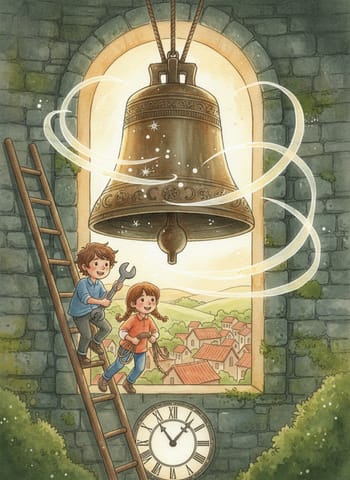
The tower has one hundred and twenty steps. By the time the girls reach the top, Calla's legs shake. A pigeon flies out of the window with an angry sound. The bell hangs in the middle of the room, large and black. A green stain runs around its edge.
Menara itu punya seratus dua puluh anak tangga. Saat kedua gadis itu sampai di puncak, kaki Calla gemetar. Seekor merpati terbang keluar dari jendela dengan bunyi marah. Lonceng itu menggantung di tengah ruangan, besar dan hitam. Noda hijau mengitari tepinya.
It does not look alive, but it hums very quietly. Calla feels the sound in her teeth.
Lonceng itu tidak tampak hidup, tetapi ia berdengung sangat pelan. Calla merasakan bunyinya di giginya.
"It is eleven forty," Pilar says. "We have twenty minutes."
"Pukul sebelas empat puluh," kata Pilar. "Kita punya dua puluh menit."
They work fast. Calla holds the heavy clapper with both hands. Pilar ties the strap around it in a tight knot. Then Pilar holds the wooden wheel ready and checks it twice.
Mereka bekerja cepat. Calla memegang pemukul yang berat itu dengan kedua tangan. Pilar mengikatkan tali di sekelilingnya dengan simpul erat. Lalu Pilar menyiapkan roda kayu itu dan memeriksanya dua kali.
"If the strap holds, the bell will stay quiet until I let go," she says. "Then I count to twelve, and everything is perfect."
"Kalau talinya kuat, lonceng akan diam sampai aku melepaskannya," katanya. "Lalu aku menghitung sampai dua belas, dan semuanya sempurna."
At eleven fifty-nine, the humming gets louder. The strap begins to tremble. Calla steps back and holds her breath.
Pada pukul sebelas lewat lima puluh sembilan, dengungnya makin keras. Tali itu mulai bergetar. Calla melangkah mundur dan menahan napas.
Pilar touches the wheel. At that moment, the strap snaps with a sharp crack, and the clapper swings free. The bell rings.
Pilar menyentuh roda. Saat itu juga, tali itu putus dengan bunyi retak tajam, dan pemukul itu berayun bebas. Lonceng berbunyi.
One. Two. Three. The sound is so loud that the pigeons rise from every roof in the village. Pilar covers her ears and shouts something, but Calla cannot hear her. Four, five, six, seven, eight.
Satu. Dua. Tiga. Bunyinya begitu keras sampai merpati-merpati beterbangan dari setiap atap di desa. Pilar menutup telinganya dan berteriak sesuatu, tetapi Calla tidak bisa mendengarnya. Empat, lima, enam, tujuh, delapan.
Nine.
Sembilan.
Then the bell is silent again. The strap lies on the floor in two pieces, and the wheel spins slowly by itself.
Lalu lonceng itu sunyi lagi. Tali itu tergeletak di lantai dalam dua potong, dan roda itu berputar pelan dengan sendirinya.
"That did not work," Pilar says at last. Her voice sounds small in the quiet room. "I was so sure."
"Tidak berhasil," kata Pilar akhirnya. Suaranya terdengar kecil di ruangan yang sunyi. "Padahal aku yakin sekali."
Calla sits down on the dusty floor. "Maybe we are wrong about the bell. Maybe it does not make a mistake. Maybe it rings nine because it means nine."
Calla duduk di lantai yang berdebu. "Mungkin kita salah soal lonceng ini. Mungkin ia tidak membuat kesalahan. Mungkin ia berdentang sembilan kali karena memang maksudnya sembilan."
"Nine what?"
"Sembilan apa?"
"I don't know yet." Calla thinks hard. "Last week, when the bell rang four times at noon, what happened?"
"Aku belum tahu." Calla berpikir keras. "Minggu lalu, ketika lonceng berdentang empat kali pada tengah hari, apa yang terjadi?"
Pilar frowns. "The mill door fell off, and four people carried it into the yard. I helped. We all complained that the bell was wrong again."
Pilar mengerutkan kening. "Pintu penggilingan lepas, dan empat orang mengangkatnya ke halaman. Aku membantu. Kami semua mengeluh bahwa lonceng itu salah lagi."
"And the week before, it rang six, and six of us pulled the goat out of the well." Calla jumps up. "It rings the number of helpers somebody needs. It rings the wrong time because it does not care about time."
"Dan minggu sebelumnya, ia berdentang enam kali, dan enam orang dari kita menarik kambing keluar dari sumur." Calla melompat berdiri. "Ia berdentang sebanyak jumlah penolong yang dibutuhkan seseorang. Ia berdentang pada waktu yang salah karena ia tidak peduli pada waktu."
"That is a crazy idea." Pilar looks at her for a moment. Then she looks out of the window. "Calla. Come here."
"Itu ide gila." Pilar menatapnya sesaat. Lalu ia memandang ke luar jendela. "Calla. Ke sini."
From the top of the tower, they see the whole road to the stone bridge. A farmer's wagon stands in the middle of the bridge, full of heavy barrels. One wheel hangs over the edge, and the donkey sits on the stones and refuses to move. The farmer waves both arms at the empty fields.
Dari puncak menara, mereka melihat seluruh jalan menuju jembatan batu. Sebuah pedati petani berhenti di tengah jembatan, penuh tong-tong berat. Satu rodanya menggantung di tepi, dan keledainya duduk di atas batu dan menolak bergerak. Si petani melambaikan kedua lengannya ke ladang-ladang yang kosong.
"Nobody can hear him," Calla says. "The fair is on the other side of the village."
"Tidak ada yang bisa mendengarnya," kata Calla. "Pasar malamnya ada di sisi lain desa."
"A wagon like that needs nine people to lift," Pilar says slowly. "Nine helpers."
"Pedati seperti itu butuh sembilan orang untuk mengangkatnya," kata Pilar pelan. "Sembilan penolong."
"Nine strokes." Calla grabs her friend's arm. "Our plan went wrong, but the bell did its job. Now we have to do ours."
"Sembilan dentang." Calla meraih lengan temannya. "Rencana kita gagal, tapi lonceng itu menjalankan tugasnya. Sekarang kita harus menjalankan tugas kita."
They run down the stairs two at a time. At the bottom, Calla stops and thinks. If they run to the bridge, they are only two. If they go to the fair, they will lose precious minutes.
Mereka berlari menuruni tangga, dua anak tangga sekaligus. Di bawah, Calla berhenti dan berpikir. Kalau mereka berlari ke jembatan, mereka hanya berdua. Kalau mereka pergi ke pasar malam, mereka akan kehilangan menit-menit berharga.
"We need seven more," she says. "Pilar, take the wheel. Turn it as fast as you can and make a loud noise at the market gate."
"Kita butuh tujuh lagi," katanya. "Pilar, bawa rodanya. Putar secepat mungkin dan buat bunyi keras di gerbang pasar."
"And you?"
"Dan kamu?"
"I am going to ask the whole fair for help."
"Aku akan meminta bantuan seluruh pasar."
Pilar runs one way, spinning the wooden wheel like a rattle. The sound is dry and sharp across the square. Calla runs the other way and climbs onto the fountain at the edge of the market. The traders stop and look at her.
Pilar berlari ke satu arah, memutar roda kayu itu seperti kerincingan. Bunyinya kering dan tajam di seberang alun-alun. Calla berlari ke arah lain dan memanjat air mancur di tepi pasar. Para pedagang berhenti dan menatapnya.
"Please listen!" she shouts. "The bell did not make a mistake. It rang nine because a wagon is stuck on the stone bridge, and the farmer needs nine helpers. We are only two. We need seven more!"
"Tolong dengarkan!" teriaknya. "Lonceng itu tidak salah. Ia berdentang sembilan kali karena sebuah pedati terjebak di jembatan batu, dan si petani butuh sembilan penolong. Kami baru berdua. Kami butuh tujuh lagi!"
For a moment, nobody moves. A trader with a cart of apples laughs. Then a woman in a long coat puts down her basket and says, "Seven? That is easy." Three men from the fair follow her, and a boy runs ahead of them.
Sesaat tak seorang pun bergerak. Seorang pedagang dengan gerobak apel tertawa. Lalu seorang perempuan berjas panjang menurunkan keranjangnya dan berkata, "Tujuh? Gampang." Tiga pria dari pasar mengikutinya, dan seorang anak laki-laki berlari mendahului mereka.
By the time Calla reaches the bridge, five more people are running behind her. Pilar arrives with the wheel in her hand and a girl from the school. The farmer looks at them with wet eyes.
Saat Calla sampai di jembatan, lima orang lagi berlari di belakangnya. Pilar tiba dengan roda di tangannya dan seorang gadis dari sekolah. Si petani menatap mereka dengan mata basah.
"Everybody take a place," Calla says. "On three, we lift."
"Semua ambil posisi," kata Calla. "Pada hitungan ketiga, kita angkat."
They stand around the wagon in a circle. Calla counts the people with her finger. There are nine, with the farmer among them. She takes a breath.
Mereka berdiri mengelilingi pedati membentuk lingkaran. Calla menghitung orang-orang itu dengan jarinya. Ada sembilan, termasuk si petani. Ia menarik napas.
"One, two, three!"
"Satu, dua, tiga!"
The wagon lifts. The donkey stands up in surprise, and the wheel rolls back onto the bridge. The barrels do not lose a single drop. The farmer shakes everybody's hand twice.
Pedati itu terangkat. Keledai itu berdiri karena terkejut, dan roda itu menggelinding kembali ke atas jembatan. Tong-tong itu tidak kehilangan setetes pun. Si petani menjabat tangan semua orang dua kali.
"I have crossed this bridge for thirty years," he says. "No one has ever come this fast."
"Sudah tiga puluh tahun saya melintasi jembatan ini," katanya. "Belum pernah ada yang datang secepat ini."
On the way back, Pilar walks beside Calla and carries the broken strap. "I still want to fix the bell," she says. "Just not today."
Dalam perjalanan kembali, Pilar berjalan di samping Calla sambil membawa tali yang putus. "Aku masih ingin memperbaiki lonceng itu," katanya. "Hanya saja tidak hari ini."
"Maybe never," Calla answers. "Maybe a bell that tells the truth is better than a bell that tells the time."
"Mungkin tidak pernah," jawab Calla. "Mungkin lonceng yang mengatakan kebenaran lebih baik daripada lonceng yang menunjukkan waktu."
Behind them, high in the tower, the bell gives one more stroke, soft and clear and short.
Di belakang mereka, tinggi di dalam menara, lonceng itu berdentang sekali lagi, lembut dan jernih dan singkat.
Dong.
Dong.