Nine Strokes at Noon
Uma história gratuita em inglês de nível B1 para estudantes, para ler online em 7 idiomas, com opção de ouvir no app gratuito Storyteller.
Two friends try to fix a tower bell that rings the wrong number of strokes and discover what it really counts.
Essa foi a prévia! Ouça a história completa no app gratuito Storyteller. Baixar o app
O áudio não está disponível no momento.
Every day at noon, the bell in the village tower rings nine times. Noon should have twelve strokes, and everybody knows it.
Todos os dias ao meio-dia, o sino da torre da aldeia toca nove vezes. O meio-dia deveria ter doze badaladas, e todo mundo sabe disso.
Calla sweeps the stairs of the tower on Saturdays, and she hates the sound. This morning she stands at the bottom with a broom and looks up at the dark wooden steps.
Calla varre as escadas da torre aos sábados, e odeia o som. Nesta manhã, ela está embaixo com uma vassoura e olha para os degraus escuros de madeira.
"Today is the fair," she says to her friend Pilar. "The traders from the next valley are coming. They hear nine strokes, and they think they are early."
"Hoje é a feira", diz ela à amiga Pilar. "Os comerciantes do vale vizinho vão chegar. Eles ouvem nove badaladas e pensam que chegaram cedo."
"They are not the only ones," Pilar says. "Last week the miller's clock and the bell disagreed for a whole hour."
"Não são os únicos", diz Pilar. "Semana passada o relógio do moleiro e o sino discordaram por uma hora inteira."
Calla laughs. "You know what my brother says. He says the bell is alive and it does this on purpose."
Calla ri. "Você sabe o que meu irmão diz. Ele diz que o sino é vivo e faz isso de propósito."
"I say the bell is old and nobody has looked at it for fifty years." Pilar pulls a leather strap and a wooden wheel out of her bag. "So I made a plan. We climb up before noon. We tie the clapper with this strap. Then I turn the wheel by hand, one click for each stroke, and the bell stops at twelve."
"Eu digo que o sino é velho e ninguém olha para ele há cinquenta anos." Pilar tira da bolsa uma tira de couro e uma roda de madeira. "Então fiz um plano. Subimos antes do meio-dia. Amarramos o badalo com esta tira. Aí eu giro a roda à mão, um estalo para cada badalada, e o sino para em doze."
"And if it does not stop?"
"E se não parar?"
"Then we try again tomorrow. The ringer is away at a wedding until Monday, so nobody will tell us no."
"Então tentamos de novo amanhã. O sineiro está num casamento até segunda, então ninguém vai nos dizer não."
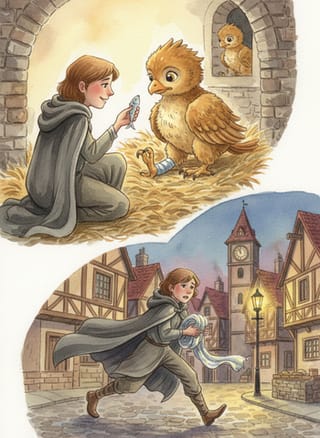
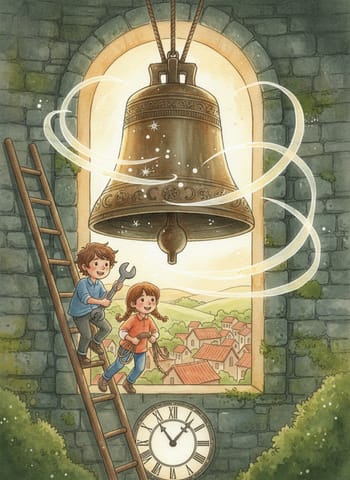
The tower has one hundred and twenty steps. By the time the girls reach the top, Calla's legs shake. A pigeon flies out of the window with an angry sound. The bell hangs in the middle of the room, large and black. A green stain runs around its edge.
A torre tem cento e vinte degraus. Quando as meninas chegam ao topo, as pernas de Calla tremem. Um pombo sai voando pela janela com um som irritado. O sino pende no meio da sala, grande e preto. Uma mancha verde corre ao redor da borda.
It does not look alive, but it hums very quietly. Calla feels the sound in her teeth.
Ele não parece vivo, mas zumbe bem baixinho. Calla sente o som nos dentes.
"It is eleven forty," Pilar says. "We have twenty minutes."
"São onze e quarenta", diz Pilar. "Temos vinte minutos."
They work fast. Calla holds the heavy clapper with both hands. Pilar ties the strap around it in a tight knot. Then Pilar holds the wooden wheel ready and checks it twice.
Elas trabalham depressa. Calla segura o pesado badalo com as duas mãos. Pilar amarra a tira em volta dele com um nó apertado. Depois Pilar segura a roda de madeira pronta e confere duas vezes.
"If the strap holds, the bell will stay quiet until I let go," she says. "Then I count to twelve, and everything is perfect."
"Se a tira aguentar, o sino ficará quieto até eu soltar", diz ela. "Então eu conto até doze, e tudo fica perfeito."
At eleven fifty-nine, the humming gets louder. The strap begins to tremble. Calla steps back and holds her breath.
Às onze e cinquenta e nove, o zumbido fica mais alto. A tira começa a tremer. Calla recua e prende a respiração.
Pilar touches the wheel. At that moment, the strap snaps with a sharp crack, and the clapper swings free. The bell rings.
Pilar toca a roda. Nesse momento, a tira se rompe com um estalo seco, e o badalo balança livre. O sino toca.
One. Two. Three. The sound is so loud that the pigeons rise from every roof in the village. Pilar covers her ears and shouts something, but Calla cannot hear her. Four, five, six, seven, eight.
Um. Dois. Três. O som é tão alto que os pombos levantam voo de todos os telhados da aldeia. Pilar tapa os ouvidos e grita algo, mas Calla não consegue ouvir. Quatro, cinco, seis, sete, oito.
Nine.
Nove.
Then the bell is silent again. The strap lies on the floor in two pieces, and the wheel spins slowly by itself.
Então o sino fica em silêncio de novo. A tira jaz no chão em dois pedaços, e a roda gira devagar sozinha.
"That did not work," Pilar says at last. Her voice sounds small in the quiet room. "I was so sure."
"Isso não deu certo", diz Pilar por fim. Sua voz parece pequena na sala quieta. "Eu tinha tanta certeza."
Calla sits down on the dusty floor. "Maybe we are wrong about the bell. Maybe it does not make a mistake. Maybe it rings nine because it means nine."
Calla se senta no chão empoeirado. "Talvez a gente esteja errada sobre o sino. Talvez ele não cometa erro. Talvez toque nove porque quer dizer nove."
"Nine what?"
"Nove o quê?"
"I don't know yet." Calla thinks hard. "Last week, when the bell rang four times at noon, what happened?"
"Ainda não sei." Calla pensa com força. "Semana passada, quando o sino tocou quatro vezes ao meio-dia, o que aconteceu?"
Pilar frowns. "The mill door fell off, and four people carried it into the yard. I helped. We all complained that the bell was wrong again."
Pilar franze a testa. "A porta do moinho caiu, e quatro pessoas a carregaram para o pátio. Eu ajudei. Todos reclamamos que o sino estava errado de novo."
"And the week before, it rang six, and six of us pulled the goat out of the well." Calla jumps up. "It rings the number of helpers somebody needs. It rings the wrong time because it does not care about time."
"E na semana anterior, tocou seis, e seis de nós tiramos a cabra do poço." Calla se levanta num salto. "Ele toca o número de ajudantes que alguém precisa. Toca na hora errada porque não se importa com a hora."
"That is a crazy idea." Pilar looks at her for a moment. Then she looks out of the window. "Calla. Come here."
"Que ideia maluca." Pilar a olha por um momento. Depois olha pela janela. "Calla. Venha cá."
From the top of the tower, they see the whole road to the stone bridge. A farmer's wagon stands in the middle of the bridge, full of heavy barrels. One wheel hangs over the edge, and the donkey sits on the stones and refuses to move. The farmer waves both arms at the empty fields.
Do alto da torre, elas veem toda a estrada até a ponte de pedra. A carroça de um fazendeiro está parada no meio da ponte, cheia de barris pesados. Uma roda pende sobre a borda, e o burro se sentou nas pedras e se recusa a andar. O fazendeiro acena com os dois braços para os campos vazios.
"Nobody can hear him," Calla says. "The fair is on the other side of the village."
"Ninguém consegue ouvi-lo", diz Calla. "A feira fica do outro lado da aldeia."
"A wagon like that needs nine people to lift," Pilar says slowly. "Nine helpers."
"Uma carroça assim precisa de nove pessoas para levantar", diz Pilar devagar. "Nove ajudantes."
"Nine strokes." Calla grabs her friend's arm. "Our plan went wrong, but the bell did its job. Now we have to do ours."
"Nove badaladas." Calla agarra o braço da amiga. "Nosso plano deu errado, mas o sino fez o trabalho dele. Agora temos que fazer o nosso."
They run down the stairs two at a time. At the bottom, Calla stops and thinks. If they run to the bridge, they are only two. If they go to the fair, they will lose precious minutes.
Elas descem as escadas de dois em dois degraus. Embaixo, Calla para e pensa. Se correrem para a ponte, serão só duas. Se forem à feira, perderão minutos preciosos.
"We need seven more," she says. "Pilar, take the wheel. Turn it as fast as you can and make a loud noise at the market gate."
"Precisamos de mais sete", diz ela. "Pilar, pegue a roda. Gire o mais rápido que puder e faça um barulho alto no portão do mercado."
"And you?"
"E você?"
"I am going to ask the whole fair for help."
"Vou pedir ajuda para a feira inteira."
Pilar runs one way, spinning the wooden wheel like a rattle. The sound is dry and sharp across the square. Calla runs the other way and climbs onto the fountain at the edge of the market. The traders stop and look at her.
Pilar corre para um lado, girando a roda de madeira como uma matraca. O som é seco e agudo pela praça. Calla corre para o outro e sobe na fonte na beira do mercado. Os comerciantes param e olham para ela.
"Please listen!" she shouts. "The bell did not make a mistake. It rang nine because a wagon is stuck on the stone bridge, and the farmer needs nine helpers. We are only two. We need seven more!"
"Por favor, escutem!", grita ela. "O sino não cometeu erro. Tocou nove porque uma carroça está presa na ponte de pedra, e o fazendeiro precisa de nove ajudantes. Somos só duas. Precisamos de mais sete!"
For a moment, nobody moves. A trader with a cart of apples laughs. Then a woman in a long coat puts down her basket and says, "Seven? That is easy." Three men from the fair follow her, and a boy runs ahead of them.
Por um momento, ninguém se move. Um comerciante com um carrinho de maçãs ri. Então uma mulher de casaco comprido põe a cesta no chão e diz: "Sete? Isso é fácil." Três homens da feira a seguem, e um menino corre na frente deles.
By the time Calla reaches the bridge, five more people are running behind her. Pilar arrives with the wheel in her hand and a girl from the school. The farmer looks at them with wet eyes.
Quando Calla chega à ponte, mais cinco pessoas correm atrás dela. Pilar chega com a roda na mão e uma menina da escola. O fazendeiro olha para eles com os olhos úmidos.
"Everybody take a place," Calla says. "On three, we lift."
"Cada um assuma um lugar", diz Calla. "No três, levantamos."
They stand around the wagon in a circle. Calla counts the people with her finger. There are nine, with the farmer among them. She takes a breath.
Eles se posicionam ao redor da carroça num círculo. Calla conta as pessoas com o dedo. São nove, contando o fazendeiro. Ela respira fundo.
"One, two, three!"
"Um, dois, três!"
The wagon lifts. The donkey stands up in surprise, and the wheel rolls back onto the bridge. The barrels do not lose a single drop. The farmer shakes everybody's hand twice.
A carroça se ergue. O burro se levanta surpreso, e a roda volta rolando para a ponte. Os barris não perdem uma única gota. O fazendeiro aperta a mão de todos duas vezes.
"I have crossed this bridge for thirty years," he says. "No one has ever come this fast."
"Atravesso esta ponte há trinta anos", diz ele. "Nunca ninguém veio tão rápido."
On the way back, Pilar walks beside Calla and carries the broken strap. "I still want to fix the bell," she says. "Just not today."
No caminho de volta, Pilar anda ao lado de Calla e carrega a tira rompida. "Ainda quero consertar o sino", diz. "Só que não hoje."
"Maybe never," Calla answers. "Maybe a bell that tells the truth is better than a bell that tells the time."
"Talvez nunca", responde Calla. "Talvez um sino que diz a verdade seja melhor que um sino que diz a hora."
Behind them, high in the tower, the bell gives one more stroke, soft and clear and short.
Atrás delas, no alto da torre, o sino dá mais uma badalada, suave, clara e curta.
Dong.
Dong.