The Two Lamps in the Binoculars
A free B1-level English story for language learners, readable online in 7 languages, with an option to listen via the free Storyteller app.
After an observatory open night, a volunteer looks through old binoculars and must choose which of two distant lamps to answer.
That was the preview! Hear the full story in the free Storyteller app. Get the app
Audio isn't available right now.
Frida had one rule about the old binoculars in the drawer. Nobody touched them until the last visitor had gone home.
Caspian had worked at the observatory for six weeks, and he had not yet seen them used. They were heavy and black, with brass rings round the lenses. Whenever he cleaned the office, he lifted them out, polished them and put them back. Frida always watched him do it with a small, odd smile.
"Why can't I try them?" he asked once.
"Not yet," Frida said. "They are not for open nights. They are for after open nights."
Tonight was the biggest open night of the year. The sky was clear, and the car park on the hill was already full by seven o'clock. Families walked up the path with flasks and blankets. Children ran ahead with paper star maps. Caspian stood at the door in his blue jacket and counted people until he lost count.
The main telescope stood under the great dome. Frida had pointed it at Saturn, and the queue reached all the way to the stairs. Caspian's job was to move people along. He had to keep them happy while they waited. He also had to stop them touching the mirror.
"Is that really Saturn?" asked a small girl near the front.
"It really is," Caspian said. "The light you will see has travelled for more than an hour to reach us."
"Then it's old," the girl said.
"Very old," he said. "But it still looks fresh when it arrives."
She seemed to like that answer. She climbed the little steps, looked into the eyepiece and stayed there far too long. Her mother had to lift her away. Her mouth was open, and she did not say anything for a full minute.
By ten o'clock Caspian's feet ached. The last family left at a quarter to eleven, carrying a sleepy boy on a shoulder. The dome fell quiet, and the cooling machines hummed softly in the walls.
Frida switched off the big lights. In the dark she said, "Now. Bring the binoculars."
Caspian hurried to the office and returned with the heavy case. His hands were not quite steady. Frida led him outside to the stone terrace, where the whole night sky stretched over the valley.
"Before you look," she said, "I must explain something. These binoculars do not show you stars."
"What do they show?" Caspian asked.
"Other watchers," Frida said. "Somewhere far away, people stand on their own hills at night, and they look at the sky too. Through this glass, you can see their lamps."
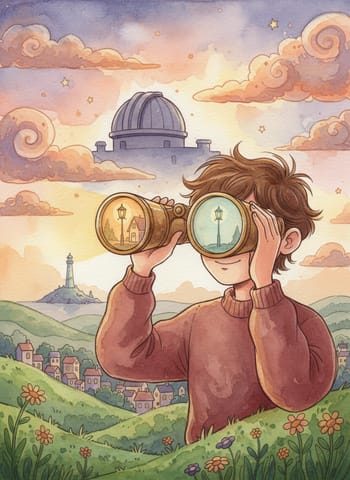
Caspian laughed. Then he saw that she was not joking. He lifted the binoculars to his eyes.
At first, he saw only the usual black and silver. Then, slowly, something changed. Among the stars he found tiny points of light that were not quite stars. They were warmer. They blinked, and each one had its own rhythm. There were dozens of them, scattered like fireflies over the whole sky.
"They're beautiful," he whispered.
"They are lonely," Frida said gently. "That is why we have the torch."
She handed him a small, plain torch from her pocket. "The glass carries one answer a night. You choose one lamp and flash a message to it. Then the glass goes dark until tomorrow. I have used it thirty-one times, and I have always chosen carefully."
"How do I choose?" Caspian asked.
"I can't tell you," Frida said. "I can only tell you that tonight I will not say a word."
She sat on a low wall and folded her arms.
Caspian looked again. Most of the lamps were faint and flickering. Two of them were different. One hung low over the eastern hills, big and golden, and it burned steadily like a lighthouse. The other lay far away to the north. It was small and pale. It blinked three short times and then one long time, over and over.
Both seemed like good choices. That was the trouble.
He studied the golden lamp first. It was so bright that his eyes watered, and its light felt friendly. When he looked longer, he noticed thin threads of light rising towards it from other places. Other watchers were already answering it. The sky around that lamp was crowded with replies, flashing and flickering.
"That one is popular," he said.
"Yes," Frida said from the wall.
"It must be a good place," he said. "If I answer, they will see me for sure. And I will join the others."
"That is true," Frida said.
He turned to the small lamp in the north. Nothing rose towards it. No threads of light, no replies, and no crowd. It simply blinked three short and one long, as if it were asking a question. Then it asked again.
Caspian lowered the binoculars and rubbed his eyes. His hands were cold. "How long has it been asking?" he said.
"I don't know," Frida said. "I have seen it three times this year. It was there last night, too."
"And no one has answered?"
"No one that I have seen," she said.
He thought about the golden lamp, which was strong and happy and sure of itself. It did not need him. It would shine tomorrow, and it would shine the next day. A hundred other watchers would flash their torches before dawn.
Then he thought about the small lamp. Three short, one long. It had asked the same question all evening, like someone knocking on a door.
"If I choose the golden one," he said slowly, "I know I will be one of many. It would be nice, but I would be easy to forget. If I choose the small one, I might be the first."
"The first to do what?" Frida asked.
"To say we heard," he said.
He raised the binoculars again and found the pale lamp. He held the torch against the lens, as Frida showed him with a nod, and pressed the button. He flashed three short times. Then he held the light for one long breath.
For a moment, nothing changed. The lamp kept blinking its usual pattern. Caspian's stomach dropped.
Then the small lamp stopped. It stayed dark for two whole seconds. Suddenly it flared twice, very fast, bright as a struck match.
Caspian gasped. The lamp flared again, and the binoculars went suddenly heavy and cold in his hands. The golden lamp and all the other lights vanished. There was only the plain night sky and the stars.
"It saw me," he said. His voice shook. "Frida, it saw me. Did you see that?"
"I saw your face," Frida said. She stood up, and she was smiling properly now. "That was enough."
"Why did you never tell me which one to choose?" Caspian asked.
"Because now," Frida said, "whatever it is asking, you are the one who answered."