The Brush with Three Hairs
Una historia gratuita en inglés de nivel B1 para estudiantes, para leer en línea en 7 idiomas, con opción de escucharla en la app gratuita Storyteller.
Two apprentices find an odd brush that brings paintings to life just before the biggest festival of the year.
¡Ese fue el avance! Escucha la historia completa en la app gratuita Storyteller. Descargar la app
El audio no está disponible en este momento.
On the day of the Lantern Festival, the workshop smelled of glue and warm paper. Lars sat at the long table with a pot of ink and a stack of plain lanterns. Across from him, Yusra painted silver stars on a blue one without looking up.
El día del Festival de los Faroles, el taller olía a pegamento y a papel tibio. Lars estaba sentado a la larga mesa con un tintero y una pila de faroles lisos. Frente a él, Yusra pintaba estrellas plateadas en uno azul sin levantar la vista.
They had painted since sunrise. The master had left early for the harbour, where the great festival lantern needed hanging. Before he went, he put a list on the wall. It said that one hundred and twenty small lanterns must be ready by dusk.
Llevaban pintando desde el amanecer. El maestro se había ido temprano al puerto, donde había que colgar el gran farol del festival. Antes de irse, puso una lista en la pared. Decía que ciento veinte faroles pequeños debían estar listos al anochecer.
"How many have we finished?" Lars asked.
«¿Cuántos hemos terminado?», preguntó Lars.
"Eighty-one," Yusra said. "I counted twice. Do not ask me again."
«Ochenta y uno», dijo Yusra. «Los conté dos veces. No me lo vuelvas a preguntar».
Lars sighed and painted another moon. It was his fortieth moon of the day, and it looked exactly like the other thirty-nine. His wrist hurt, and his brush was falling apart. The tip had split into three loose bits, and the ink ran in lines instead of curves.
Lars suspiró y pintó otra luna. Era su luna número cuarenta del día, y se parecía exactamente a las otras treinta y nueve. Le dolía la muñeca, y su pincel se estaba deshaciendo. La punta se había partido en tres pedazos sueltos, y la tinta salía en líneas en vez de curvas.
"I need a new brush," he said.
«Necesito un pincel nuevo», dijo.
"The spare ones are in the old jar by the window," Yusra said. "Take the best one."
«Los de repuesto están en el jarrón viejo junto a la ventana», dijo Yusra. «Toma el mejor».
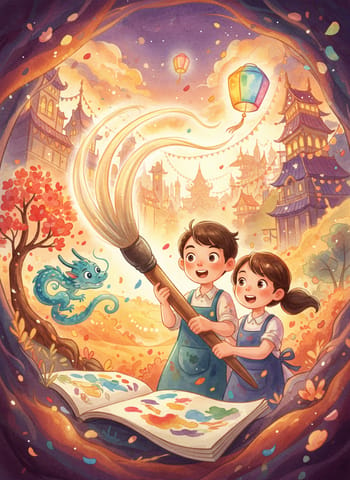
Lars walked across the room and tipped the jar over his hand. Dusty brushes fell out. Most had bent handles or hard, dry tips. At the very bottom lay a thin brush of dark wood. It was so light that he almost missed it.
Lars cruzó la sala y volcó el jarrón sobre su mano. Cayeron pinceles polvorientos. La mayoría tenía el mango torcido o las puntas duras y secas. Justo en el fondo había un pincel fino de madera oscura. Era tan liviano que casi no lo notó.
He held it up to the window. It had only three hairs. One was silver, one was gold, and one was black as a crow's feather.
Lo levantó hacia la ventana. Tenía solo tres pelos. Uno era plateado, uno dorado y uno negro como la pluma de un cuervo.
"That is not a brush," Yusra said. "That is a joke."
«Eso no es un pincel», dijo Yusra. «Es una broma».
"Maybe. But it is thin enough for small work." Lars dipped it in the ink and tried it on a spoiled lantern. The paper had a crack. He painted a little fish with a curved tail, and he gave it one round eye.
«Quizás. Pero es lo bastante fino para trabajos pequeños». Lars lo mojó en la tinta y lo probó en un farol echado a perder. El papel tenía una grieta. Pintó un pececito con la cola curva, y le dio un ojo redondo.
The ink was still wet when the fish moved.
La tinta todavía estaba húmeda cuando el pez se movió.
It happened slowly. First the tail twitched. Then the whole fish pulled away from the paper, shining, and hung in the air above the table. It was as small as his thumb. It turned once in a circle and looked at him with its round eye. Then it swam towards Yusra's nose.
Ocurrió despacio. Primero se agitó la cola. Luego todo el pez se despegó del papel, brillante, y quedó suspendido en el aire sobre la mesa. Era tan pequeño como su pulgar. Dio una vuelta en círculo y lo miró con su ojo redondo. Luego nadó hacia la nariz de Yusra.
Yusra dropped her brush.
Yusra soltó su pincel.
"Lars," she whispered. "Did you do that?"
«Lars», susurró. «¿Tú hiciste eso?».
"I only painted it," he said. His voice shook. "I did not know it would do that."
«Solo lo pinté», dijo él. La voz le temblaba. «No sabía que haría eso».
The fish flew a lazy circle around the lamp above them. Then it landed on the edge of the ink pot. It looked quite happy. Neither of them dared to breathe.
El pez voló en un círculo perezoso alrededor de la lámpara que tenían encima. Luego se posó en el borde del tintero. Parecía bastante feliz. Ninguno de los dos se atrevía a respirar.
"Try again," Yusra said at last. "But try something small."
«Prueba otra vez», dijo Yusra al fin. «Pero algo pequeño».
Lars chose a spare lantern and used only the silver hair. He drew a simple line, a short curve that might be a lamp. The line began to glow, as soft and white as the moon. When he touched the paper, it was cool.
Lars eligió un farol de repuesto y usó solo el pelo plateado. Trazó una línea sencilla, una curva corta que podría ser una lámpara. La línea empezó a brillar, suave y blanca como la luna. Cuando tocó el papel, estaba fresco.
"That one gives light," Yusra said. She took the brush from him and tried the gold hair on a leaf. The leaf turned green and warm, and it curled its stem around her finger like a tiny hand.
«Ese da luz», dijo Yusra. Le quitó el pincel y probó el pelo dorado en una hoja. La hoja se volvió verde y tibia, y enroscó su tallo en su dedo como una manita.
"The gold one gives life," she said, laughing. "And the black one?"
«El dorado da vida», dijo, riendo. «¿Y el negro?».
"I am not sure I want to know."
«No estoy seguro de querer saberlo».
But she dipped the black hair anyway, and she drew a short, dark line on the wall. At once a shadow came away from the paint. It was a mouse's shadow, small and fast. It ran along the floor and vanished under the door.
Pero ella mojó el pelo negro de todos modos, y trazó una línea corta y oscura en la pared. De inmediato se desprendió una sombra de la pintura. Era la sombra de un ratón, pequeña y veloz. Corrió por el suelo y desapareció bajo la puerta.
"Well," said Yusra. "The black one is for shadows."
«Pues», dijo Yusra. «El negro es para las sombras».
For a few minutes they forgot the festival. They painted tiny stars that floated, and a moth that carried its own light. The room filled with soft, moving colours. Lars had never been so happy.
Durante unos minutos olvidaron el festival. Pintaron diminutas estrellas que flotaban, y una polilla que llevaba su propia luz. La sala se llenó de colores suaves y móviles. Lars nunca había sido tan feliz.
Then he looked at the wall. The list was still there, and the sun was lower than before.
Entonces miró la pared. La lista seguía ahí, y el sol estaba más bajo que antes.
"We have thirty-nine lanterns left," he said. "And no time."
«Nos quedan treinta y nueve faroles», dijo. «Y no tenemos tiempo».
"And the fish is gone."
«Y el pez se fue».
He turned. The little fish was no longer on the ink pot. The window stood open, and a cool breeze moved the curtain. Far away, over the roofs, a spark of silver was flying towards the harbour.
Se volvió. El pececito ya no estaba en el tintero. La ventana estaba abierta, y una brisa fresca movía la cortina. A lo lejos, sobre los tejados, una chispa plateada volaba hacia el puerto.
"Oh, no," Lars said. "The master will see it. He will want to know what we did."
«Ay, no», dijo Lars. «El maestro lo verá. Querrá saber qué hicimos».
"If it follows the lanterns, it will go to the festival." Yusra was already pulling a wooden cart from the corner. "We cannot leave it. Somebody might catch it and break it."
«Si sigue a los faroles, irá al festival». Yusra ya estaba sacando un carro de madera del rincón. «No podemos dejarlo. Alguien podría atraparlo y romperlo».
"And the thirty-nine lanterns?"
«¿Y los treinta y nueve faroles?».
"We take them with us. We can paint on the cart."
«Nos los llevamos. Podemos pintar en el carro».
They loaded the lanterns into boxes and ran down the hill, with the cart bumping over the cobbles. The streets were full of people hanging ribbons, and nobody noticed two apprentices running past. Lars held the three-haired brush tightly in his fist. It felt warm.
Cargaron los faroles en cajas y bajaron corriendo la colina, con el carro rebotando sobre los adoquines. Las calles estaban llenas de gente colgando cintas, y nadie notó a dos aprendices que pasaban corriendo. Lars sujetaba con fuerza el pincel de tres pelos en el puño. Se sentía tibio.
At the harbour, a crowd had gathered under the great lantern. It was ten metres tall, and it hung from a tall wooden frame above the water. It was supposed to shine first, at dusk, and light all the others.
En el puerto, una multitud se había reunido bajo el gran farol. Medía diez metros de alto y colgaba de un alto armazón de madera sobre el agua. Debía brillar primero, al anochecer, y encender a todos los demás.
But a long, ugly tear ran across one side. A gull had flown into it, and the paper hung open like a torn sail.
Pero un desgarrón largo y feo cruzaba uno de sus lados. Una gaviota había chocado contra él, y el papel colgaba abierto como una vela rota.
The master stood below with his hands on his head. "It will never be repaired in time," he said to the people near him. "The paper is too thin to patch. Without the great lantern, we cannot start."
El maestro estaba abajo con las manos en la cabeza. «No lo repararán a tiempo», les decía a las personas cercanas. «El papel es demasiado fino para remendarlo. Sin el gran farol, no podemos empezar».
On top of the frame, a tiny silver fish swam around the hole. It looked as if it wanted to help.
Encima del armazón, un diminuto pez plateado nadaba alrededor del agujero. Parecía que quisiera ayudar.
"There," Yusra said quietly. "That is where it went."
«Ahí», dijo Yusra en voz baja. «Ahí fue».
Lars pushed through the crowd. His heart was beating hard. He did not stop to ask for permission, because he did not think he would get it. He climbed the ladder, one step at a time, with the brush between his teeth. At the top, he could feel the heat of the sun on the paper.
Lars se abrió paso entre la multitud. El corazón le latía fuerte. No se detuvo a pedir permiso, porque no creía que se lo darían. Subió la escalera, peldaño a peldaño, con el pincel entre los dientes. Arriba, sintió el calor del sol sobre el papel.
He dipped the silver hair into a small pot of ink that hung from his belt. Then he drew a moon on the torn paper. It was a big, round, simple moon, like the forty he had painted that morning.
Mojó el pelo plateado en un pequeño tintero que colgaba de su cinturón. Luego dibujó una luna sobre el papel desgarrado. Era una luna grande, redonda y sencilla, como las cuarenta que había pintado esa mañana.
For a second, nothing happened. The crowd below was quiet, and he thought he had made a mistake.
Por un segundo, no pasó nada. La multitud de abajo guardaba silencio, y pensó que había cometido un error.
Then the moon began to glow. The light spread through the paper from the edge of the tear. The hole closed like a mouth. The whole lantern lit up white and gold, so brightly that the water below shone like glass.
Entonces la luna empezó a brillar. La luz se extendió por el papel desde el borde del desgarrón. El agujero se cerró como una boca. Todo el farol se iluminó de blanco y dorado, con tanto brillo que el agua de abajo resplandecía como vidrio.
The crowd cheered. The little fish dived into the light, circled twice, and became a part of the moon. Somewhere on the quay, a band began to play.
La multitud aplaudió. El pececito se lanzó dentro de la luz, dio dos vueltas y pasó a formar parte de la luna. En algún lugar del muelle, una banda empezó a tocar.
When Lars climbed down, the master was waiting. His face was very serious. He looked at the brush, then at Lars, then at the lantern.
Cuando Lars bajó, el maestro lo estaba esperando. Su rostro estaba muy serio. Miró el pincel, luego a Lars, luego el farol.
"Where did you find that?" he asked.
«¿Dónde encontraste eso?», preguntó.
"In the old jar," Lars said. "I am sorry. I should have asked."
«En el jarrón viejo», dijo Lars. «Lo siento. Debí preguntar».
The master looked at him for a long moment. Then his mouth moved, and it turned into a wide smile. "That jar has been there for thirty years," he said. "I always wondered who would be brave enough to look at the bottom."
El maestro lo miró un largo momento. Entonces se le movió la boca, y se convirtió en una amplia sonrisa. «Ese jarrón lleva ahí treinta años», dijo. «Siempre me pregunté quién sería lo bastante valiente para mirar el fondo».
Yusra grinned and pointed back at the hill. "Lars, how many lanterns do we still have to paint?" she asked.
Yusra sonrió de oreja a oreja y señaló la colina. «Lars, ¿cuántos faroles nos quedan por pintar?», preguntó.
"Thirty-nine."
«Treinta y nueve».
"Then tell the fish to help."
«Entonces dile al pez que ayude».