The Slow Stopwatch at the Taxi Rank
Una historia gratuita en inglés de nivel B1 para estudiantes, para leer en línea en 7 idiomas, con opción de escucharla en la app gratuita Storyteller.
A teenager spots that his cousin's stopwatch lies and finds a school shortcut to get a tower key across town before noon.
¡Ese fue el avance! Escucha la historia completa en la app gratuita Storyteller. Descargar la app
El audio no está disponible en este momento.
Deniz hates the stopwatch. It hangs on a string above the dashboard of his cousin's taxi, and it is always wrong.
Deniz odia el cronómetro. Cuelga de un cordel sobre el tablero del taxi de su primo, y siempre está mal.
Today is the first day of the summer holiday. Deniz sits in the front seat with a bottle of juice. Emre drives the green taxi at the Market Square rank. He lets Deniz come along when there are no passengers. The rank is boring, and two people can be bored together.
Hoy es el primer día de las vacaciones de verano. Deniz está sentado en el asiento delantero con una botella de jugo. Emre conduce el taxi verde en la parada de la Plaza del Mercado. Deja que Deniz lo acompañe cuando no hay pasajeros. La parada es aburrida, y dos personas pueden aburrirse juntas.
"It is not wrong," Emre says for the hundredth time. "It is slow. That is different."
«No está mal», dice Emre por centésima vez. «Es lento. Es diferente».
"Slow is wrong," says Deniz.
«Lento es estar mal», dice Deniz.
"Slow is a style." Emre taps the glass. "A clockmaker gave me this stopwatch. She said it counts time the way a cat walks across a room. It gets there, but not in a hurry."
«Lento es un estilo». Emre golpea el vidrio con el dedo. «Una relojera me dio este cronómetro. Dijo que cuenta el tiempo como un gato que cruza una habitación. Llega, pero sin prisa».
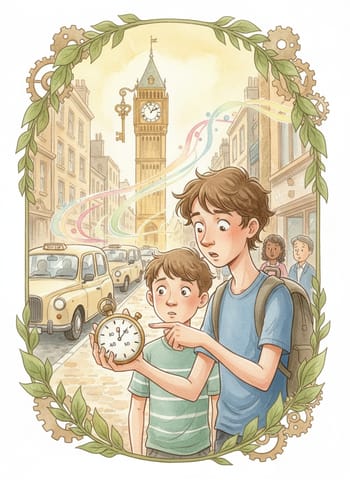
The stopwatch is round and silver, with a crack across the face. Deniz has measured it many times. For every five minutes in the real world, it counts only four. Emre has learned to add a little in his head. Deniz thinks this is a silly way to live.
El cronómetro es redondo y plateado, con una grieta en la carátula. Deniz lo ha medido muchas veces. Por cada cinco minutos del mundo real, cuenta solo cuatro. Emre ha aprendido a sumar un poco de cabeza. Deniz piensa que es una manera tonta de vivir.
It is eleven thirty-eight when the girl comes running across the square. She has a bag on her back and dust on her sleeves. She pulls open the back door and almost falls onto the seat.
Son las once treinta y ocho cuando la chica llega corriendo por la plaza. Lleva una mochila a la espalda y polvo en las mangas. Abre la puerta trasera de un tirón y casi se cae sobre el asiento.
"The clock tower," she gasps. "Please. As fast as you can."
«La torre del reloj», dice jadeando. «Por favor. Lo más rápido que pueda».
"Which clock tower?" Emre asks. "We have three."
«¿Cuál torre del reloj?», pregunta Emre. «Tenemos tres».
"The tall one on Hare Street. The noon bell." She holds up a brass key as long as a spoon. "I work for the clockmaker. The old key broke this morning. If this one does not reach the tower before twelve, the bell will not ring."
«La alta de la calle Hare. La campana del mediodía». Levanta una llave de latón tan larga como una cuchara. «Trabajo para la relojera. La llave vieja se rompió esta mañana. Si esta no llega a la torre antes de las doce, la campana no sonará».
Deniz turns round. "So? A bell is only a bell."
Deniz se da la vuelta. «¿Y qué? Una campana es solo una campana».
The girl looks at him as if he has said something terrible. "On Hare Street, it is not only a bell. The stone hares in the square sleep until the noon bell rings. If it stays silent, they wake up and run all over the town. Last time it happened, one of them ate a flower stall."
La chica lo mira como si hubiera dicho algo terrible. «En la calle Hare no es solo una campana. Las liebres de piedra de la plaza duermen hasta que suena la campana del mediodía. Si se queda callada, despiertan y corren por todo el pueblo. La última vez que pasó, una de ellas se comió un puesto de flores».
Emre raises an eyebrow. In this town, everyone knows about the hares, and nobody enjoys talking about them.
Emre arquea una ceja. En este pueblo todos conocen a las liebres y a nadie le gusta hablar de ellas.
"Seat belt," he says. He presses the stopwatch button with his thumb. "We have twenty-two minutes. Easy."
«Cinturón», dice. Aprieta el botón del cronómetro con el pulgar. «Tenemos veintidós minutos. Fácil».
The taxi pulls out of the rank.
El taxi sale de la parada.
Market day is a bad day for driving. The main road is full of delivery vans and cyclists. One very large goat walks in the middle of the street as if it owns the town. Emre drives carefully round the goat. At the first crossroads, the traffic lights freeze and stay that way for ever.
El día de mercado es un mal día para conducir. La calle principal está llena de camionetas de reparto y ciclistas. Una cabra enorme camina por el medio de la calle como si el pueblo fuera suyo. Emre rodea la cabra con cuidado. En el primer cruce, los semáforos se congelan y se quedan así para siempre.
Deniz watches the stopwatch. The second hand moves in a lazy circle. Seven minutes. Eight minutes. The girl in the back seat chews her thumb.
Deniz mira el cronómetro. La manecilla avanza en un círculo perezoso. Siete minutos. Ocho minutos. La chica del asiento trasero se muerde el pulgar.
"We are doing well," Emre says. "Stopwatch says nine minutes, so we have thirteen left."
«Vamos bien», dice Emre. «El cronómetro dice nueve minutos, así que nos quedan trece».
Deniz looks out of the window. Over the roofs, he can see the face of the town hall clock. It shows eleven forty-nine.
Deniz mira por la ventana. Por encima de los techos se ve la carátula del reloj del ayuntamiento. Marca las once cuarenta y nueve.
He does the sum in his head, and his stomach drops.
Hace la cuenta de cabeza y se le hunde el estómago.
"Emre. The stopwatch is slow, remember? You started it at eleven thirty-eight. The town clock says eleven forty-nine. That is eleven real minutes, not nine."
«Emre. El cronómetro es lento, ¿recuerdas? Lo pusiste en marcha a las once treinta y ocho. El reloj del pueblo marca las once cuarenta y nueve. Son once minutos reales, no nueve».
"I add a little in my head," Emre says.
«Yo sumo un poco de cabeza», dice Emre.
"Do you? Because you just said thirteen left. It is eleven." Deniz points at the girl. "Eleven minutes, and the road ahead is full of vans."
«¿Ah, sí? Porque acabas de decir que quedan trece. Son once». Deniz señala a la chica. «Once minutos, y el camino de adelante está lleno de camionetas».
Emre goes quiet. A van in front of them blows its horn for no reason. The girl closes her eyes.
Emre se queda callado. Una camioneta frente a ellos toca la bocina sin motivo. La chica cierra los ojos.
"Can we go another way?" she asks.
«¿Podemos ir por otro camino?», pregunta.
"There is no other way," Emre says. "The old bridge is closed. The ring road takes twenty minutes."
«No hay otro camino», dice Emre. «El puente viejo está cerrado. La circunvalación toma veinte minutos».
Deniz stares at the roofs. He knows this part of town better than anyone in the car. He has walked it every morning for four years, with a heavy school bag. Behind the tower, there is a long wall. Behind the wall is a football pitch. And at the other end of the pitch is a gate that nobody locks on Saturdays.
Deniz mira fijamente los techos. Conoce esta parte del pueblo mejor que nadie en el auto. La ha recorrido a pie todas las mañanas durante cuatro años, con una mochila escolar pesada. Detrás de la torre hay un muro largo. Detrás del muro hay una cancha de fútbol. Y en el otro extremo de la cancha hay una puerta que nadie cierra con llave los sábados.
"My school," he says suddenly. "It is behind the tower. The back gate opens onto Hare Street."
«Mi escuela», dice de repente. «Está detrás de la torre. La puerta de atrás da a la calle Hare».
"A taxi cannot drive through a school," Emre says.
«Un taxi no puede pasar por una escuela», dice Emre.
"It is a football pitch. There is a service road next to it. I have seen a delivery van on it." Deniz twists in his seat. "It is not a road for cars, but it is a road."
«Es una cancha de fútbol. Hay un camino de servicio al lado. He visto una camioneta de reparto por ahí». Deniz se retuerce en el asiento. «No es un camino para autos, pero es un camino».
"The gate will be closed."
«La puerta estará cerrada».
"The side gate has a code. It is 1-9-5-0. Everyone knows it. The football team uses it."
«La puerta lateral tiene un código. Es 1-9-5-0. Todos lo saben. Lo usa el equipo de fútbol».
Emre looks at the clock on the dashboard. He looks at the girl in his mirror. She nods hard, with wet eyes.
Emre mira el reloj del tablero. Mira a la chica en el espejo. Ella asiente con fuerza, con los ojos húmedos.
"If a teacher shouts at us," he says, "I will say that you told me to."
«Si un maestro nos grita», dice, «diré que tú me lo mandaste».
"That is fine," says Deniz.
«Está bien», dice Deniz.
Emre turns the wheel hard and goes down a narrow side street. It is the kind of street that has bins on both sides and a sleeping cat. The taxi scrapes past a wall with a hiss of paint. Deniz holds the door handle with both hands.
Emre gira el volante con fuerza y se mete por una calle lateral angosta. Es el tipo de calle que tiene botes de basura a ambos lados y un gato dormido. El taxi roza una pared con un siseo de pintura. Deniz se agarra de la manija de la puerta con las dos manos.
The school gate appears at the end, tall and grey. Deniz jumps out before the taxi has fully stopped and presses the numbers. The lock clicks. He pulls the gate wide open, and the taxi rolls through.
La puerta de la escuela aparece al fondo, alta y gris. Deniz salta antes de que el taxi se haya detenido por completo y marca los números. La cerradura hace clic. Abre la puerta de par en par y el taxi pasa rodando.
The service road is narrow, with grass in the middle and a sign that says NO VEHICLES. Emre drives past the sign very slowly, as if it cannot see him. On the left, the football pitch shines in the sun. On the right, a row of bicycles leans on a fence.
El camino de servicio es angosto, con pasto en el medio y un letrero que dice PROHIBIDO EL PASO DE VEHÍCULOS. Emre pasa junto al letrero muy despacio, como si no pudiera verlo. A la izquierda, la cancha de fútbol brilla al sol. A la derecha, una fila de bicicletas se apoya en una cerca.
"Eleven fifty-six," Deniz reads from his phone. "Four minutes."
«Once cincuenta y seis», lee Deniz en su teléfono. «Cuatro minutos».
At the end of the pitch the road bends round a wall. Then the tower rises above them. It is old and brown, with a white clock face and a small door at the base. Emre brakes hard on the loose stones. The girl is out of the car before the engine stops.
Al final de la cancha el camino da la vuelta a un muro. Entonces la torre se alza sobre ellos. Es vieja y marrón, con una carátula blanca y una puertita en la base. Emre frena con fuerza sobre las piedras sueltas. La chica ya salió del auto antes de que se apague el motor.
"Thank you!" she shouts. She runs up the back steps two at a time, with the brass key held high.
«¡Gracias!», grita. Sube corriendo los escalones de atrás de dos en dos, con la llave de latón en alto.
Deniz and Emre stand next to the taxi. In the square at the front of the tower, the stone hares sit on their benches. Their ears are up and their eyes are closed. Nothing moves. Somewhere inside the tower, a lock turns with a heavy clunk.
Deniz y Emre se quedan junto al taxi. En la plaza, frente a la torre, las liebres de piedra están sentadas en sus bancas. Tienen las orejas levantadas y los ojos cerrados. Nada se mueve. En algún lugar dentro de la torre, una cerradura gira con un golpe sordo.
Emre looks at the silver stopwatch on its string. Its hands show sixteen minutes, and the glass is still cracked.
Emre mira el cronómetro plateado en su cordel. Sus manecillas marcan dieciséis minutos, y el vidrio sigue agrietado.
"I will never trust that thing again," he says.
«Nunca volveré a confiar en esa cosa», dice.
"You said that last year," Deniz says.
«Eso dijiste el año pasado», dice Deniz.
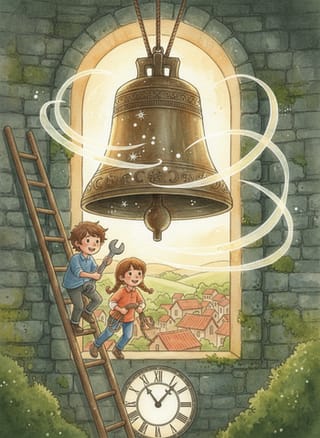
The big clock on the tower face clicks on to twelve. For one long second everything is still. Then, above their heads, the great bronze bell swings once.
La gran manecilla de la carátula de la torre avanza con un clic hasta las doce. Durante un largo segundo todo está quieto. Entonces, sobre sus cabezas, la gran campana de bronce se balancea una vez.
Dong.
Dong.