The Slow Stopwatch at the Taxi Rank
Uma história gratuita em inglês de nível B1 para estudantes, para ler online em 7 idiomas, com opção de ouvir no app gratuito Storyteller.
A teenager spots that his cousin's stopwatch lies and finds a school shortcut to get a tower key across town before noon.
Essa foi a prévia! Ouça a história completa no app gratuito Storyteller. Baixar o app
O áudio não está disponível no momento.
Deniz hates the stopwatch. It hangs on a string above the dashboard of his cousin's taxi, and it is always wrong.
Deniz odeia o cronômetro. Ele fica pendurado num cordão acima do painel do táxi do primo dele, e está sempre errado.
Today is the first day of the summer holiday. Deniz sits in the front seat with a bottle of juice. Emre drives the green taxi at the Market Square rank. He lets Deniz come along when there are no passengers. The rank is boring, and two people can be bored together.
Hoje é o primeiro dia das férias de verão. Deniz está sentado no banco da frente com uma garrafa de suco. Emre dirige o táxi verde no ponto da Praça do Mercado. Ele deixa Deniz ir junto quando não há passageiros. O ponto é entediante, e duas pessoas podem se entediar juntas.
"It is not wrong," Emre says for the hundredth time. "It is slow. That is different."
"Não está errado", diz Emre pela centésima vez. "Está lento. É diferente."
"Slow is wrong," says Deniz.
"Lento é errado", diz Deniz.
"Slow is a style." Emre taps the glass. "A clockmaker gave me this stopwatch. She said it counts time the way a cat walks across a room. It gets there, but not in a hurry."
"Lento é um estilo." Emre bate no vidro. "Uma relojoeira me deu este cronômetro. Ela disse que ele conta o tempo do jeito que um gato atravessa uma sala. Chega lá, mas sem pressa."
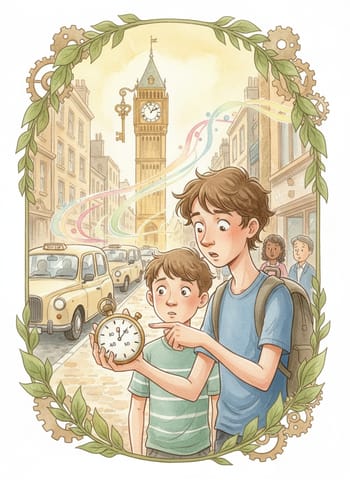
The stopwatch is round and silver, with a crack across the face. Deniz has measured it many times. For every five minutes in the real world, it counts only four. Emre has learned to add a little in his head. Deniz thinks this is a silly way to live.
O cronômetro é redondo e prateado, com uma rachadura no mostrador. Deniz já o mediu muitas vezes. A cada cinco minutos no mundo real, ele conta só quatro. Emre aprendeu a somar um pouco de cabeça. Deniz acha que isso é um jeito bobo de viver.
It is eleven thirty-eight when the girl comes running across the square. She has a bag on her back and dust on her sleeves. She pulls open the back door and almost falls onto the seat.
São onze e trinta e oito quando a menina vem correndo pela praça. Ela tem uma mochila nas costas e poeira nas mangas. Ela abre a porta de trás e quase cai no banco.
"The clock tower," she gasps. "Please. As fast as you can."
"A torre do relógio", ela arfa. "Por favor. O mais rápido que puder."
"Which clock tower?" Emre asks. "We have three."
"Qual torre do relógio?", pergunta Emre. "Temos três."
"The tall one on Hare Street. The noon bell." She holds up a brass key as long as a spoon. "I work for the clockmaker. The old key broke this morning. If this one does not reach the tower before twelve, the bell will not ring."
"A alta da Rua da Lebre. O sino do meio-dia." Ela ergue uma chave de latão tão comprida quanto uma colher. "Eu trabalho para a relojoeira. A chave velha quebrou esta manhã. Se esta não chegar à torre antes das doze, o sino não vai tocar."
Deniz turns round. "So? A bell is only a bell."
Deniz se vira. "E daí? Um sino é só um sino."
The girl looks at him as if he has said something terrible. "On Hare Street, it is not only a bell. The stone hares in the square sleep until the noon bell rings. If it stays silent, they wake up and run all over the town. Last time it happened, one of them ate a flower stall."
A menina olha para ele como se ele tivesse dito algo terrível. "Na Rua da Lebre, não é só um sino. As lebres de pedra da praça dormem até o sino do meio-dia tocar. Se ele ficar calado, elas acordam e saem correndo pela cidade inteira. Da última vez que aconteceu, uma delas comeu uma barraca de flores."
Emre raises an eyebrow. In this town, everyone knows about the hares, and nobody enjoys talking about them.
Emre ergue uma sobrancelha. Nesta cidade, todo mundo conhece as lebres, e ninguém gosta de falar delas.
"Seat belt," he says. He presses the stopwatch button with his thumb. "We have twenty-two minutes. Easy."
"Cinto de segurança", diz ele. Ele aperta o botão do cronômetro com o polegar. "Temos vinte e dois minutos. Fácil."
The taxi pulls out of the rank.
O táxi sai do ponto.
Market day is a bad day for driving. The main road is full of delivery vans and cyclists. One very large goat walks in the middle of the street as if it owns the town. Emre drives carefully round the goat. At the first crossroads, the traffic lights freeze and stay that way for ever.
Dia de feira é um péssimo dia para dirigir. A rua principal está cheia de vans de entrega e ciclistas. Uma cabra muito grande caminha no meio da rua como se fosse dona da cidade. Emre contorna a cabra com cuidado. No primeiro cruzamento, o semáforo congela e fica assim para sempre.
Deniz watches the stopwatch. The second hand moves in a lazy circle. Seven minutes. Eight minutes. The girl in the back seat chews her thumb.
Deniz observa o cronômetro. O ponteiro dos segundos se move num círculo preguiçoso. Sete minutos. Oito minutos. A menina no banco de trás rói o polegar.
"We are doing well," Emre says. "Stopwatch says nine minutes, so we have thirteen left."
"Estamos indo bem", diz Emre. "O cronômetro diz nove minutos, então faltam treze."
Deniz looks out of the window. Over the roofs, he can see the face of the town hall clock. It shows eleven forty-nine.
Deniz olha pela janela. Por cima dos telhados, ele vê o mostrador do relógio da prefeitura. Marca onze e quarenta e nove.
He does the sum in his head, and his stomach drops.
Ele faz a conta de cabeça, e seu estômago despenca.
"Emre. The stopwatch is slow, remember? You started it at eleven thirty-eight. The town clock says eleven forty-nine. That is eleven real minutes, not nine."
"Emre. O cronômetro é lento, lembra? Você o ligou às onze e trinta e oito. O relógio da cidade marca onze e quarenta e nove. São onze minutos de verdade, não nove."
"I add a little in my head," Emre says.
"Eu somo um pouco de cabeça", diz Emre.
"Do you? Because you just said thirteen left. It is eleven." Deniz points at the girl. "Eleven minutes, and the road ahead is full of vans."
"Soma? Porque você acabou de dizer que faltam treze. Faltam onze." Deniz aponta para a menina. "Onze minutos, e a estrada à frente está cheia de vans."
Emre goes quiet. A van in front of them blows its horn for no reason. The girl closes her eyes.
Emre fica quieto. Uma van na frente deles buzina sem motivo. A menina fecha os olhos.
"Can we go another way?" she asks.
"Dá para ir por outro caminho?", pergunta ela.
"There is no other way," Emre says. "The old bridge is closed. The ring road takes twenty minutes."
"Não há outro caminho", diz Emre. "A ponte velha está fechada. A avenida de contorno leva vinte minutos."
Deniz stares at the roofs. He knows this part of town better than anyone in the car. He has walked it every morning for four years, with a heavy school bag. Behind the tower, there is a long wall. Behind the wall is a football pitch. And at the other end of the pitch is a gate that nobody locks on Saturdays.
Deniz fica olhando os telhados. Ele conhece essa parte da cidade melhor que qualquer um no carro. Ele a percorre toda manhã há quatro anos, com uma mochila escolar pesada. Atrás da torre há um muro comprido. Atrás do muro há um campo de futebol. E na outra ponta do campo há um portão que ninguém tranca aos sábados.
"My school," he says suddenly. "It is behind the tower. The back gate opens onto Hare Street."
"Minha escola", diz ele de repente. "Fica atrás da torre. O portão dos fundos dá na Rua da Lebre."
"A taxi cannot drive through a school," Emre says.
"Um táxi não pode atravessar uma escola", diz Emre.
"It is a football pitch. There is a service road next to it. I have seen a delivery van on it." Deniz twists in his seat. "It is not a road for cars, but it is a road."
"É um campo de futebol. Tem uma estrada de serviço ao lado. Já vi uma van de entrega nela." Deniz se contorce no banco. "Não é uma estrada para carros, mas é uma estrada."
"The gate will be closed."
"O portão vai estar fechado."
"The side gate has a code. It is 1-9-5-0. Everyone knows it. The football team uses it."
"O portão lateral tem uma senha. É 1-9-5-0. Todo mundo sabe. O time de futebol usa."
Emre looks at the clock on the dashboard. He looks at the girl in his mirror. She nods hard, with wet eyes.
Emre olha o relógio do painel. Olha para a menina no espelho. Ela assente com força, de olhos molhados.
"If a teacher shouts at us," he says, "I will say that you told me to."
"Se algum professor gritar com a gente", diz ele, "vou dizer que foi você que mandou."
"That is fine," says Deniz.
"Tudo bem", diz Deniz.
Emre turns the wheel hard and goes down a narrow side street. It is the kind of street that has bins on both sides and a sleeping cat. The taxi scrapes past a wall with a hiss of paint. Deniz holds the door handle with both hands.
Emre vira o volante com força e entra numa ruazinha estreita. É o tipo de rua que tem lixeiras dos dois lados e um gato dormindo. O táxi raspa num muro com um chiado de tinta. Deniz segura a maçaneta da porta com as duas mãos.
The school gate appears at the end, tall and grey. Deniz jumps out before the taxi has fully stopped and presses the numbers. The lock clicks. He pulls the gate wide open, and the taxi rolls through.
O portão da escola aparece no fim, alto e cinza. Deniz pula para fora antes de o táxi parar por completo e aperta os números. A fechadura estala. Ele abre o portão de par em par, e o táxi passa rolando.
The service road is narrow, with grass in the middle and a sign that says NO VEHICLES. Emre drives past the sign very slowly, as if it cannot see him. On the left, the football pitch shines in the sun. On the right, a row of bicycles leans on a fence.
A estrada de serviço é estreita, com grama no meio e uma placa que diz PROIBIDA A ENTRADA DE VEÍCULOS. Emre passa pela placa bem devagar, como se ela não pudesse vê-lo. À esquerda, o campo de futebol brilha ao sol. À direita, uma fileira de bicicletas está encostada numa cerca.
"Eleven fifty-six," Deniz reads from his phone. "Four minutes."
"Onze e cinquenta e seis", lê Deniz no celular. "Quatro minutos."
At the end of the pitch the road bends round a wall. Then the tower rises above them. It is old and brown, with a white clock face and a small door at the base. Emre brakes hard on the loose stones. The girl is out of the car before the engine stops.
No fim do campo, a estrada contorna um muro. Então a torre se ergue acima deles. É antiga e marrom, com um mostrador branco e uma portinha na base. Emre freia forte sobre as pedras soltas. A menina já saiu do carro antes de o motor parar.
"Thank you!" she shouts. She runs up the back steps two at a time, with the brass key held high.
"Obrigada!", grita ela. Ela sobe correndo os degraus dos fundos de dois em dois, com a chave de latão erguida.
Deniz and Emre stand next to the taxi. In the square at the front of the tower, the stone hares sit on their benches. Their ears are up and their eyes are closed. Nothing moves. Somewhere inside the tower, a lock turns with a heavy clunk.
Deniz e Emre ficam ao lado do táxi. Na praça, em frente à torre, as lebres de pedra estão sentadas em seus bancos. As orelhas estão erguidas e os olhos fechados. Nada se mexe. Em algum lugar dentro da torre, uma fechadura gira com um baque pesado.
Emre looks at the silver stopwatch on its string. Its hands show sixteen minutes, and the glass is still cracked.
Emre olha o cronômetro prateado em seu cordão. Os ponteiros marcam dezesseis minutos, e o vidro continua rachado.
"I will never trust that thing again," he says.
"Nunca mais vou confiar nessa coisa", diz ele.
"You said that last year," Deniz says.
"Você disse isso no ano passado", diz Deniz.
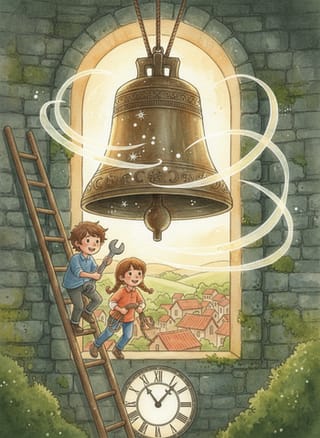
The big clock on the tower face clicks on to twelve. For one long second everything is still. Then, above their heads, the great bronze bell swings once.
O grande relógio no alto da torre avança com um estalo até as doze. Por um longo segundo, tudo fica parado. Então, acima de suas cabeças, o grande sino de bronze balança uma vez.
Dong.
Dong.