The Spare Oar at Ninth Lock
Una historia gratuita en inglés de nivel B1 para estudiantes, para leer en línea en 7 idiomas, con opción de escucharla en la app gratuita Storyteller.
A lock keeper promises that nobody will take a magic oar from her lock, then must save a drifting ferry.
¡Ese fue el avance! Escucha la historia completa en la app gratuita Storyteller. Descargar la app
El audio no está disponible en este momento.
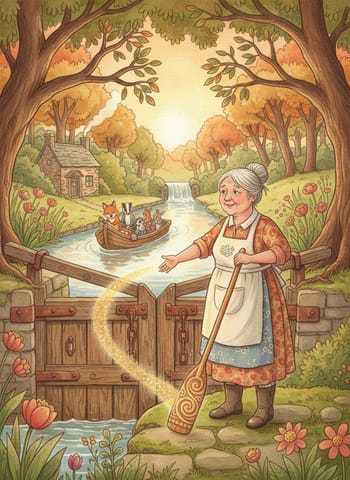
Rhoda had kept Ninth Lock for nine years. In that time, she had never lost a boat. She knew every stone of the old chamber and every turn of the brass wheel. Most of all, she knew the river, which hummed under her floor at night like a sleeping cat.
Rhoda había cuidado la Esclusa Novena durante nueve años. En todo ese tiempo, nunca había perdido un bote. Conocía cada piedra de la vieja cámara y cada vuelta de la rueda de latón. Sobre todo, conocía el río, que zumbaba bajo su suelo por las noches como un gato dormido.
Above the lock, the Slow River ran quietly through the fields. Below it, the water changed. Past the last gate lay the Dark Reach, a wide black stretch that had no bottom. Ordinary oars sank in the Reach, or they snapped like dry twigs. Only boats with the right kind of wood could cross it.
Sobre la esclusa, el Río Lento corría tranquilo entre los campos. Debajo, el agua cambiaba. Pasada la última compuerta se extendía el Tramo Oscuro, una franja ancha y negra que no tenía fondo. Los remos comunes se hundían en el Tramo, o se quebraban como ramitas secas. Solo los botes con el tipo de madera adecuado podían cruzarlo.
One evening, a narrow boat slid into the chamber. A tall man stood at the back, holding a pale paddle. A second oar, just as pale and much longer, lay along the bottom of the boat.
Una tarde, un bote angosto se deslizó dentro de la cámara. Un hombre alto iba de pie en la popa, con una pala pálida en las manos. Un segundo remo, igual de pálido y mucho más largo, yacía a lo largo del fondo del bote.
"Good evening, keeper," he said. "My name is Vasco. I need to cross the Reach tonight."
«Buenas tardes, guardiana», dijo. «Me llamo Vasco. Necesito cruzar el Tramo esta noche».
"Then I will lower you," Rhoda said. "But nobody has come back from the far shore in years."
«Entonces te bajaré», dijo Rhoda. «Pero hace años que nadie regresa de la orilla lejana».
"I know." Vasco lifted the long oar and held it out to her. "This is a spare, cut from river-ash. It has a twin, and twins pull toward each other."
«Lo sé». Vasco levantó el remo largo y se lo ofreció. «Este es un repuesto, tallado en fresno de río. Tiene un gemelo, y los gemelos se atraen».
"Your paddle is its twin?" Rhoda asked.
«¿Tu pala es su gemela?», preguntó Rhoda.
"Yes. As long as this oar hangs in your lock, my paddle will always pull me home."
«Sí. Mientras este remo cuelgue en tu esclusa, mi pala siempre me atraerá de vuelta a casa».
"Then why not carry both with you?"
«Entonces, ¿por qué no llevas los dos contigo?».
"The Reach pulls too hard for two oars, and I have only two hands." He looked at her steadily. "But if anyone takes the spare away, I will lose my way back. Promise me that nobody will take it from this lock. Not for gold, and not for a good reason."
«El Tramo tira demasiado fuerte para dos remos, y yo solo tengo dos manos». La miró fijamente. «Pero si alguien se lleva el repuesto, perderé el camino de regreso. Prométeme que nadie lo sacará de esta esclusa. Ni por oro ni por una buena razón».
Rhoda thought for a moment. She had never broken her word to anyone on the river. "I promise," she said. "No one will take it from this lock."
Rhoda lo pensó un momento. Nunca había faltado a su palabra con nadie en el río. «Lo prometo», dijo. «Nadie lo sacará de esta esclusa».
Vasco smiled. Rhoda lowered the water and opened the lower gate. Then she watched his lamp shrink in the dark until the Reach swallowed it.
Vasco sonrió. Rhoda bajó el agua y abrió la compuerta inferior. Luego observó cómo su lámpara se hacía pequeña en la oscuridad hasta que el Tramo se la tragó.
She hung the oar on a hook above her stove. At night, it hummed softly, as if it were listening for something far away. After a few days, she found that she was listening too.
Colgó el remo de un gancho sobre su estufa. Por las noches, zumbaba suavemente, como si escuchara algo muy lejano. Después de unos días, descubrió que ella también estaba escuchando.
On the sixth day, a trader came through with a barge full of lamp oil. He saw the oar through the window and stopped talking in the middle of a sentence.
El sexto día, pasó un comerciante con una barcaza llena de aceite para lámparas. Vio el remo por la ventana y dejó de hablar a mitad de una frase.
"That is fine wood," he said at last. "I would pay ten silver coins for it."
«Esa es una madera fina», dijo al fin. «Pagaría diez monedas de plata por ella».
"It is not for sale," Rhoda said.
«No está en venta», dijo Rhoda.
"Twenty, then. Thirty."
«Veinte, entonces. Treinta».
"It is not mine to sell." She closed the window, and he left with a puzzled face.
«No me corresponde venderlo». Cerró la ventana, y él se fue con cara de desconcierto.
Twenty days passed. The moon grew full, and Vasco did not come back. Every morning, Rhoda polished the oar and told it the small news of the river. She told herself that a promise does not get lighter just because it gets longer.
Pasaron veinte días. La luna se puso llena y Vasco no regresó. Cada mañana, Rhoda pulía el remo y le contaba las pequeñas noticias del río. Se decía a sí misma que una promesa no se vuelve más ligera solo porque se vuelve más larga.
On the twenty-fourth night, a thin cry drifted up from the water below the lock. Rhoda grabbed her lantern and ran to the wall. Far out on the Reach, a wide flat ferry turned slowly in the dark. It was the wedding ferry from Upper Mill. Its long pole had snapped on the weir. Now the Reach was pulling it away from the shore.
La vigésimo cuarta noche, un grito débil subió desde el agua bajo la esclusa. Rhoda tomó su farol y corrió hasta el muro. Muy lejos, en el Tramo, un ancho transbordador plano giraba lentamente en la oscuridad. Era el transbordador de bodas de Molino Alto. Su larga pértiga se había quebrado en el vertedero. Ahora el Tramo lo arrastraba lejos de la orilla.
Within minutes, half the village stood on the bank. Everyone spoke at once.
En pocos minutos, la mitad del pueblo estaba en la ribera. Todos hablaban a la vez.
"They have no oars!" a fisherman shouted. "Ours would break in the Reach!"
«¡No tienen remos!», gritó un pescador. «¡Los nuestros se romperían en el Tramo!».
"Your pale oar!" a woman cried. "Lend it to a rower, keeper. Please!"
«¡Su remo pálido!», gritó una mujer. «¡Préstelo a un remero, guardiana! ¡Por favor!».
Rhoda stood very still. Behind her, in the lock house, the oar hummed so loudly that the cups rattled on their shelf. She had given her word. If she sent the oar away, Vasco might never find his way home. If she kept it on the hook, a dozen people would drift into the dark. Both choices felt like a door closing.
Rhoda se quedó muy quieta. Detrás de ella, en la casa de la esclusa, el remo zumbaba tan fuerte que las tazas tintineaban en su estante. Había dado su palabra. Si enviaba el remo, Vasco quizá nunca encontraría el camino a casa. Si lo dejaba en el gancho, una docena de personas se perderían en la oscuridad. Las dos opciones se sentían como una puerta que se cierra.
Then she remembered his exact words. He had not asked her to guard the oar like a treasure. He had asked her to make sure that nobody took it from the lock. To take a thing means to lose your hold on it.
Entonces recordó sus palabras exactas. Él no le había pedido que guardara el remo como un tesoro. Le había pedido que se asegurara de que nadie se lo llevara de la esclusa. Llevarse una cosa significa perder el control sobre ella.
"Nobody will take it," she said aloud. "But a keeper may carry it."
«Nadie se lo llevará», dijo en voz alta. «Pero una guardiana puede cargarlo».
She ran inside and lifted the oar from its hook. The wood felt warm, like a hand. "You are not being taken," she told it. "I am carrying you. I hope Vasco will see the difference."
Corrió adentro y levantó el remo de su gancho. La madera se sentía tibia, como una mano. «No te están llevando», le dijo. «Te estoy cargando yo. Espero que Vasco vea la diferencia».
The fisherman reached out. "Give it to me. I am the strongest rower here."
El pescador extendió la mano. «Démelo. Soy el remero más fuerte de aquí».
"No." Rhoda pulled the oar against her chest. "It stays in my hands the whole time. Tie this rope to the bollard and let it out as I go."
«No». Rhoda apretó el remo contra su pecho. «Se queda en mis manos todo el tiempo. Ate esta soga al noray y vaya soltándola mientras me alejo».
She jumped into the small skiff that she used for repairs and pushed off. The water of the Reach felt like thick black glass. She set the oar over the stern and sculled the way river people do. The pale wood did not sink, and it did not snap. Each stroke left a faint silver ring on the surface, and the black water held firm beneath her.
Saltó al pequeño esquife que usaba para las reparaciones y se impulsó. El agua del Tramo se sentía como vidrio negro y espeso. Colocó el remo sobre la popa y bogó a la manera de la gente del río. La madera pálida no se hundió ni se quebró. Cada palada dejaba un tenue anillo plateado en la superficie, y el agua negra se mantenía firme bajo ella.
The ferry came slowly closer. She could see the bride's white sleeves and a child hiding his face in his father's coat. When she was near enough, she threw the end of the rope across the gap.
El transbordador se fue acercando despacio. Podía ver las mangas blancas de la novia y a un niño escondiendo la cara en el abrigo de su padre. Cuando estuvo lo bastante cerca, lanzó el extremo de la soga a través del hueco.
"Tie it to the post!" she called. "The village will pull, and I will push!"
«¡Átenla al poste!», gritó. «¡El pueblo tirará y yo empujaré!».
Hands caught the rope. On the bank, thirty people leaned back together. The ferry shivered and turned its nose toward the lock. But the Reach was strong, and the rope was stretching thin. Rhoda's arms began to shake. The ferry stopped, and then it started to slide backward again.
Unas manos atraparon la soga. En la ribera, treinta personas se echaron hacia atrás a la vez. El transbordador se estremeció y volvió su proa hacia la esclusa. Pero el Tramo era fuerte y la soga se estiraba hasta casi romperse. A Rhoda le empezaron a temblar los brazos. El transbordador se detuvo y luego empezó a deslizarse hacia atrás otra vez.
At that moment, a second hum answered her oar from the darkness. It was low and steady, like a deep bell. Rhoda looked up. A small lamp bobbed toward her across the water. Under it she saw a tall figure with a pale paddle.
En ese momento, un segundo zumbido respondió a su remo desde la oscuridad. Era grave y constante, como una campana profunda. Rhoda alzó la vista. Una pequeña lámpara se mecía hacia ella sobre el agua. Debajo vio una figura alta con una pala pálida.
"Keep rowing!" Vasco shouted. "I have been drifting for three weeks, but your oar has pulled me here like a string!"
«¡Sigue remando!», gritó Vasco. «¡He estado a la deriva tres semanas, pero tu remo me ha arrastrado hasta aquí como con un hilo!».
He pushed his boat beside hers and drove his paddle into the water next to her oar. The two pieces of wood sang together in one clear note. Suddenly the black water went smooth, as if someone had pulled a cloth tight. The ferry swung round and glided toward the lock. The people on the bank fell backward in a laughing heap.
Acercó su bote al de ella y hundió su pala en el agua junto a su remo. Las dos piezas de madera cantaron juntas en una sola nota clara. De pronto el agua negra se alisó, como si alguien hubiera estirado un paño. El transbordador giró y se deslizó hacia la esclusa. La gente de la ribera cayó hacia atrás en un montón de risas.
By the time the sky turned grey, the wedding guests were safe on dry stone. Children slept in blankets. The bride thanked Rhoda four times and kissed the oar once, which seemed to embarrass it.
Cuando el cielo se puso gris, los invitados a la boda estaban a salvo en tierra firme. Los niños dormían en mantas. La novia le dio las gracias a Rhoda cuatro veces y besó el remo una vez, lo que pareció avergonzarlo.
Vasco climbed onto the wall and stood in front of Rhoda. He looked at the pale oar in her hands, and his face became serious.
Vasco subió al muro y se paró frente a Rhoda. Miró el remo pálido en sus manos, y su rostro se puso serio.
"You took it out of the lock," he said quietly.
«Lo sacaste de la esclusa», dijo en voz baja.
"No one took it," Rhoda said. "I carried it, and it never left my hands."
«Nadie lo sacó», dijo Rhoda. «Yo lo cargué, y nunca salió de mis manos».
He stared at her for a long moment. Then he began to laugh, so loudly that the fisherman jumped. "You have kept your promise better than I asked you to," he said.
La miró fijamente durante un largo momento. Luego empezó a reír, tan fuerte que el pescador dio un salto. «Has cumplido tu promesa mejor de lo que te pedí», dijo.
Rhoda carried the oar back to the lock house and hung it on its hook above the stove. Then she picked up her lantern and walked out to the wall. She turned the brass wheel to let his boat in.
Rhoda llevó el remo de vuelta a la casa de la esclusa y lo colgó en su gancho sobre la estufa. Luego tomó su farol y salió al muro. Giró la rueda de latón para dejar entrar su bote.