The Devil With the Three Golden Hairs
A free B1-level English story for language learners, readable online in 7 languages, with an option to listen via the free Storyteller app.
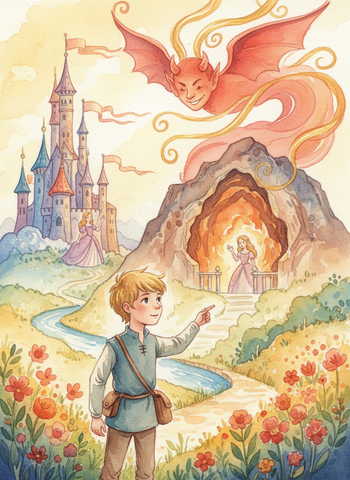
A boy born with a lucky caul is destined to marry a princess, so a jealous king sends him on an impossible errand to fetch three golden hairs from the devil's own head.
There was once a poor woman who gave birth to a little son; and as he came into the world with a caul on, it was predicted that in his fourteenth year he would have the King’s daughter for his wife. It happened that soon afterwards the King came into the village, and no one knew that he was the King, and when he asked the people what news there was, they answered, “A child has just been born with a caul on; whatever any one so born undertakes turns out well. It is prophesied, too, that in his fourteenth year he will have the King’s daughter for his wife.”
Había una vez una pobre mujer que dio a luz a un hijito; y como había venido al mundo con el amnios sobre la cabeza, se predijo que en su decimocuarto año tendría por esposa a la hija del Rey. Sucedió que poco después el Rey llegó al pueblo, y nadie sabía que era el Rey, y cuando preguntó a la gente qué noticias había, le respondieron: «Acaba de nacer un niño con el amnios sobre la cabeza; todo lo que emprenda quien nace así saldrá bien. Se predice, además, que en su decimocuarto año tendrá por esposa a la hija del Rey».
The King, who had a bad heart, and was angry about the prophecy, went to the parents, and, seeming quite friendly, said, “You poor people, let me have your child, and I will take care of it.” At first they refused, but when the stranger offered them a large amount of gold for it, and they thought, “It is a luck-child, and everything must turn out well for it,” they at last consented, and gave him the child.
El Rey, que tenía mal corazón y se enfadó por la profecía, fue a ver a los padres, y, fingiéndose muy amistoso, dijo: «Buena gente, dadme a vuestro hijo, y yo lo cuidaré». Al principio se negaron, pero cuando el desconocido les ofreció una gran cantidad de oro por él, y ellos pensaron: «Es un niño de suerte, y todo debe salirle bien», acabaron consintiendo y le entregaron al niño.
The King put it in a box and rode away with it until he came to a deep piece of water; then he threw the box into it and thought, “I have freed my daughter from her unlooked-for suitor.”
El Rey lo puso en una caja y cabalgó con ella hasta llegar a un lugar de aguas profundas; entonces arrojó la caja al agua y pensó: «He librado a mi hija de este pretendiente inesperado».
The box, however, did not sink, but floated like a boat, and not a drop of water made its way into it. And it floated to within two miles of the King’s chief city, where there was a mill, and it came to a stand-still at the mill-dam. A miller’s boy, who by good luck was standing there, noticed it and pulled it out with a hook, thinking that he had found a great treasure, but when he opened it there lay a pretty boy inside, quite fresh and lively.
La caja, sin embargo, no se hundió, sino que flotó como un bote, y ni una gota de agua entró en ella. Y flotó hasta llegar a dos millas de la ciudad principal del Rey, donde había un molino, y quedó detenida en la presa del molino. Un mozo del molinero, que por buena suerte estaba allí, la vio y la sacó con un gancho, pensando que había hallado un gran tesoro, pero cuando la abrió encontró dentro a un niño hermoso, fresco y lleno de vida.
He took him to the miller and his wife, and as they had no children they were glad, and said, “God has given him to us.” They took great care of the foundling, and he grew up in all goodness.
Lo llevó ante el molinero y su esposa, y como no tenían hijos se alegraron, y dijeron: «Dios nos lo ha dado». Cuidaron con esmero al expósito, y él creció adornado de toda bondad.
It happened that once in a storm, the King went into the mill, and he asked the mill-folk if the tall youth was their son. “No,” answered they, “he’s a foundling. Fourteen years ago he floated down to the mill-dam in a box, and the mill-boy pulled him out of the water.”
Sucedió que una vez, durante una tormenta, el Rey entró en el molino, y preguntó a la gente del molino si el mozo alto era hijo suyo. «No», respondieron, «es un expósito. Hace catorce años bajó flotando hasta la presa del molino dentro de una caja, y el mozo del molino lo sacó del agua».
Then the King knew that it was none other than the luck-child which he had thrown into the water, and he said, “My good people, could not the youth take a letter to the Queen; I will give him two gold pieces as a reward?” “Just as the King commands,” answered they, and they told the boy to hold himself in readiness. Then the King wrote a letter to the Queen, wherein he said, “As soon as the boy arrives with this letter, let him be killed and buried, and all must be done before I come home.”
Entonces el Rey supo que no era otro sino el niño de suerte que él había arrojado al agua, y dijo: «Buena gente, ¿no podría el mozo llevar una carta a la Reina? Le daré dos monedas de oro como recompensa». «Como el Rey ordene», respondieron ellos, y le dijeron al muchacho que se tuviera dispuesto. Entonces el Rey escribió una carta a la Reina, en la que decía: «Tan pronto como el muchacho llegue con esta carta, que lo maten y lo entierren, y todo debe hacerse antes de que yo regrese a casa».
The boy set out with this letter; but he lost his way, and in the evening came to a large forest. In the darkness he saw a small light; he went towards it and reached a cottage. When he went in, an old woman was sitting by the fire quite alone. She started when she saw the boy, and said, “Whence do you come, and whither are you going?” “I come from the mill,” he answered, “and wish to go to the Queen, to whom I am taking a letter; but as I have lost my way in the forest I should like to stay here over night.”
El muchacho partió con esta carta; pero perdió el camino, y al anochecer llegó a un gran bosque. En la oscuridad vio una lucecita; se dirigió hacia ella y llegó a una cabaña. Al entrar, había una anciana sentada junto al fuego, completamente sola. Se sobresaltó al ver al muchacho, y dijo: «¿De dónde vienes, y adónde vas?». «Vengo del molino», respondió él, «y quiero ir hasta la Reina, a quien llevo una carta; pero como he perdido el camino en el bosque, quisiera quedarme aquí esta noche».
“You poor boy,” said the woman, “you have come into a den of thieves, and when they come home they will kill you.” “Let them come,” said the boy, “I am not afraid; but I am so tired that I cannot go any farther:” and he stretched himself upon a bench and fell asleep.
«Pobre muchacho», dijo la mujer, «has venido a caer en una guarida de ladrones, y cuando vuelvan a casa te matarán». «Que vengan», dijo el muchacho, «no tengo miedo; pero estoy tan cansado que no puedo andar más»: y se tendió en un banco y se quedó dormido.
Soon afterwards the robbers came, and angrily asked what strange boy was lying there? “Ah,” said the old woman, “it is an innocent child who has lost himself in the forest, and out of pity I have let him come in; he has to take a letter to the Queen.” The robbers opened the letter and read it, and in it was written that the boy as soon as he arrived should be put to death.
Poco después llegaron los ladrones, y preguntaron enfadados qué muchacho extraño era aquel que estaba allí tendido. «Ah», dijo la anciana, «es un niño inocente que se ha perdido en el bosque, y por compasión lo dejé entrar; tiene que llevar una carta a la Reina». Los ladrones abrieron la carta y la leyeron, y en ella estaba escrito que el muchacho, en cuanto llegara, debía ser condenado a muerte.
Then the hard-hearted robbers felt pity, and their leader tore up the letter and wrote another, saying, that as soon as the boy came, he should be married at once to the King’s daughter. Then they let him lie quietly on the bench until the next morning, and when he awoke they gave him the letter, and showed him the right way.
Entonces los ladrones, de duro corazón, sintieron piedad, y su jefe rompió la carta y escribió otra, diciendo que, en cuanto llegara el muchacho, debía casarse de inmediato con la hija del Rey. Luego lo dejaron descansar tranquilamente en el banco hasta la mañana siguiente, y cuando despertó le dieron la carta y le mostraron el camino correcto.
And the Queen, when she had received the letter and read it, did as was written in it, and had a splendid wedding-feast prepared, and the King’s daughter was married to the luck-child, and as the youth was handsome and agreeable she lived with him in joy and contentment.
Y la Reina, cuando recibió la carta y la leyó, hizo lo que en ella estaba escrito, y mandó preparar un espléndido banquete de bodas, y la hija del Rey se casó con el niño de suerte, y como el joven era apuesto y agradable, ella vivió con él con gozo y contento.
After some time the King returned to his palace and saw that the prophecy was fulfilled, and the luck-child married to his daughter. “How has that come to pass?” said he; “I gave quite another order in my letter.”
Al cabo de un tiempo el Rey regresó a su palacio y vio que la profecía se había cumplido, y que el niño de suerte se había casado con su hija. «¿Cómo ha llegado esto a suceder?», dijo; «yo di una orden bien distinta en mi carta».
So the Queen gave him the letter, and said that he might see for himself what was written in it. The King read the letter and saw quite well that it had been exchanged for the other. He asked the youth what had become of the letter entrusted to him, and why he had brought another instead of it. “I know nothing about it,” answered he; “it must have been changed in the night, when I slept in the forest.”
Entonces la Reina le dio la carta, y le dijo que podía ver por sí mismo lo que en ella estaba escrito. El Rey leyó la carta y vio muy bien que había sido cambiada por la otra. Preguntó al joven qué había sido de la carta que se le había confiado, y por qué había traído otra en su lugar. «No sé nada de eso», respondió; «debió de cambiarse durante la noche, cuando dormía en el bosque».
The King said in a passion, “You shall not have everything quite so much your own way; whosoever marries my daughter must fetch me from hell three golden hairs from the head of the devil; bring me what I want, and you shall keep my daughter.” In this way the King hoped to be rid of him for ever. But the luck-child answered, “I will fetch the golden hairs, I am not afraid of the Devil;” thereupon he took leave of them and began his journey.
El Rey dijo con ira: «No vas a salirte siempre con la tuya; quien case con mi hija debe traerme del infierno tres cabellos de oro de la cabeza del diablo; tráeme lo que pido, y podrás quedarte con mi hija». De este modo el Rey esperaba librarse de él para siempre. Pero el niño de suerte respondió: «Iré a buscar los cabellos de oro, no le tengo miedo al Diablo»; y con esto se despidió de ellos y emprendió su viaje.
The road led him to a large town, where the watchman by the gates asked him what his trade was, and what he knew. “I know everything,” answered the luck-child. “Then you can do us a favour,” said the watchman, “if you will tell us why our market-fountain, which once flowed with wine has become dry, and no longer gives even water?” “That you shall know,” answered he; “only wait until I come back.”
El camino lo llevó a una gran ciudad, donde el guardián de las puertas le preguntó cuál era su oficio y qué sabía hacer. «Lo sé todo», respondió el niño de suerte. «Entonces puedes hacernos un favor», dijo el guardián, «si nos dices por qué nuestra fuente del mercado, que antes manaba vino, se ha secado y ya ni siquiera da agua». «Eso lo sabréis», respondió; «solo esperad a que regrese».
Then he went farther and came to another town, and there also the gatekeeper asked him what was his trade, and what he knew. “I know everything,” answered he. “Then you can do us a favour and tell us why a tree in our town which once bore golden apples now does not even put forth leaves?” “You shall know that,” answered he; “only wait until I come back.”
Luego siguió su camino y llegó a otra ciudad, y allí también el guardián de la puerta le preguntó cuál era su oficio y qué sabía hacer. «Lo sé todo», respondió. «Entonces puedes hacernos un favor y decirnos por qué un árbol de nuestra ciudad, que antes daba manzanas de oro, ya no echa ni siquiera hojas». «Eso lo sabréis», respondió; «solo esperad a que regrese».
Then he went on and came to a wide river over which he must go. The ferryman asked him what his trade was, and what he knew. “I know everything,” answered he. “Then you can do me a favour,” said the ferryman, “and tell me why I must always be rowing backwards and forwards, and am never set free?” “You shall know that,” answered he; “only wait until I come back.”
Luego siguió adelante y llegó a un ancho río que debía cruzar. El barquero le preguntó cuál era su oficio y qué sabía hacer. «Lo sé todo», respondió. «Entonces puedes hacerme un favor», dijo el barquero, «y decirme por qué debo estar siempre remando de un lado a otro, sin ser liberado jamás». «Eso lo sabréis», respondió; «solo esperad a que regrese».
When he had crossed the water he found the entrance to Hell. It was black and sooty within, and the Devil was not at home, but his grandmother was sitting in a large arm-chair. “What do you want?” said she to him, but she did not look so very wicked. “I should like to have three golden hairs from the devil’s head,” answered he, “else I cannot keep my wife.” “That is a good deal to ask for,” said she; “if the devil comes home and finds you, it will cost you your life; but as I pity you, I will see if I cannot help you.”
Cuando hubo cruzado el agua encontró la entrada del Infierno. Era negra y llena de hollín por dentro, y el Diablo no estaba en casa, pero su abuela estaba sentada en un gran sillón. «¿Qué quieres?», le dijo ella, aunque no parecía muy malvada. «Quisiera tener tres cabellos de oro de la cabeza del diablo», respondió él, «pues de otro modo no puedo quedarme con mi esposa». «Eso es pedir mucho», dijo ella; «si el diablo vuelve a casa y te encuentra, te costará la vida; pero como me das lástima, veré si puedo ayudarte».
She changed him into an ant and said, “Creep into the folds of my dress, you will be safe there.” “Yes,” answered he, “so far, so good; but there are three things besides that I want to know: why a fountain which once flowed with wine has become dry, and no longer gives even water; why a tree which once bore golden apples does not even put forth leaves; and why a ferry-man must always be going backwards and forwards, and is never set free?”
Lo convirtió en hormiga y dijo: «Métete entre los pliegues de mi vestido, allí estarás a salvo». «Sí», respondió él, «hasta ahí, muy bien; pero hay otras tres cosas que quiero saber: por qué una fuente que antes manaba vino se ha secado y ya no da ni siquiera agua; por qué un árbol que antes daba manzanas de oro ya no echa ni siquiera hojas; y por qué un barquero debe estar siempre yendo de un lado a otro, sin ser liberado jamás».
“Those are difficult questions,” answered she, “but only be silent and quiet and pay attention to what the devil says when I pull out the three golden hairs.”
«Esas son preguntas difíciles», respondió ella, «pero quédate en silencio y calladito, y presta atención a lo que diga el diablo cuando le arranque los tres cabellos de oro».
As the evening came on, the devil returned home. No sooner had he entered than he noticed that the air was not pure. “I smell man’s flesh,” said he; “all is not right here.” Then he pried into every corner, and searched, but could not find anything. His grandmother scolded him. “It has just been swept,” said she, “and everything put in order, and now you are upsetting it again; you have always got man’s flesh in your nose. Sit down and eat your supper.”
Al caer la tarde, el diablo volvió a casa. Apenas había entrado cuando notó que el aire no estaba limpio. «Huelo carne humana», dijo; «aquí no todo está bien». Entonces se puso a fisgonear en cada rincón, y buscó, pero no pudo encontrar nada. Su abuela lo regañó. «Se acaba de barrer», dijo, «y todo estaba en orden, y ahora vienes tú a revolverlo otra vez; siempre tienes carne humana en la nariz. Siéntate y come tu cena».
When he had eaten and drunk he was tired, and laid his head in his grandmother’s lap, and before long he was fast asleep, snoring and breathing heavily. Then the old woman took hold of a golden hair, pulled it out, and laid it down near her. “Oh!” cried the devil, “what are you doing?” “I have had a bad dream,” answered the grandmother, “so I seized hold of your hair.” “What did you dream then?” said the devil.
Cuando hubo comido y bebido, estaba cansado, y apoyó la cabeza en el regazo de su abuela, y al poco rato estaba profundamente dormido, roncando y respirando con fuerza. Entonces la anciana tomó uno de los cabellos de oro, lo arrancó, y lo dejó a su lado. «¡Ay!», gritó el diablo, «¿qué estás haciendo?». «He tenido un mal sueño», respondió la abuela, «así que te agarré del cabello». «¿Y qué soñaste?», dijo el diablo.
“I dreamed that a fountain in a market-place from which wine once flowed was dried up, and not even water would flow out of it; what is the cause of it?” “Oh, ho! if they did but know it,” answered the devil; “there is a toad sitting under a stone in the well; if they killed it, the wine would flow again.”
«Soñé que una fuente en una plaza de mercado, de la que antes manaba vino, se había secado, y que ni siquiera el agua quería salir de ella; ¿cuál es la causa?». «¡Ah, si lo supieran!», respondió el diablo; «hay un sapo sentado bajo una piedra en el pozo; si lo mataran, el vino volvería a manar».
He went to sleep again and snored until the windows shook. Then she pulled the second hair out. “Ha! what are you doing?” cried the devil angrily. “Do not take it ill,” said she, “I did it in a dream.” “What have you dreamt this time?” asked he. “I dreamt that in a certain kingdom there stood an apple-tree which had once borne golden apples, but now would not even bear leaves. What, think you, was the reason?”
Volvió a dormirse y roncó hasta que las ventanas temblaron. Entonces ella le arrancó el segundo cabello. «¡Ay! ¿Qué estás haciendo?», gritó el diablo, enfadado. «No te lo tomes a mal», dijo ella, «lo hice en sueños». «¿Qué has soñado esta vez?», preguntó él. «Soñé que en cierto reino se alzaba un manzano que antes daba manzanas de oro, pero que ya ni siquiera echaba hojas. ¿Cuál crees tú que sería la razón?».
“Oh! if they did but know,” answered the devil. “A mouse is gnawing at the root; if they killed this they would have golden apples again, but if it gnaws much longer the tree will wither altogether. But leave me alone with your dreams: if you disturb me in my sleep again you will get a box on the ear.”
«¡Ah, si lo supieran!», respondió el diablo. «Un ratón está royendo la raíz; si lo mataran, volverían a tener manzanas de oro, pero si sigue royendo mucho más tiempo, el árbol acabará por marchitarse del todo. Pero déjame en paz con tus sueños: si vuelves a molestarme mientras duermo, te llevarás un bofetón».
The grandmother spoke gently to him until he fell asleep again and snored. Then she took hold of the third golden hair and pulled it out. The devil jumped up, roared out, and would have treated her ill if she had not quieted him once more and said, “Who can help bad dreams?” “What was the dream, then?” asked he, and was quite curious. “I dreamt of a ferry-man who complained that he must always ferry from one side to the other, and was never released. What is the cause of it?”
La abuela le habló con suavidad hasta que volvió a dormirse y a roncar. Entonces tomó el tercer cabello de oro y lo arrancó. El diablo dio un salto, rugió, y la habría tratado mal si ella no lo hubiera calmado de nuevo diciendo: «¿Quién puede evitar los malos sueños?». «¿Cuál fue el sueño, entonces?», preguntó él, ya bastante curioso. «Soñé con un barquero que se quejaba de tener que llevar siempre la barca de un lado a otro, sin ser liberado jamás. ¿Cuál es la causa de eso?».
“Ah! the fool,” answered the devil; “when any one comes and wants to go across he must put the oar in his hand, and the other man will have to ferry and he will be free.” As the grandmother had plucked out the three golden hairs, and the three questions were answered, she let the old serpent alone, and he slept until daybreak.
«Ah, qué tonto», respondió el diablo; «cuando alguien llegue y quiera cruzar, debe ponerle el remo en la mano, y el otro tendrá que hacer de barquero, y así él quedará libre». Como la abuela había arrancado los tres cabellos de oro, y las tres preguntas habían sido respondidas, dejó tranquila a la vieja serpiente, y este durmió hasta el amanecer.
When the devil had gone out again the old woman took the ant out of the folds of her dress, and gave the luck-child his human shape again. “There are the three golden hairs for you,” said she. “What the Devil said to your three questions, I suppose you heard?” “Yes,” answered he, “I heard, and will take care to remember.” “You have what you want,” said she, “and now you can go your way.” He thanked the old woman for helping him in his need, and left hell well content that everything had turned out so fortunately.
Cuando el diablo salió de nuevo, la anciana sacó a la hormiga de los pliegues de su vestido y le devolvió al niño de suerte su forma humana. «Ahí tienes los tres cabellos de oro», dijo ella. «Lo que el Diablo dijo a tus tres preguntas, supongo que lo oíste». «Sí», respondió él, «lo oí, y tendré cuidado de recordarlo». «Tienes lo que querías», dijo ella, «y ahora puedes seguir tu camino». Él dio las gracias a la anciana por haberlo ayudado en su necesidad, y salió del infierno muy satisfecho de que todo hubiera resultado tan bien.
When he came to the ferry-man he was expected to give the promised answer. “Ferry me across first,” said the luck-child, “and then I will tell you how you can be set free,” and when he reached the opposite shore he gave him the devil’s advice: “Next time any one comes, who wants to be ferried over, just put the oar in his hand.”
Cuando llegó adonde el barquero, este esperaba la respuesta prometida. «Pásame primero a la otra orilla», dijo el niño de suerte, «y luego te diré cómo puedes quedar libre», y cuando llegó a la orilla opuesta le dio el consejo del diablo: «La próxima vez que alguien venga y quiera que lo pases, ponle el remo en la mano».
He went on and came to the town wherein stood the unfruitful tree, and there too the watchman wanted an answer. So he told him what he had heard from the devil: “Kill the mouse which is gnawing at its root, and it will again bear golden apples.” Then the watchman thanked him, and gave him as a reward two asses laden with gold, which followed him.
Siguió su camino y llegó a la ciudad donde estaba el árbol infructuoso, y allí también el guardián quería una respuesta. Así que le contó lo que había oído del diablo: «Matad al ratón que roe su raíz, y volverá a dar manzanas de oro». Entonces el guardián le dio las gracias, y le entregó como recompensa dos asnos cargados de oro, que lo siguieron.
At last he came to the town whose well was dry. He told the watchman what the devil had said: “A toad is in the well beneath a stone; you must find it and kill it, and the well will again give wine in plenty.” The watchman thanked him, and also gave him two asses laden with gold.
Por fin llegó a la ciudad cuyo pozo estaba seco. Le contó al guardián lo que había dicho el diablo: «Hay un sapo en el pozo bajo una piedra; debéis encontrarlo y matarlo, y el pozo volverá a dar vino en abundancia». El guardián le dio las gracias, y también le dio dos asnos cargados de oro.
At last the luck-child got home to his wife, who was heartily glad to see him again, and to hear how well he had prospered in everything. To the King he took what he had asked for, the devil’s three golden hairs, and when the King saw the four asses laden with gold he was quite content, and said, “Now all the conditions are fulfilled, and you can keep my daughter. But tell me, dear son-in-law, where did all that gold come from? this is tremendous wealth!”
Por fin el niño de suerte llegó a su casa junto a su esposa, que se alegró de todo corazón al verlo de nuevo, y de oír cuán bien le había ido en todo. Al Rey le llevó lo que había pedido, los tres cabellos de oro del diablo, y cuando el Rey vio los cuatro asnos cargados de oro quedó bastante satisfecho, y dijo: «Ahora se han cumplido todas las condiciones, y puedes quedarte con mi hija. Pero dime, querido yerno, ¿de dónde salió todo ese oro? ¡Esto es una riqueza tremenda!».
“I was rowed across a river,” answered he, “and got it there; it lies on the shore instead of sand.” “Can I too fetch some of it?” said the King; and he was quite eager about it. “As much as you like,” answered he. “There is a ferry-man on the river; let him ferry you over, and you can fill your sacks on the other side.” The greedy King set out in all haste, and when he came to the river he beckoned to the ferry-man to put him across.
«Me llevaron en barca a través de un río», respondió él, «y allí lo conseguí; yace en la orilla en lugar de arena». «¿Puedo ir yo también a buscar un poco?», dijo el Rey; y estaba muy ansioso por hacerlo. «Todo el que quieras», respondió él. «Hay un barquero en el río; deja que te pase, y podrás llenar tus sacos en la otra orilla». El Rey codicioso partió a toda prisa, y cuando llegó al río hizo señas al barquero para que lo pasara.
The ferry-man came and bade him get in, and when they got to the other shore he put the oar in his hand and sprang out. But from this time forth the King had to ferry, as a punishment for his sins. Perhaps he is ferrying still? If he is, it is because no one has taken the oar from him.
El barquero se acercó y le dijo que subiera, y cuando llegaron a la otra orilla le puso el remo en la mano y saltó fuera. Pero desde ese momento el Rey tuvo que hacer de barquero, como castigo por sus pecados. ¿Acaso sigue todavía pasando gente de un lado a otro? Si es así, es porque nadie le ha quitado el remo.
