The Spare Oar at Ninth Lock
A free B1-level English story for language learners, readable online in 7 languages, with an option to listen via the free Storyteller app.
A lock keeper promises that nobody will take a magic oar from her lock, then must save a drifting ferry.
That was the preview! Hear the full story in the free Storyteller app. Get the app
Audio isn't available right now.
Rhoda had kept Ninth Lock for nine years. In that time, she had never lost a boat. She knew every stone of the old chamber and every turn of the brass wheel. Most of all, she knew the river, which hummed under her floor at night like a sleeping cat.
Above the lock, the Slow River ran quietly through the fields. Below it, the water changed. Past the last gate lay the Dark Reach, a wide black stretch that had no bottom. Ordinary oars sank in the Reach, or they snapped like dry twigs. Only boats with the right kind of wood could cross it.
One evening, a narrow boat slid into the chamber. A tall man stood at the back, holding a pale paddle. A second oar, just as pale and much longer, lay along the bottom of the boat.
"Good evening, keeper," he said. "My name is Vasco. I need to cross the Reach tonight."
"Then I will lower you," Rhoda said. "But nobody has come back from the far shore in years."
"I know." Vasco lifted the long oar and held it out to her. "This is a spare, cut from river-ash. It has a twin, and twins pull toward each other."
"Your paddle is its twin?" Rhoda asked.
"Yes. As long as this oar hangs in your lock, my paddle will always pull me home."
"Then why not carry both with you?"
"The Reach pulls too hard for two oars, and I have only two hands." He looked at her steadily. "But if anyone takes the spare away, I will lose my way back. Promise me that nobody will take it from this lock. Not for gold, and not for a good reason."
Rhoda thought for a moment. She had never broken her word to anyone on the river. "I promise," she said. "No one will take it from this lock."
Vasco smiled. Rhoda lowered the water and opened the lower gate. Then she watched his lamp shrink in the dark until the Reach swallowed it.
She hung the oar on a hook above her stove. At night, it hummed softly, as if it were listening for something far away. After a few days, she found that she was listening too.
On the sixth day, a trader came through with a barge full of lamp oil. He saw the oar through the window and stopped talking in the middle of a sentence.
"That is fine wood," he said at last. "I would pay ten silver coins for it."
"It is not for sale," Rhoda said.
"Twenty, then. Thirty."
"It is not mine to sell." She closed the window, and he left with a puzzled face.
Twenty days passed. The moon grew full, and Vasco did not come back. Every morning, Rhoda polished the oar and told it the small news of the river. She told herself that a promise does not get lighter just because it gets longer.
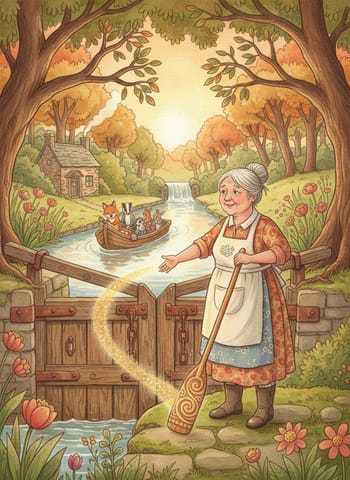
On the twenty-fourth night, a thin cry drifted up from the water below the lock. Rhoda grabbed her lantern and ran to the wall. Far out on the Reach, a wide flat ferry turned slowly in the dark. It was the wedding ferry from Upper Mill. Its long pole had snapped on the weir. Now the Reach was pulling it away from the shore.
Within minutes, half the village stood on the bank. Everyone spoke at once.
"They have no oars!" a fisherman shouted. "Ours would break in the Reach!"
"Your pale oar!" a woman cried. "Lend it to a rower, keeper. Please!"
Rhoda stood very still. Behind her, in the lock house, the oar hummed so loudly that the cups rattled on their shelf. She had given her word. If she sent the oar away, Vasco might never find his way home. If she kept it on the hook, a dozen people would drift into the dark. Both choices felt like a door closing.
Then she remembered his exact words. He had not asked her to guard the oar like a treasure. He had asked her to make sure that nobody took it from the lock. To take a thing means to lose your hold on it.
"Nobody will take it," she said aloud. "But a keeper may carry it."
She ran inside and lifted the oar from its hook. The wood felt warm, like a hand. "You are not being taken," she told it. "I am carrying you. I hope Vasco will see the difference."
The fisherman reached out. "Give it to me. I am the strongest rower here."
"No." Rhoda pulled the oar against her chest. "It stays in my hands the whole time. Tie this rope to the bollard and let it out as I go."
She jumped into the small skiff that she used for repairs and pushed off. The water of the Reach felt like thick black glass. She set the oar over the stern and sculled the way river people do. The pale wood did not sink, and it did not snap. Each stroke left a faint silver ring on the surface, and the black water held firm beneath her.
The ferry came slowly closer. She could see the bride's white sleeves and a child hiding his face in his father's coat. When she was near enough, she threw the end of the rope across the gap.
"Tie it to the post!" she called. "The village will pull, and I will push!"
Hands caught the rope. On the bank, thirty people leaned back together. The ferry shivered and turned its nose toward the lock. But the Reach was strong, and the rope was stretching thin. Rhoda's arms began to shake. The ferry stopped, and then it started to slide backward again.
At that moment, a second hum answered her oar from the darkness. It was low and steady, like a deep bell. Rhoda looked up. A small lamp bobbed toward her across the water. Under it she saw a tall figure with a pale paddle.
"Keep rowing!" Vasco shouted. "I have been drifting for three weeks, but your oar has pulled me here like a string!"
He pushed his boat beside hers and drove his paddle into the water next to her oar. The two pieces of wood sang together in one clear note. Suddenly the black water went smooth, as if someone had pulled a cloth tight. The ferry swung round and glided toward the lock. The people on the bank fell backward in a laughing heap.
By the time the sky turned grey, the wedding guests were safe on dry stone. Children slept in blankets. The bride thanked Rhoda four times and kissed the oar once, which seemed to embarrass it.
Vasco climbed onto the wall and stood in front of Rhoda. He looked at the pale oar in her hands, and his face became serious.
"You took it out of the lock," he said quietly.
"No one took it," Rhoda said. "I carried it, and it never left my hands."
He stared at her for a long moment. Then he began to laugh, so loudly that the fisherman jumped. "You have kept your promise better than I asked you to," he said.
Rhoda carried the oar back to the lock house and hung it on its hook above the stove. Then she picked up her lantern and walked out to the wall. She turned the brass wheel to let his boat in.