Twelve Small Windows
Una historia gratuita en inglés de nivel A2 para estudiantes, para leer en línea en 7 idiomas, con opción de escucharla en la app gratuita Storyteller.
Adaeze promises her friend she will grow a jar of mystery seeds, but her first try fails.
¡Ese fue el avance! Escucha la historia completa en la app gratuita Storyteller. Descargar la app
El audio no está disponible en este momento.
The dance studio sits above a pharmacy. To reach it, Adaeze climbs a narrow stair. It smells of soap and cough sweets. At the top, a wooden door opens onto one long room. It has mirrors on three walls.
El estudio de danza está encima de una farmacia. Para llegar, Adaeze sube una escalera angosta. Huele a jabón y a caramelos para la tos. Arriba, una puerta de madera da a un salón largo. Tiene espejos en tres paredes.
Adaeze started dancing here at nine. Calla started the same week. They stand side by side at the barre. They know each other's steps by heart.
Adaeze empezó a bailar aquí a los nueve años. Calla empezó la misma semana. Se paran lado a lado en la barra. Se saben de memoria los pasos de la otra.
Today the room feels too big. Calla's bag sits by the door, next to a small cardboard box.
Hoy el salón se siente demasiado grande. El bolso de Calla está junto a la puerta, al lado de una pequeña caja de cartón.
"My mother says the truck leaves at noon," Calla says.
«Mi mamá dice que el camión sale al mediodía», dice Calla.
"I know," says Adaeze. She looks at her feet.
«Lo sé», dice Adaeze. Mira sus pies.
"Don't be like that." Calla opens the box and takes out a glass jar. It is full of tiny brown seeds, dry and light like dust. There is no label on it.
«No te pongas así». Calla abre la caja y saca un frasco de vidrio. Está lleno de semillas diminutas y cafés, secas y livianas como polvo. No tiene etiqueta.
"What are they?" Adaeze asks.
«¿Qué son?», pregunta Adaeze.
"I don't know." Calla laughs. "My neighbour gave them to me last week. She said they come from her mother's garden. She did not remember the name."
«No sé». Calla se ríe. «Mi vecina me las dio la semana pasada. Dijo que son del jardín de su mamá. No recordaba el nombre».
"Then why give them to me?"
«Entonces, ¿por qué me las das a mí?».
"Because I want you to promise something." Calla holds the jar with both hands. "Plant them. Make them grow. When the first flower opens, send me a photo."
«Porque quiero que me prometas algo». Calla sostiene el frasco con ambas manos. «Plántalas. Haz que crezcan. Cuando se abra la primera flor, mándame una foto».
Adaeze stares at the jar. She does not have a garden. She lives in a flat on the fourth floor. It has one small balcony and no soil.
Adaeze mira fijamente el frasco. No tiene jardín. Vive en un departamento en el cuarto piso. Tiene un balcón pequeño y nada de tierra.
"That's a big promise," she says.
«Es una promesa grande», dice.
"I know. That is why I trust you." Calla puts the jar in her hands. It is cold and heavier than it looks. "Promise."
«Lo sé. Por eso confío en ti». Calla pone el frasco en sus manos. Está frío y es más pesado de lo que parece. «Prométemelo».
"I promise," Adaeze says.
«Lo prometo», dice Adaeze.
Then the stair creaks, and Calla's mother calls from below. The two girls hug for a long time. Then Calla runs down the steps. The door at the bottom closes with a bang.
Entonces la escalera cruje, y la mamá de Calla llama desde abajo. Las dos chicas se abrazan durante mucho tiempo. Luego Calla baja corriendo los escalones. La puerta de abajo se cierra con un golpe.
Adaeze stands alone in the long room. The jar sits in her hands like a small, silent question.
Adaeze se queda sola en el salón largo. El frasco descansa en sus manos como una pequeña pregunta silenciosa.
That night, she asks the pharmacist downstairs. The pharmacist is a kind, tired woman who asks no questions. She fills a paper bag with soil. It is from the big pots by her door. "Good luck," she says.
Esa noche, le pregunta a la farmacéutica de abajo. La farmacéutica es una mujer amable y cansada que no hace preguntas. Llena una bolsa de papel con tierra. Es de las macetas grandes junto a su puerta. «Buena suerte», dice.
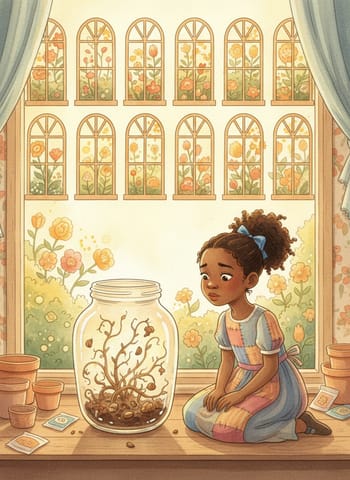
Adaeze fills a cracked blue bowl. She presses most of the seeds into the soil and covers them. She keeps a spoonful in the jar, only in case. She puts the bowl on the studio windowsill. The sun comes in all morning.
Adaeze llena un tazón azul rajado. Presiona la mayoría de las semillas en la tierra y las cubre. Guarda una cucharada en el frasco, solo por si acaso. Pone el tazón en el alféizar del estudio. El sol entra toda la mañana.
She waters it every day. She waters it twice when she feels worried.
Lo riega todos los días. Lo riega dos veces cuando se siente preocupada.
A week goes by. Nothing happens.
Pasa una semana. No pasa nada.
Two weeks go by. The soil stays flat and dark. The teacher looks at the bowl and shakes her head.
Pasan dos semanas. La tierra sigue plana y oscura. La maestra mira el tazón y niega con la cabeza.
"Too much water," she says. "You give them too much."
«Demasiada agua», dice. «Les das demasiada».
Adaeze stops watering for three days. Then the soil cracks and turns to dust. She starts again, but a little at a time. She is afraid to do it wrong.
Adaeze deja de regar por tres días. Entonces la tierra se agrieta y se vuelve polvo. Empieza de nuevo, pero poco a poco. Tiene miedo de hacerlo mal.
On the twentieth day, a smell comes from the bowl. It is bad and wet. Adaeze lifts a spoon of soil. The seeds are soft and grey. They are dead.
El día veinte, sale un olor del tazón. Es malo y húmedo. Adaeze levanta una cucharada de tierra. Las semillas están blandas y grises. Están muertas.
She sits on the floor, and her eyes burn. She does not cry, but she wants to. Her phone shows a message from Calla. It says, Any news? Send a picture!
Se sienta en el piso, y le arden los ojos. No llora, pero quiere. Su teléfono muestra un mensaje de Calla. Dice: ¿Alguna novedad? ¡Manda una foto!
Adaeze does not answer. She puts the phone face down on the floor.
Adaeze no responde. Pone el teléfono boca abajo en el piso.
The door opens. A small voice says, "Why are you sitting there?"
La puerta se abre. Una vocecita dice: «¿Por qué estás sentada ahí?».
It is Pim, one of the little ones from the Saturday class. She is seven, and she wears a pink tutu over her jeans. Behind her stand eleven more children, all in a line.
Es Pim, una de las pequeñas de la clase del sábado. Tiene siete años, y lleva un tutú rosa sobre los jeans. Detrás de ella están otros once niños, todos en fila.
"I'm fine," Adaeze says. "Class starts in a minute."
«Estoy bien», dice Adaeze. «La clase empieza en un minuto».
"You look sad," Pim says. She walks over and looks at the bowl. "Is that a dead garden?"
«Te ves triste», dice Pim. Se acerca y mira el tazón. «¿Eso es un jardín muerto?».
"Yes. It is a dead garden."
«Sí. Es un jardín muerto».
"Why?"
«¿Por qué?».
Adaeze takes a breath. Then she tells her the whole story. She tells her about Calla, the truck and the promise. She feels silly telling a seven-year-old. But Pim listens with her mouth open.
Adaeze respira hondo. Luego le cuenta toda la historia. Le habla de Calla, del camión y de la promesa. Se siente tonta contándoselo a una niña de siete años. Pero Pim escucha con la boca abierta.
"Do you have any more seeds?" Pim asks.
«¿Tienes más semillas?», pregunta Pim.
Adaeze almost says no. Then she remembers. That first night, she kept a spoonful of seeds in the jar. She did not know why. She only thought, in case.
Adaeze casi dice que no. Entonces recuerda. Esa primera noche, guardó una cucharada de semillas en el frasco. No sabía por qué. Solo pensó: por si acaso.
She gets the jar from her bag and shakes it. About fifty seeds rattle inside.
Saca el frasco de su bolso y lo agita. Suenan unas cincuenta semillas adentro.
"That is not enough for a garden," she says.
«No es suficiente para un jardín», dice.
"It is enough for a cup," says Pim. "Everybody has a cup."
«Es suficiente para un vaso», dice Pim. «Todos tienen un vaso».
The other children come closer. They look at the jar with big, round eyes.
Los otros niños se acercan. Miran el frasco con ojos grandes y redondos.
Adaeze thinks about it. A promise is a promise. But nobody says she must keep it alone.
Adaeze lo piensa. Una promesa es una promesa. Pero nadie dice que deba cumplirla sola.
She tears twelve small squares of paper from her notebook. She puts four seeds on each. She folds them like little letters. Then she gives one to every child.
Rompe doce cuadritos de papel de su cuaderno. Pone cuatro semillas en cada uno. Los dobla como cartitas. Luego le da uno a cada niño.
"Plant it in a cup at home," she says. "Put it in a sunny place. Water it a little, not a lot. And bring a photo when something grows."
«Plántenlo en un vaso en su casa», dice. «Pónganlo en un lugar soleado. Rieguen un poco, no mucho. Y traigan una foto cuando algo crezca».
"What if nothing grows?" a boy asks.
«¿Y si no crece nada?», pregunta un niño.
"Then tell me," Adaeze says. "We will try again."
«Entonces me lo dicen», dice Adaeze. «Lo intentaremos de nuevo».
Weeks pass. Every Saturday, the children tell her the news. One cup grows nothing. One cup grows a tall green shoot that falls over. One boy waters his cup with orange juice by mistake. Adaeze laughs until her side hurts.
Pasan las semanas. Cada sábado, los niños le cuentan las novedades. Un vaso no da nada. Un vaso da un tallo verde y alto que se cae. Un niño riega su vaso con jugo de naranja por error. Adaeze se ríe hasta que le duele el costado.
But slowly, twelve small windows in the city begin to turn green.
Pero poco a poco, doce ventanitas de la ciudad empiezan a ponerse verdes.
Then comes a Saturday in the spring. Pim runs up the stairs with her phone held high. Her cup has a yellow flower, as round as a coin.
Entonces llega un sábado de primavera. Pim sube corriendo las escaleras con el teléfono en alto. Su vaso tiene una flor amarilla, tan redonda como una moneda.
"Look!" she shouts.
«¡Mira!», grita.
By the end of class, there are more. A white one, as soft as paper. A purple one that looks like a small bell. A tall orange flower with a dark middle. A pink one that opens only in the afternoon. They are all different. Nobody knows what any of them is.
Para el final de la clase, hay más. Una blanca, suave como el papel. Una morada que parece una campanita. Una flor alta y anaranjada con el centro oscuro. Una rosa que solo se abre por la tarde. Todas son distintas. Nadie sabe qué es ninguna de ellas.
Adaeze looks at the photos on her phone. Her chest feels tight. Calla's seeds were not one flower. They were many.
Adaeze mira las fotos en su teléfono. Siente el pecho apretado. Las semillas de Calla no eran una sola flor. Eran muchas.
She sits on the studio floor. She puts all the pictures in one message. She writes only a few words. Here is your garden, finally.
Se sienta en el piso del estudio. Junta todas las fotos en un solo mensaje. Escribe solo unas pocas palabras. Aquí está tu jardín, por fin.
She holds her thumb above the screen. Then she presses send.
Sostiene el pulgar sobre la pantalla. Luego presiona enviar.