The Question at the Coat Desk
Una historia gratuita en inglés de nivel A2 para estudiantes, para leer en línea en 7 idiomas, con opción de escucharla en la app gratuita Storyteller.
A museum cloakroom worker has an answer nobody asks for until one painter finally does.
¡Ese fue el avance! Escucha la historia completa en la app gratuita Storyteller. Descargar la app
El audio no está disponible en este momento.
Jonas took the cloakroom job in June because he needed money. He was twenty-two and had no plan for his life.
Jonas aceptó el trabajo en el guardarropa en junio porque necesitaba dinero. Tenía veintidós años y ningún plan para su vida.
"So, what is your plan?" his mother asked every Sunday on the phone. Every Sunday he said, "I work on it every day." It was not true.
«Entonces, ¿cuál es tu plan?», le preguntaba su madre cada domingo por teléfono. Cada domingo él decía: «Trabajo en eso todos los días». No era verdad.
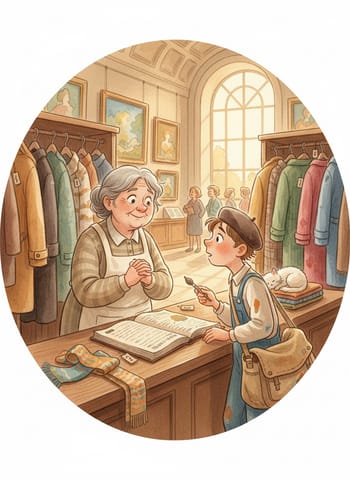
The cloakroom sat just inside the front door of the museum. It was a small room with a long wooden desk. Behind the desk stood rows of hooks. Each hook had a number.
El guardarropa estaba justo a la entrada del museo. Era un cuarto pequeño con un largo mostrador de madera. Detrás del mostrador había filas de ganchos. Cada gancho tenía un número.
Jonas took coats and bags all day. He gave each person a plastic number. Then he hung the coat on its hook and sat down.
Jonas recibía abrigos y bolsos todo el día. A cada persona le daba una ficha de plástico con un número. Luego colgaba el abrigo en su gancho y se sentaba.
Visitors asked him many things. "Where are the toilets?" they asked. "Is the café open?" Or, "How do I find the blue room?" Jonas always answered with a smile.
Los visitantes le preguntaban muchas cosas. «¿Dónde están los baños?», preguntaban. «¿Está abierta la cafetería?». O: «¿Cómo llego a la sala azul?». Jonas siempre respondía con una sonrisa.
Nobody asked about him. Nobody asked what he thought about anything. He did not mind. A cloakroom was a good place to hide.
Nadie preguntaba por él. Nadie le preguntaba qué pensaba de nada. No le molestaba. Un guardarropa era un buen lugar para esconderse.
Every morning at eight, a woman came in through the side door. Her badge said Hester. She worked in the room where the museum fixed its paintings.
Todas las mañanas a las ocho, una mujer entraba por la puerta lateral. Su credencial decía Hester. Trabajaba en la sala donde el museo restauraba sus pinturas.
Hester always used hook nine. She hung her coat there. Then she took a thin wooden case from her bag. She slid it into her shirt pocket. It was as long as a pencil. Once, she saw Jonas draw. She said nothing.
Hester siempre usaba el gancho nueve. Colgaba allí su abrigo. Luego sacaba de su bolso un estuche delgado de madera. Se lo deslizaba en el bolsillo de la camisa. Era largo como un lápiz. Una vez, vio a Jonas dibujar. No dijo nada.
One morning the case fell open on the desk. Jonas saw a paintbrush inside. It had a short handle and only three hairs.
Una mañana el estuche se abrió sobre el mostrador. Jonas vio un pincel adentro. Tenía el mango corto y solo tres cerdas.
Jonas wanted to ask, "Is it broken?" He did not. Hester closed the case, said good morning, and walked away.
Jonas quiso preguntar: «¿Está roto?». No lo hizo. Hester cerró el estuche, dijo buenos días y se fue.
For weeks he thought about that brush. A painter needs a lot of hairs. A brush with three could paint almost nothing.
Durante semanas pensó en ese pincel. Un pintor necesita muchas cerdas. Un pincel con tres casi no podría pintar nada.
He kept quiet. Everyone in the museum looked so serious. Asking felt like walking on a floor that was too clean.
Se quedó callado. Todos en el museo parecían tan serios. Preguntar se sentía como caminar sobre un piso demasiado limpio.
When the hall was empty, Jonas drew. He used the back of the paper number slips. From his chair, he could see through two open doors. At the far end of the long hall hung one small painting. It showed a boat on a gray sea.
Cuando el salón estaba vacío, Jonas dibujaba. Usaba el reverso de los talones de papel con los números. Desde su silla, podía ver a través de dos puertas abiertas. Al fondo del largo salón colgaba una pintura pequeña. Mostraba un bote en un mar gris.
The painting was far away. He drew it again and again to see it better. He drew it forty times. By July he knew every wave. He also knew the small white mark in the sky. It looked like a comma.
La pintura estaba lejos. La dibujaba una y otra vez para verla mejor. La dibujó cuarenta veces. Para julio se sabía cada ola. También conocía la pequeña marca blanca en el cielo. Parecía una coma.
He never told anyone about the mark. Nobody asked him anything, so it stayed in his drawings.
Nunca le habló a nadie de la marca. Nadie le preguntaba nada, así que se quedó en sus dibujos.
One Thursday, Hester stopped at the desk just before closing. She did not take her coat. She just stood there.
Un jueves, Hester se detuvo en el mostrador justo antes del cierre. No tomó su abrigo. Se quedó parada allí.
"Can I ask you something?" she said.
«¿Puedo preguntarte algo?», dijo.
"Of course," said Jonas. "Is it about a bag?"
«Por supuesto», dijo Jonas. «¿Es sobre un bolso?».
"No." She looked at the long room behind him. "I saw you draw the boat painting. People ask you where things are all day. But I never hear anyone ask what you see from this chair."
«No». Miró el largo salón detrás de él. «Te vi dibujar la pintura del bote. La gente te pregunta dónde están las cosas todo el día. Pero nunca oigo que nadie te pregunte qué ves desde esa silla».
Jonas did not know what to say. Nobody ever asked that. His mouth felt dry.
Jonas no supo qué decir. Nadie le preguntaba eso nunca. Sintió la boca seca.
"So," said Hester. "What do you see?"
«Entonces», dijo Hester. «¿Qué ves?».
He opened the drawer and took out his slips. His hands shook. He put them on the desk one by one. Forty small boats lay in a row.
Abrió el cajón y sacó sus talones. Le temblaban las manos. Los puso sobre el mostrador uno por uno. Cuarenta botes pequeños quedaron en fila.
Hester looked at them for a long time. Then she put a finger next to the tiny comma.
Hester los miró durante un buen rato. Luego puso un dedo junto a la diminuta coma.
"You drew this," she said.
«Dibujaste esto», dijo.
"It is in the painting," said Jonas. "A small white mark. I think it is an old mistake."
«Está en la pintura», dijo Jonas. «Una pequeña marca blanca. Creo que es un error antiguo».
Hester laughed. It was a small, surprised laugh.
Hester se rio. Fue una risa pequeña, sorprendida.
"Every year we argue about that mark," she said. "Is it the painter's work, or a mark made later? Some people say it is dust under the glass."
«Cada año discutimos sobre esa marca», dijo. «¿Es obra del pintor, o una marca hecha después? Algunos dicen que es polvo bajo el vidrio».
"It is not dust," said Jonas. "Dust does not stay the same shape."
«No es polvo», dijo Jonas. «El polvo no conserva la misma forma».
Hester nodded slowly. "That is what I think too. But I cannot decide if I should touch it."
Hester asintió lentamente. «Eso pienso yo también. Pero no sé si debería tocarla».
Jonas looked at the case in her pocket. This time the question came out before he could stop it.
Jonas miró el estuche en su bolsillo. Esta vez la pregunta salió antes de que pudiera detenerla.
"Why does your brush have three hairs?"
«¿Por qué tu pincel tiene tres cerdas?».
Hester took out the case and opened it. "My first boss made it shorter for me," she said. "She told me one thing. If you only have three hairs, you choose each line with care."
Hester sacó el estuche y lo abrió. «Mi primera jefa me lo acortó», dijo. «Me dijo una sola cosa. Si solo tienes tres cerdas, eliges cada línea con cuidado».
"Does it work?" asked Jonas.
«¿Funciona?», preguntó Jonas.
"Most days," she said. "On the days I am not sure, I do nothing."
«La mayoría de los días», dijo ella. «Los días en que no estoy segura, no hago nada».
She closed the case and held it out. Jonas did not take it. He only looked at it.
Cerró el estuche y lo extendió. Jonas no lo tomó. Solo lo miró.
"Tomorrow, come to the boat painting after closing," Hester said. "Stand where you stood when you drew it. Tell me what the mark looks like from there."
«Mañana, ven a la pintura del bote después del cierre», dijo Hester. «Párate donde estabas cuando la dibujaste. Dime cómo se ve la marca desde allí».
"I am not a painter," said Jonas.
«No soy pintor», dijo Jonas.
"No," she said. "You are the person who looked."
«No», dijo ella. «Eres la persona que miró».
She walked to the side door and went out. Jonas put his slips back in the drawer. Then he turned off the lamp and looked at the hooks.
Caminó hacia la puerta lateral y salió. Jonas guardó sus talones en el cajón. Luego apagó la lámpara y miró los ganchos.
Hook nine was not empty. Hester's coat still hung there.
El gancho nueve no estaba vacío. El abrigo de Hester seguía colgado allí.
He locked the door and left the coat where it was. Tomorrow, he thought, he was going to stand in the right place.
Cerró con llave y dejó el abrigo donde estaba. Mañana, pensó, iba a pararse en el lugar correcto.