The Question at the Coat Desk
A free A2-level English story for language learners, readable online in 7 languages, with an option to listen via the free Storyteller app.
A museum cloakroom worker has an answer nobody asks for until one painter finally does.
That was the preview! Hear the full story in the free Storyteller app. Get the app
Audio isn't available right now.
Jonas took the cloakroom job in June because he needed money. He was twenty-two and had no plan for his life.
"So, what is your plan?" his mother asked every Sunday on the phone. Every Sunday he said, "I work on it every day." It was not true.
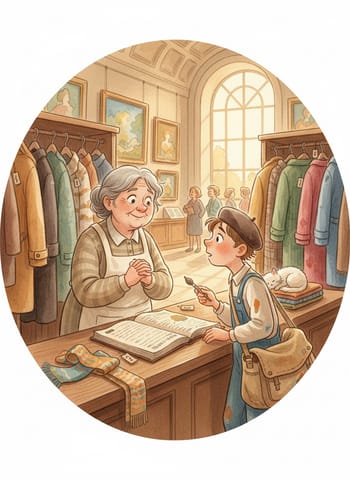
The cloakroom sat just inside the front door of the museum. It was a small room with a long wooden desk. Behind the desk stood rows of hooks. Each hook had a number.
Jonas took coats and bags all day. He gave each person a plastic number. Then he hung the coat on its hook and sat down.
Visitors asked him many things. "Where are the toilets?" they asked. "Is the café open?" Or, "How do I find the blue room?" Jonas always answered with a smile.
Nobody asked about him. Nobody asked what he thought about anything. He did not mind. A cloakroom was a good place to hide.
Every morning at eight, a woman came in through the side door. Her badge said Hester. She worked in the room where the museum fixed its paintings.
Hester always used hook nine. She hung her coat there. Then she took a thin wooden case from her bag. She slid it into her shirt pocket. It was as long as a pencil. Once, she saw Jonas draw. She said nothing.
One morning the case fell open on the desk. Jonas saw a paintbrush inside. It had a short handle and only three hairs.
Jonas wanted to ask, "Is it broken?" He did not. Hester closed the case, said good morning, and walked away.
For weeks he thought about that brush. A painter needs a lot of hairs. A brush with three could paint almost nothing.
He kept quiet. Everyone in the museum looked so serious. Asking felt like walking on a floor that was too clean.
When the hall was empty, Jonas drew. He used the back of the paper number slips. From his chair, he could see through two open doors. At the far end of the long hall hung one small painting. It showed a boat on a gray sea.
The painting was far away. He drew it again and again to see it better. He drew it forty times. By July he knew every wave. He also knew the small white mark in the sky. It looked like a comma.
He never told anyone about the mark. Nobody asked him anything, so it stayed in his drawings.
One Thursday, Hester stopped at the desk just before closing. She did not take her coat. She just stood there.
"Can I ask you something?" she said.
"Of course," said Jonas. "Is it about a bag?"
"No." She looked at the long room behind him. "I saw you draw the boat painting. People ask you where things are all day. But I never hear anyone ask what you see from this chair."
Jonas did not know what to say. Nobody ever asked that. His mouth felt dry.
"So," said Hester. "What do you see?"
He opened the drawer and took out his slips. His hands shook. He put them on the desk one by one. Forty small boats lay in a row.
Hester looked at them for a long time. Then she put a finger next to the tiny comma.
"You drew this," she said.
"It is in the painting," said Jonas. "A small white mark. I think it is an old mistake."
Hester laughed. It was a small, surprised laugh.
"Every year we argue about that mark," she said. "Is it the painter's work, or a mark made later? Some people say it is dust under the glass."
"It is not dust," said Jonas. "Dust does not stay the same shape."
Hester nodded slowly. "That is what I think too. But I cannot decide if I should touch it."
Jonas looked at the case in her pocket. This time the question came out before he could stop it.
"Why does your brush have three hairs?"
Hester took out the case and opened it. "My first boss made it shorter for me," she said. "She told me one thing. If you only have three hairs, you choose each line with care."
"Does it work?" asked Jonas.
"Most days," she said. "On the days I am not sure, I do nothing."
She closed the case and held it out. Jonas did not take it. He only looked at it.
"Tomorrow, come to the boat painting after closing," Hester said. "Stand where you stood when you drew it. Tell me what the mark looks like from there."
"I am not a painter," said Jonas.
"No," she said. "You are the person who looked."
She walked to the side door and went out. Jonas put his slips back in the drawer. Then he turned off the lamp and looked at the hooks.
Hook nine was not empty. Hester's coat still hung there.
He locked the door and left the coat where it was. Tomorrow, he thought, he was going to stand in the right place.