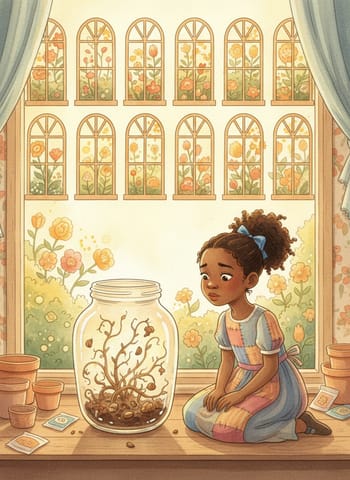
Twelve Small Windows
A free A2-level English story for language learners, readable online in 7 languages, with an option to listen via the free Storyteller app.
Adaeze promises her friend she will grow a jar of mystery seeds, but her first try fails.
That was the preview! Hear the full story in the free Storyteller app. Get the app
Audio isn't available right now.
The dance studio sits above a pharmacy. To reach it, Adaeze climbs a narrow stair. It smells of soap and cough sweets. At the top, a wooden door opens onto one long room. It has mirrors on three walls.
Adaeze started dancing here at nine. Calla started the same week. They stand side by side at the barre. They know each other's steps by heart.
Today the room feels too big. Calla's bag sits by the door, next to a small cardboard box.
"My mother says the truck leaves at noon," Calla says.
"I know," says Adaeze. She looks at her feet.
"Don't be like that." Calla opens the box and takes out a glass jar. It is full of tiny brown seeds, dry and light like dust. There is no label on it.
"What are they?" Adaeze asks.
"I don't know." Calla laughs. "My neighbour gave them to me last week. She said they come from her mother's garden. She did not remember the name."
"Then why give them to me?"
"Because I want you to promise something." Calla holds the jar with both hands. "Plant them. Make them grow. When the first flower opens, send me a photo."
Adaeze stares at the jar. She does not have a garden. She lives in a flat on the fourth floor. It has one small balcony and no soil.
"That's a big promise," she says.
"I know. That is why I trust you." Calla puts the jar in her hands. It is cold and heavier than it looks. "Promise."
"I promise," Adaeze says.
Then the stair creaks, and Calla's mother calls from below. The two girls hug for a long time. Then Calla runs down the steps. The door at the bottom closes with a bang.
Adaeze stands alone in the long room. The jar sits in her hands like a small, silent question.
That night, she asks the pharmacist downstairs. The pharmacist is a kind, tired woman who asks no questions. She fills a paper bag with soil. It is from the big pots by her door. "Good luck," she says.
Adaeze fills a cracked blue bowl. She presses most of the seeds into the soil and covers them. She keeps a spoonful in the jar, only in case. She puts the bowl on the studio windowsill. The sun comes in all morning.
She waters it every day. She waters it twice when she feels worried.
A week goes by. Nothing happens.
Two weeks go by. The soil stays flat and dark. The teacher looks at the bowl and shakes her head.
"Too much water," she says. "You give them too much."
Adaeze stops watering for three days. Then the soil cracks and turns to dust. She starts again, but a little at a time. She is afraid to do it wrong.
On the twentieth day, a smell comes from the bowl. It is bad and wet. Adaeze lifts a spoon of soil. The seeds are soft and grey. They are dead.
She sits on the floor, and her eyes burn. She does not cry, but she wants to. Her phone shows a message from Calla. It says, Any news? Send a picture!
Adaeze does not answer. She puts the phone face down on the floor.
The door opens. A small voice says, "Why are you sitting there?"
It is Pim, one of the little ones from the Saturday class. She is seven, and she wears a pink tutu over her jeans. Behind her stand eleven more children, all in a line.
"I'm fine," Adaeze says. "Class starts in a minute."
"You look sad," Pim says. She walks over and looks at the bowl. "Is that a dead garden?"
"Yes. It is a dead garden."
"Why?"
Adaeze takes a breath. Then she tells her the whole story. She tells her about Calla, the truck and the promise. She feels silly telling a seven-year-old. But Pim listens with her mouth open.
"Do you have any more seeds?" Pim asks.
Adaeze almost says no. Then she remembers. That first night, she kept a spoonful of seeds in the jar. She did not know why. She only thought, in case.
She gets the jar from her bag and shakes it. About fifty seeds rattle inside.
"That is not enough for a garden," she says.
"It is enough for a cup," says Pim. "Everybody has a cup."
The other children come closer. They look at the jar with big, round eyes.
Adaeze thinks about it. A promise is a promise. But nobody says she must keep it alone.
She tears twelve small squares of paper from her notebook. She puts four seeds on each. She folds them like little letters. Then she gives one to every child.
"Plant it in a cup at home," she says. "Put it in a sunny place. Water it a little, not a lot. And bring a photo when something grows."
"What if nothing grows?" a boy asks.
"Then tell me," Adaeze says. "We will try again."
Weeks pass. Every Saturday, the children tell her the news. One cup grows nothing. One cup grows a tall green shoot that falls over. One boy waters his cup with orange juice by mistake. Adaeze laughs until her side hurts.
But slowly, twelve small windows in the city begin to turn green.
Then comes a Saturday in the spring. Pim runs up the stairs with her phone held high. Her cup has a yellow flower, as round as a coin.
"Look!" she shouts.
By the end of class, there are more. A white one, as soft as paper. A purple one that looks like a small bell. A tall orange flower with a dark middle. A pink one that opens only in the afternoon. They are all different. Nobody knows what any of them is.
Adaeze looks at the photos on her phone. Her chest feels tight. Calla's seeds were not one flower. They were many.
She sits on the studio floor. She puts all the pictures in one message. She writes only a few words. Here is your garden, finally.
She holds her thumb above the screen. Then she presses send.