A Name on Drawer Fourteen
Una historia gratuita en inglés de nivel A2 para estudiantes, para leer en línea en 7 idiomas, con opción de escucharla en la app gratuita Storyteller.
Hugo promises his moving friend to put something from a tiny cactus into an empty seed drawer, but he nearly kills the plant first.
¡Ese fue el avance! Escucha la historia completa en la app gratuita Storyteller. Descargar la app
El audio no está disponible en este momento.
The village hall had a wall of small wooden drawers. There were sixty of them. Each drawer held paper envelopes full of seeds.
El salón comunal tenía una pared de cajoncitos de madera. Eran sesenta. Cada cajón guardaba sobres de papel llenos de semillas.
A sign hung above the drawers. It said, "Take seeds. Grow them. Bring seeds back." That was the whole rule. Nobody paid, and nobody signed a paper.
Un letrero colgaba sobre los cajones. Decía: «Toma semillas. Cultívalas. Devuelve semillas». Esa era toda la regla. Nadie pagaba y nadie firmaba ningún papel.
Hugo worked there on Saturday mornings. He was fifteen. He sorted envelopes, wrote labels and swept the floor. In return, the librarian let him eat the biscuits on the table.
Hugo trabajaba allí los sábados por la mañana. Tenía quince años. Clasificaba sobres, escribía etiquetas y barría el piso. A cambio, la bibliotecaria le dejaba comer las galletas que había sobre la mesa.
His best friend Xavier came every Saturday too. Xavier did not like seeds. He liked the hall. It was quiet and smelled of old wood.
Su mejor amigo Xavier también venía todos los sábados. A Xavier no le gustaban las semillas. Le gustaba el salón. Era tranquilo y olía a madera vieja.
In June, Xavier's family decided to move to a city far away. They were going to leave in two weeks. Xavier told Hugo on the steps of the hall. Neither of them spoke for a long time.
En junio, la familia de Xavier decidió mudarse a una ciudad lejana. Se iban a ir en dos semanas. Xavier se lo dijo a Hugo en los escalones del salón. Ninguno de los dos habló durante un largo rato.
On the last Saturday, Xavier came with a small paper bag. He held it out in both hands. "Open it," he said.
El último sábado, Xavier llegó con una bolsita de papel. La sostuvo con ambas manos. «Ábrela», dijo.
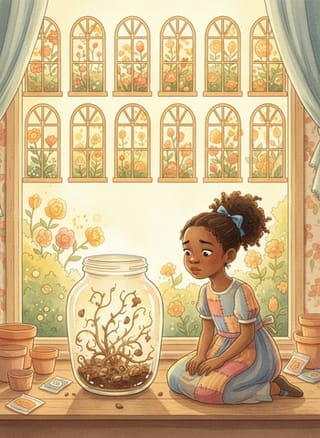
Inside was a tiny cactus. It sat in a pot the size of an egg cup. It was round and green, with white dots. It was no bigger than a thumb.
Dentro había un cactus diminuto. Estaba en una maceta del tamaño de una huevera. Era redondo y verde, con puntitos blancos. No era más grande que un pulgar.
"This is Pip," said Xavier. "I had him for four years. He never grew."
«Este es Pip», dijo Xavier. «Lo tuve cuatro años. Nunca creció».
"Why are you giving him to me?"
«¿Por qué me lo das a mí?».
"Because he cannot come in the car. My mother says the pot will break." Xavier looked at the floor. "Take care of him, okay?"
«Porque no puede ir en el auto. Mi mamá dice que la maceta se va a romper». Xavier miró el suelo. «Cuídalo, ¿sí?».
"Okay."
«Sí».
"And one more thing." Xavier pointed at the wall. "Drawer fourteen is empty. It has no seeds. I always looked at it and felt bad."
«Y una cosa más». Xavier señaló la pared. «El cajón catorce está vacío. No tiene semillas. Siempre lo miraba y me daba pena».
"What about it?"
«¿Qué pasa con él?».
"Put something in it by the end of summer. Something from Pip. Put my name on the label." Xavier tried to smile. "Then, when I come back, something has my name."
«Pon algo ahí antes de que acabe el verano. Algo de Pip. Pon mi nombre en la etiqueta». Xavier trató de sonreír. «Así, cuando vuelva, habrá algo con mi nombre».
Hugo took the little pot. It was very light.
Hugo tomó la maceta pequeña. Pesaba muy poco.
"Cactus seeds?" he said. "Pip is too young. He does not even have a flower."
«¿Semillas de cactus?», dijo. «Pip es demasiado joven. Ni siquiera tiene una flor».
"I know. That is why it is a hard one." Xavier stood up. "Promise?"
«Ya lo sé. Por eso es una tarea difícil». Xavier se puso de pie. «¿Lo prometes?».
"I promise," said Hugo.
«Lo prometo», dijo Hugo.
Xavier left on Monday. Hugo did not go to say goodbye. He stayed in his room and did not look out.
Xavier se fue el lunes. Hugo no fue a despedirse. Se quedó en su cuarto y no miró por la ventana.
That night, he put Pip on the windowsill in his room. He looked at him for a long time. "Don't worry," he said. "I know what to do."
Esa noche puso a Pip en el alféizar de su cuarto. Lo miró durante un largo rato. «No te preocupes», dijo. «Sé lo que tengo que hacer».
He did not know at all. So the next morning, he asked the librarian.
No lo sabía en absoluto. Así que a la mañana siguiente le preguntó a la bibliotecaria.
"Cactus seeds?" She raised her eyebrows. "Pip is very young. He needs sun, and he needs a lot of patience."
«¿Semillas de cactus?». Levantó las cejas. «Pip es muy joven. Necesita sol, y necesita mucha paciencia».
"How much water?"
«¿Cuánta agua?».
"Very little. Once a month, maybe."
«Muy poca. Una vez al mes, quizás».
Hugo nodded. But he did not trust the words "very little". He loved Pip, and he wanted him to grow. So he gave him water every morning.
Hugo asintió. Pero no confiaba en las palabras «muy poca». Quería mucho a Pip, y quería que creciera. Así que le daba agua todas las mañanas.
For two weeks, nothing happened. Pip sat on the windowsill and did not change. Hugo watered him and talked to him. He turned the pot to the sun.
Durante dos semanas no pasó nada. Pip se quedó en el alféizar y no cambió. Hugo lo regaba y le hablaba. Giraba la maceta hacia el sol.
Then, in the third week, Hugo touched the base of the cactus. It felt soft. It was not hard like a stone, as it was before. It felt like a wet sponge.
Entonces, en la tercera semana, Hugo tocó la base del cactus. Se sentía blanda. Ya no estaba dura como una piedra, como antes. Se sentía como una esponja mojada.
He felt cold. He ran to the hall with the pot in his hands. He put it on the librarian's table.
Sintió frío. Corrió al salón con la maceta en las manos. La puso sobre la mesa de la bibliotecaria.
"What did you do?" she asked.
«¿Qué hiciste?», preguntó ella.
"I gave him water."
«Le di agua».
"How often?"
«¿Con qué frecuencia?».
"Every day."
«Todos los días».
The librarian closed her eyes for a second. "Oh, Hugo."
La bibliotecaria cerró los ojos un segundo. «Ay, Hugo».
"Is he dead?"
«¿Está muerto?».
"Nearly." She took a small knife from her desk. "The bottom is rotten. But the top may be fine. Let me see."
«Casi». Sacó un cuchillito de su escritorio. «La parte de abajo está podrida. Pero la de arriba quizá esté bien. Déjame ver».
She cut away the soft parts, one thin slice at a time. Under the green skin, the cactus was brown and wet. She cut and cut. At last, there was only a green piece left. It was the size of a bean.
Cortó las partes blandas, una rebanada fina a la vez. Bajo la piel verde, el cactus estaba café y mojado. Cortó y cortó. Al final, solo quedó un trozo verde. Tenía el tamaño de un frijol.
"That is all that is good," she said. "Put it on a dry plate for a week. Do not touch it. Do not water it. Then plant it in dry sand."
«Eso es todo lo que está sano», dijo. «Ponlo en un plato seco durante una semana. No lo toques. No lo riegues. Luego plántalo en arena seca».
Hugo looked at the small green bean. It was not Pip any more. It was a tiny piece of Pip.
Hugo miró el pequeño frijol verde. Ya no era Pip. Era un trocito diminuto de Pip.
"I broke my promise," he said.
«Rompí mi promesa», dijo.
"Not yet." The librarian gave him a plate. "The summer is not over."
«Todavía no». La bibliotecaria le dio un plato. «El verano no ha terminado».
For the rest of August, Hugo did exactly what she said. He did not water anything. He put the green bean on a plate. Later, he put it in a pot of dry sand. He checked it every morning. Each morning, he felt a little worse.
Durante el resto de agosto, Hugo hizo exactamente lo que ella dijo. No regó nada. Puso el frijol verde en un plato. Más tarde lo puso en una maceta con arena seca. Lo revisaba todas las mañanas. Cada mañana se sentía un poco peor.
There were no seeds. There were no flowers. There was only the bean in the sand. It did not move.
No había semillas. No había flores. Solo estaba el frijol en la arena. No se movía.
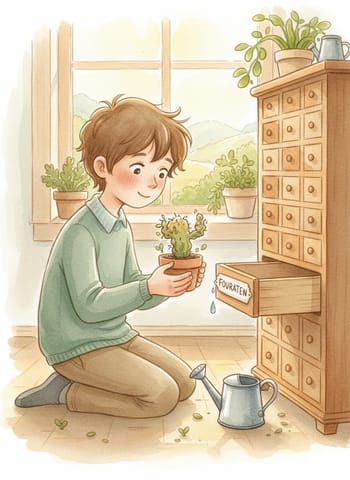
On the last Saturday of the summer, Hugo walked to the hall. He carried the pot under his arm. His feet felt heavy. He opened drawer fourteen. It was empty, with one bent paper label inside.
El último sábado del verano, Hugo caminó hasta el salón. Llevaba la maceta bajo el brazo. Los pies le pesaban. Abrió el cajón catorce. Estaba vacío, con una etiqueta de papel doblada adentro.
He took out the label. He found a pencil. Then he stopped. What could he write? "Seeds from Pip" was not true. He had no seeds.
Sacó la etiqueta. Buscó un lápiz. Luego se detuvo. ¿Qué podía escribir? «Semillas de Pip» no era verdad. No tenía semillas.
He looked at the pot. Something was different. At the bottom of the bean, a pale line came out. It was a root, thin as a thread.
Miró la maceta. Algo era diferente. En la base del trocito, salía una línea pálida. Era una raíz, fina como un hilo.
Hugo stared at it for a long moment. The cactus was not dead. It grew, very slowly, in a new place.
Hugo la miró fijamente por un largo momento. El cactus no estaba muerto. Crecía, muy lentamente, en un lugar nuevo.
"That is not a seed," he said quietly.
«Eso no es una semilla», dijo en voz baja.
"No," said the librarian from behind him. She smiled. "But the sign does not say only seeds. Look at it again."
«No», dijo la bibliotecaria detrás de él. Sonrió. «Pero el letrero no dice solo semillas. Léelo otra vez».
Hugo looked at the sign and read every word twice.
Hugo miró el letrero y leyó cada palabra dos veces.
"It says seeds," he said.
«Dice semillas», dijo.
"It does. But the rule is older than the sign. It is just this: take something, grow it and bring something back."
«Sí. Pero la regla es más antigua que el letrero. Es simplemente esto: toma algo, cultívalo y devuelve algo».
Hugo thought about that. Then he laughed, a short surprised laugh. He wrote on the label in careful letters: "From Xavier's cactus, Pip. Grow me. Bring a piece back. For Xavier."
Hugo lo pensó. Luego se rio, con una risa corta y sorprendida. Escribió en la etiqueta con letras cuidadosas: «Del cactus de Xavier, Pip. Cultívame. Devuelve un pedazo. Para Xavier».
He put the label in drawer fourteen and pushed the drawer shut. He put the little pot on the shelf beside it. It sat in the sun.
Puso la etiqueta en el cajón catorce y lo cerró de un empujón. Puso la maceta pequeña en el estante junto a él. Quedó al sol.
Then he wrote one word on the drawer card: "Xavier."
Luego escribió una palabra en la ficha del cajón: «Xavier».