A Name on Drawer Fourteen
Uma história gratuita em inglês de nível A2 para estudantes, para ler online em 7 idiomas, com opção de ouvir no app gratuito Storyteller.
Hugo promises his moving friend to put something from a tiny cactus into an empty seed drawer, but he nearly kills the plant first.
Essa foi a prévia! Ouça a história completa no app gratuito Storyteller. Baixar o app
O áudio não está disponível no momento.
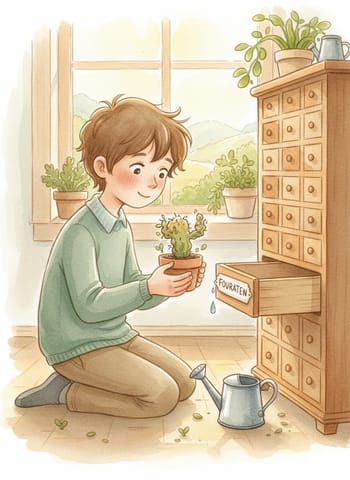
The village hall had a wall of small wooden drawers. There were sixty of them. Each drawer held paper envelopes full of seeds.
O salão da vila tinha uma parede de gavetinhas de madeira. Eram sessenta. Cada gaveta guardava envelopes de papel cheios de sementes.
A sign hung above the drawers. It said, "Take seeds. Grow them. Bring seeds back." That was the whole rule. Nobody paid, and nobody signed a paper.
Uma placa pendia acima das gavetas. Dizia: "Leve sementes. Plante-as. Traga sementes de volta." Essa era toda a regra. Ninguém pagava, e ninguém assinava papel nenhum.
Hugo worked there on Saturday mornings. He was fifteen. He sorted envelopes, wrote labels and swept the floor. In return, the librarian let him eat the biscuits on the table.
Hugo trabalhava ali nas manhãs de sábado. Tinha quinze anos. Separava envelopes, escrevia etiquetas e varria o chão. Em troca, a bibliotecária deixava que ele comesse os biscoitos da mesa.
His best friend Xavier came every Saturday too. Xavier did not like seeds. He liked the hall. It was quiet and smelled of old wood.
Seu melhor amigo Xavier também vinha todo sábado. Xavier não gostava de sementes. Gostava do salão. Era silencioso e cheirava a madeira velha.
In June, Xavier's family decided to move to a city far away. They were going to leave in two weeks. Xavier told Hugo on the steps of the hall. Neither of them spoke for a long time.
Em junho, a família de Xavier decidiu se mudar para uma cidade distante. Eles iriam embora em duas semanas. Xavier contou a Hugo nos degraus do salão. Nenhum dos dois falou por um bom tempo.
On the last Saturday, Xavier came with a small paper bag. He held it out in both hands. "Open it," he said.
No último sábado, Xavier veio com um saquinho de papel. Estendeu-o nas duas mãos. "Abra", disse.
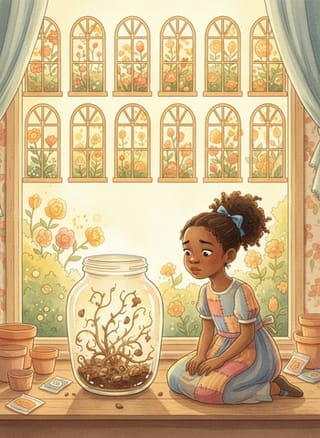
Inside was a tiny cactus. It sat in a pot the size of an egg cup. It was round and green, with white dots. It was no bigger than a thumb.
Dentro havia um cacto minúsculo. Estava num vaso do tamanho de um porta-ovo. Era redondo e verde, com pontinhos brancos. Não era maior que um polegar.
"This is Pip," said Xavier. "I had him for four years. He never grew."
"Este é o Pip", disse Xavier. "Eu o tive por quatro anos. Ele nunca cresceu."
"Why are you giving him to me?"
"Por que você está me dando ele?"
"Because he cannot come in the car. My mother says the pot will break." Xavier looked at the floor. "Take care of him, okay?"
"Porque ele não pode ir no carro. Minha mãe diz que o vaso vai quebrar." Xavier olhou para o chão. "Cuide dele, tá?"
"Okay."
"Tá."
"And one more thing." Xavier pointed at the wall. "Drawer fourteen is empty. It has no seeds. I always looked at it and felt bad."
"E mais uma coisa." Xavier apontou para a parede. "A gaveta catorze está vazia. Não tem sementes. Eu sempre olhava para ela e me sentia mal."
"What about it?"
"O que tem ela?"
"Put something in it by the end of summer. Something from Pip. Put my name on the label." Xavier tried to smile. "Then, when I come back, something has my name."
"Ponha alguma coisa nela até o fim do verão. Alguma coisa do Pip. Escreva meu nome na etiqueta." Xavier tentou sorrir. "Assim, quando eu voltar, vai ter algo com o meu nome."
Hugo took the little pot. It was very light.
Hugo pegou o vasinho. Era muito leve.
"Cactus seeds?" he said. "Pip is too young. He does not even have a flower."
"Sementes de cacto?", disse. "O Pip é novo demais. Ele nem tem flor."
"I know. That is why it is a hard one." Xavier stood up. "Promise?"
"Eu sei. É por isso que é difícil." Xavier se levantou. "Promete?"
"I promise," said Hugo.
"Prometo", disse Hugo.
Xavier left on Monday. Hugo did not go to say goodbye. He stayed in his room and did not look out.
Xavier partiu na segunda-feira. Hugo não foi se despedir. Ficou no quarto e não olhou para fora.
That night, he put Pip on the windowsill in his room. He looked at him for a long time. "Don't worry," he said. "I know what to do."
Naquela noite, pôs Pip no peitoril da janela do quarto. Olhou para ele por um bom tempo. "Não se preocupe", disse. "Eu sei o que fazer."
He did not know at all. So the next morning, he asked the librarian.
Não sabia nada. Então, na manhã seguinte, perguntou à bibliotecária.
"Cactus seeds?" She raised her eyebrows. "Pip is very young. He needs sun, and he needs a lot of patience."
"Sementes de cacto?" Ela ergueu as sobrancelhas. "O Pip é muito novo. Ele precisa de sol e de muita paciência."
"How much water?"
"Quanta água?"
"Very little. Once a month, maybe."
"Muito pouca. Uma vez por mês, talvez."
Hugo nodded. But he did not trust the words "very little". He loved Pip, and he wanted him to grow. So he gave him water every morning.
Hugo assentiu. Mas não confiava nas palavras "muito pouca". Ele amava o Pip e queria que ele crescesse. Então dava água todas as manhãs.
For two weeks, nothing happened. Pip sat on the windowsill and did not change. Hugo watered him and talked to him. He turned the pot to the sun.
Por duas semanas, nada aconteceu. Pip ficou no peitoril e não mudou. Hugo o regava e conversava com ele. Girava o vaso em direção ao sol.
Then, in the third week, Hugo touched the base of the cactus. It felt soft. It was not hard like a stone, as it was before. It felt like a wet sponge.
Então, na terceira semana, Hugo tocou a base do cacto. Ela estava mole. Não era dura como pedra, como antes. Parecia uma esponja molhada.
He felt cold. He ran to the hall with the pot in his hands. He put it on the librarian's table.
Ele sentiu um frio. Correu para o salão com o vaso nas mãos. Pôs o vaso na mesa da bibliotecária.
"What did you do?" she asked.
"O que você fez?", ela perguntou.
"I gave him water."
"Eu dei água a ele."
"How often?"
"Com que frequência?"
"Every day."
"Todo dia."
The librarian closed her eyes for a second. "Oh, Hugo."
A bibliotecária fechou os olhos por um segundo. "Ah, Hugo."
"Is he dead?"
"Ele morreu?"
"Nearly." She took a small knife from her desk. "The bottom is rotten. But the top may be fine. Let me see."
"Quase." Ela tirou uma faquinha da escrivaninha. "A parte de baixo apodreceu. Mas a de cima pode estar boa. Deixe-me ver."
She cut away the soft parts, one thin slice at a time. Under the green skin, the cactus was brown and wet. She cut and cut. At last, there was only a green piece left. It was the size of a bean.
Ela cortou as partes moles, uma fatia fina de cada vez. Sob a pele verde, o cacto estava marrom e molhado. Ela cortou e cortou. No fim, restou só um pedaço verde. Do tamanho de um feijão.
"That is all that is good," she said. "Put it on a dry plate for a week. Do not touch it. Do not water it. Then plant it in dry sand."
"Isso é tudo o que está bom", disse. "Ponha num prato seco por uma semana. Não mexa. Não regue. Depois plante em areia seca."
Hugo looked at the small green bean. It was not Pip any more. It was a tiny piece of Pip.
Hugo olhou para o pequeno feijão verde. Já não era o Pip. Era um pedacinho do Pip.
"I broke my promise," he said.
"Eu quebrei minha promessa", disse.
"Not yet." The librarian gave him a plate. "The summer is not over."
"Ainda não." A bibliotecária lhe deu um prato. "O verão não acabou."
For the rest of August, Hugo did exactly what she said. He did not water anything. He put the green bean on a plate. Later, he put it in a pot of dry sand. He checked it every morning. Each morning, he felt a little worse.
Pelo resto de agosto, Hugo fez exatamente o que ela disse. Não regou nada. Pôs o feijão verde num prato. Depois o pôs num vaso de areia seca. Olhava todas as manhãs. A cada manhã, sentia-se um pouco pior.
There were no seeds. There were no flowers. There was only the bean in the sand. It did not move.
Não havia sementes. Não havia flores. Havia só o feijão na areia. Ele não se mexia.
On the last Saturday of the summer, Hugo walked to the hall. He carried the pot under his arm. His feet felt heavy. He opened drawer fourteen. It was empty, with one bent paper label inside.
No último sábado do verão, Hugo caminhou até o salão. Levava o vaso debaixo do braço. Seus pés pareciam pesados. Abriu a gaveta catorze. Estava vazia, com uma etiqueta de papel dobrada lá dentro.
He took out the label. He found a pencil. Then he stopped. What could he write? "Seeds from Pip" was not true. He had no seeds.
Tirou a etiqueta. Achou um lápis. Então parou. O que podia escrever? "Sementes do Pip" não era verdade. Ele não tinha sementes.
He looked at the pot. Something was different. At the bottom of the bean, a pale line came out. It was a root, thin as a thread.
Olhou para o vaso. Algo estava diferente. Na base do feijão, saía uma linha pálida. Era uma raiz, fina como um fio.
Hugo stared at it for a long moment. The cactus was not dead. It grew, very slowly, in a new place.
Hugo ficou olhando por um longo momento. O cacto não estava morto. Crescia, bem devagar, num lugar novo.
"That is not a seed," he said quietly.
"Isso não é uma semente", disse baixinho.
"No," said the librarian from behind him. She smiled. "But the sign does not say only seeds. Look at it again."
"Não", disse a bibliotecária atrás dele. Ela sorriu. "Mas a placa não diz só sementes. Leia de novo."
Hugo looked at the sign and read every word twice.
Hugo olhou para a placa e leu cada palavra duas vezes.
"It says seeds," he said.
"Diz sementes", disse.
"It does. But the rule is older than the sign. It is just this: take something, grow it and bring something back."
"Diz. Mas a regra é mais antiga que a placa. É só isto: leve algo, faça crescer e traga algo de volta."
Hugo thought about that. Then he laughed, a short surprised laugh. He wrote on the label in careful letters: "From Xavier's cactus, Pip. Grow me. Bring a piece back. For Xavier."
Hugo pensou nisso. Então riu, uma risada curta e surpresa. Escreveu na etiqueta com letras caprichadas: "Do cacto do Xavier, o Pip. Plante-me. Traga um pedaço de volta. Para o Xavier."
He put the label in drawer fourteen and pushed the drawer shut. He put the little pot on the shelf beside it. It sat in the sun.
Pôs a etiqueta na gaveta catorze e empurrou a gaveta até fechar. Pôs o vasinho na prateleira ao lado. Ficou ali, ao sol.
Then he wrote one word on the drawer card: "Xavier."
Então escreveu uma palavra no cartão da gaveta: "Xavier."