The Wallet on the Green Bench
Uma história gratuita em inglês de nível B1 para estudantes, para ler online em 7 idiomas, com opção de ouvir no app gratuito Storyteller.
Two library van workers find a wallet with no name in it and try two very different ways to find its owner.
Essa foi a prévia! Ouça a história completa no app gratuito Storyteller. Baixar o app
O áudio não está disponível no momento.
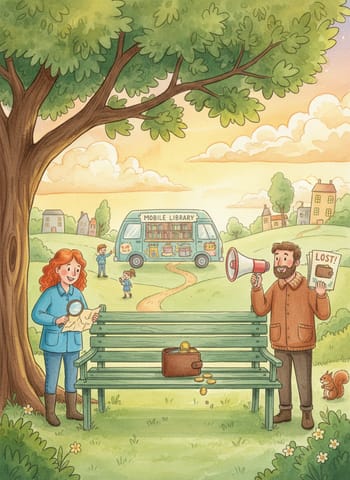
Pilar parked the library van beside the village green and switched off the engine. The morning was bright and quiet. Nobody was waiting yet. She liked this stop best, because the benches faced the old fountain and the grass smelled sweet.
Pilar estacionou a van da biblioteca ao lado da praça do vilarejo e desligou o motor. A manhã estava clara e silenciosa. Ainda não havia ninguém esperando. Ela gostava muito dessa parada, porque os bancos ficavam de frente para a velha fonte e a grama tinha um cheiro doce.
Uzma climbed out of the passenger side with a box of returned books. She had worked on the van for three months, and she still counted every book twice.
Uzma desceu pelo lado do passageiro com uma caixa de livros devolvidos. Trabalhava na van havia três meses e ainda contava cada livro duas vezes.
"Pilar, come and look," Uzma called from the far corner of the green. "There's a wallet on the bench."
"Pilar, venha ver", chamou Uzma do canto mais distante da praça. "Tem uma carteira no banco."
Pilar walked over. The wallet was brown and worn at the edges. It lay flat on the wood, as if someone had put it down on purpose.
Pilar foi até lá. A carteira era marrom e gasta nas bordas. Estava deitada sobre a madeira, como se alguém a tivesse deixado ali de propósito.
"Don't open it yet," Pilar said. "Let's see if anyone comes back for it."
"Ainda não abra", disse Pilar. "Vamos ver se alguém volta para buscá-la."
They waited ten minutes. Nobody stopped.
Esperaram dez minutos. Ninguém parou.
"Fine," Uzma said. "Now can we open it?"
"Tudo bem", disse Uzma. "Agora podemos abrir?"
Pilar nodded. Inside, they found a few coins, a shop receipt and a key on a green ribbon. There was also a small photograph of a boy holding a fish. There was no bank card and no name. There was no phone number either.
Pilar assentiu. Dentro, encontraram algumas moedas, um recibo de loja e uma chave presa a uma fita verde. Havia também uma pequena fotografia de um menino segurando um peixe. Não havia cartão do banco nem nome. Também não havia número de telefone.
"Whoever he is, he's careful," Uzma said. "Or very unlucky."
"Seja quem for, é cuidadoso", disse Uzma. "Ou muito azarado."
"Or he doesn't want to be found," Pilar said. "But I think he is just forgetful. Most people are."
"Ou não quer ser encontrado", disse Pilar. "Mas acho que é só distraído. A maioria das pessoas é."
She put the wallet in her jacket pocket. The first readers had arrived by then, and she had to open the side door of the van. For an hour, Pilar and Uzma stamped cards and answered questions. The wallet stayed heavy against Pilar's side.
Ela guardou a carteira no bolso da jaqueta. Os primeiros leitores já tinham chegado, e ela precisou abrir a porta lateral da van. Durante uma hora, Pilar e Uzma carimbaram fichas e responderam a perguntas. A carteira continuou pesando contra o lado de Pilar.
At eleven o'clock, Uzma looked up from the desk. "We can't just wait for him," she said. "Let's do something."
Às onze horas, Uzma levantou os olhos da mesa. "Não podemos simplesmente esperar por ele", disse. "Vamos fazer alguma coisa."
"Such as what?"
"Como o quê?"
"Ask around. The village shop is right there. The owner knows everybody."
"Perguntar por aí. A loja do vilarejo fica logo ali. A dona conhece todo mundo."
So they put a sign on the van door that said BACK IN TEN MINUTES. Then they walked across the green. The owner looked at the wallet for a long time and turned it over twice.
Então puseram um cartaz na porta da van que dizia VOLTO EM DEZ MINUTOS. Depois atravessaram a praça. A dona olhou a carteira por um bom tempo e a virou duas vezes.
"I've never seen it," she said. "A lot of men in this village have brown wallets."
"Nunca vi", disse. "Muitos homens deste vilarejo têm carteiras marrons."
"Do you recognise the photograph?" Pilar asked.
"Você reconhece a fotografia?", perguntou Pilar.
"A boy with a fish. That could be anyone's son, or anyone's brother." The owner gave it back. "The police station is in the next town. That's your best chance."
"Um menino com um peixe. Pode ser filho ou irmão de qualquer um." A dona devolveu a carteira. "A delegacia fica na próxima cidade. Essa é a sua melhor chance."
They tried the barber next. Then they asked the man who sold newspapers and a woman who was watering flowers. Nobody knew anything. Everybody had an opinion, though. One person said the wallet belonged to a farmer. Another said it belonged to a tourist who had already left.
Tentaram o barbeiro em seguida. Depois perguntaram ao homem que vendia jornais e a uma mulher que regava flores. Ninguém sabia de nada. Mas todo mundo tinha uma opinião. Uma pessoa disse que a carteira era de um fazendeiro. Outra disse que era de um turista que já tinha ido embora.
By noon, they were back at the van with nothing to show for their walk. Uzma sat on the step and rubbed her feet.
Ao meio-dia, estavam de volta à van sem nada para mostrar da caminhada. Uzma sentou no degrau e esfregou os pés.
"That was a failure," she said.
"Isso foi um fracasso", disse.
"It was a first attempt," Pilar said. "There is a difference."
"Foi uma primeira tentativa", disse Pilar. "Há uma diferença."
"Is there?"
"Há?"
"Yes. A failure stops. An attempt tells you what to try next."
"Há. Um fracasso para. Uma tentativa diz o que tentar em seguida."
Uzma laughed. "You should put that on a poster."
Uzma riu. "Você devia pôr isso num cartaz."
The afternoon was slow. Pilar offered to drive the wallet to the police station, but Uzma shook her head. "Then the owner has to find the police station first," she said. "Think about it. He would never look there. He would look where he lost it."
A tarde foi lenta. Pilar se ofereceu para levar a carteira à delegacia de carro, mas Uzma balançou a cabeça. "Aí o dono teria que achar a delegacia primeiro", disse. "Pense bem. Ele nunca olharia lá. Ele olharia onde a perdeu."
Pilar took the wallet out again and spread its contents on the desk. She looked at the coins, the receipt, the key, and the photograph. Then she noticed something she had missed before. A thin strip of paper had slipped behind the photograph. She pulled it out carefully.
Pilar tirou a carteira de novo e espalhou o conteúdo sobre a mesa. Olhou as moedas, o recibo, a chave e a fotografia. Então reparou em algo que antes lhe escapara. Uma tira fina de papel tinha escorregado para trás da fotografia. Ela a puxou com cuidado.
It was a due-date slip, the kind the van printed for every borrowed book. The ink had faded, but the stamp was clear. It showed a small van with open doors, the old symbol of the library.
Era um comprovante de data de devolução, do tipo que a van imprimia para cada livro emprestado. A tinta tinha desbotado, mas o carimbo estava nítido. Mostrava uma pequena van de portas abertas, o antigo símbolo da biblioteca.
"Uzma," Pilar said. "Look at this."
"Uzma", disse Pilar. "Olhe isto."
Uzma leaned over her shoulder. "A slip from our van. What's the book?"
Uzma se debruçou sobre o ombro dela. "Um comprovante da nossa van. Qual é o livro?"
"Small Boats and How to Mend Them." Pilar read the faded line again. "He borrowed it two years ago. Before you started."
"Pequenos Barcos e Como Consertá-los." Pilar leu a linha desbotada outra vez. "Ele pegou emprestado há dois anos. Antes de você começar."
"Can we find him in the records?"
"Dá para achá-lo nos registros?"
"No. We delete every name when a book comes back. That is the rule, and it is a good rule." Pilar smiled slowly. "But he must have loved that book. People keep slips for books they love."
"Não. Apagamos cada nome quando o livro volta. Essa é a regra, e é uma boa regra." Pilar sorriu devagar. "Mas ele deve ter amado esse livro. As pessoas guardam comprovantes dos livros que amam."
"So he might come back for another one."
"Então ele pode voltar para pegar outro."
"Exactly. Nobody will come looking for a lost wallet. But a man who loves boats will always come looking for a book about boats."
"Exatamente. Ninguém vai procurar uma carteira perdida. Mas um homem que ama barcos sempre vai procurar um livro sobre barcos."
Uzma stood up. "Then we stop chasing him, and we let him chase us."
Uzma se levantou. "Então paramos de correr atrás dele e deixamos que ele corra atrás de nós."
They worked quickly. Pilar found the last copy of Small Boats and How to Mend Them on the bottom shelf. Uzma set it on a stand beside the door. Next to it, she placed a hand-written card. It said: A WALLET WAS FOUND ON THE GREEN BENCH. IF YOU CAN DESCRIBE WHAT IS INSIDE, ASK THE DRIVER.
Trabalharam rápido. Pilar achou o último exemplar de Pequenos Barcos e Como Consertá-los na prateleira de baixo. Uzma o colocou num suporte ao lado da porta. Junto dele, pôs um cartão escrito à mão. Dizia: UMA CARTEIRA FOI ENCONTRADA NO BANCO VERDE. SE VOCÊ SOUBER DESCREVER O QUE HÁ DENTRO, FALE COM A MOTORISTA.
They kept the stand there for the rest of the afternoon. Several people stopped to look at it. Nobody claimed anything.
Deixaram o suporte ali pelo resto da tarde. Várias pessoas pararam para olhá-lo. Ninguém reclamou nada.
At four o'clock, Pilar started the engine for the second stop. It was a farm road at the edge of the valley. Uzma held the book stand steady on her knees. The road was rough, and the van shook like a loose drawer.
Às quatro horas, Pilar ligou o motor para a segunda parada. Era uma estrada de fazenda na beira do vale. Uzma segurava o suporte do livro firme sobre os joelhos. A estrada era áspera, e a van sacudia como uma gaveta solta.
Only one reader was waiting at the farm road. He wore a blue work shirt and stood at the gate with his hands in his pockets. His fingers were dark with oil. He came up the steps slowly and stopped when he saw the stand.
Só um leitor esperava na estrada da fazenda. Usava uma camisa azul de trabalho e estava no portão com as mãos nos bolsos. Os dedos dele estavam escuros de óleo. Subiu os degraus devagar e parou quando viu o suporte.
"Is that Small Boats?" he asked. "I've been looking for that for two years."
"Isso é Pequenos Barcos?", perguntou. "Estou procurando esse livro há dois anos."
"We kept it for you," Uzma said, before she could stop herself.
"Guardamos para você", disse Uzma, antes que pudesse se conter.
Pilar gave her a look, then turned to the man. "Did you lose anything today? Anything small and brown?"
Pilar lhe lançou um olhar, depois se virou para o homem. "Você perdeu alguma coisa hoje? Alguma coisa pequena e marrom?"
The man put a hand to his back pocket and froze. "My wallet," he said. "I thought I left it at home. I've been turning the house over since lunch."
O homem levou a mão ao bolso de trás e congelou. "Minha carteira", disse. "Achei que a tinha deixado em casa. Estou virando a casa do avesso desde o almoço."
"What is in it?" Pilar asked.
"O que tem nela?", perguntou Pilar.
"Not much. Some coins. A receipt for wire. And a photo of me when I was seven, with the biggest fish I ever caught." He grinned. "That was a lie, by the way. It was a small fish, and my father held it closer to the camera."
"Pouca coisa. Algumas moedas. Um recibo de arame. E uma foto minha aos sete anos, com o maior peixe que já peguei." Ele sorriu. "Isso era mentira, aliás. Era um peixe pequeno, e meu pai o segurou mais perto da câmera."
Pilar handed over the wallet. The man checked every part of it, one thing at a time. He seemed afraid the items had changed. Then he held the photograph up to the light and laughed.
Pilar entregou a carteira. O homem conferiu cada parte, uma coisa de cada vez. Parecia ter medo de que os itens tivessem mudado. Depois ergueu a fotografia contra a luz e riu.
"I sat on that bench to read the first chapter of this book," he said. "I must have put the wallet down to turn the page. How did you find me?"
"Sentei naquele banco para ler o primeiro capítulo deste livro", disse. "Devo ter largado a carteira para virar a página. Como vocês me acharam?"
"We didn't," Uzma said. "You found us."
"Não achamos", disse Uzma. "Você nos achou."
He borrowed the book at once. Pilar stamped the card, and Uzma printed a new slip, which he folded carefully into the wallet. At the door, he stopped and took the key on the green ribbon out of the wallet.
Ele pegou o livro emprestado na hora. Pilar carimbou a ficha, e Uzma imprimiu um novo comprovante, que ele dobrou com cuidado dentro da carteira. Na porta, ele parou e tirou da carteira a chave de fita verde.
"Please keep this for me," he said.
"Por favor, guarde isto para mim", disse.
"Why?" Pilar asked.
"Por quê?", perguntou Pilar.
"Because I have another one at home, and this is the last one I should carry around." He pressed it into her hand. "I'll tell you what it opens when I bring the boat."
"Porque tenho outra em casa, e esta é a última que eu deveria carregar por aí." Ele a pôs na mão dela. "Digo o que ela abre quando eu trouxer o barco."
He went down the steps and walked toward the gate, whistling. Pilar watched him go, with the key warm in her palm.
Desceu os degraus e foi em direção ao portão, assobiando. Pilar o viu partir, com a chave quente na palma da mão.
"What boat?" Uzma whispered.
"Que barco?", sussurrou Uzma.
"I have no idea."
"Não faço ideia."
Pilar hung the key on the hook above the driver's seat. It swung there while they drove home, tapping the glass. Neither of them said another word about it.
Pilar pendurou a chave no gancho acima do banco do motorista. Ela balançou ali durante a viagem de volta, batendo no vidro. Nenhuma das duas disse mais uma palavra sobre isso.