The Wallet on the Green Bench
Una historia gratuita en inglés de nivel B1 para estudiantes, para leer en línea en 7 idiomas, con opción de escucharla en la app gratuita Storyteller.
Two library van workers find a wallet with no name in it and try two very different ways to find its owner.
¡Ese fue el avance! Escucha la historia completa en la app gratuita Storyteller. Descargar la app
El audio no está disponible en este momento.
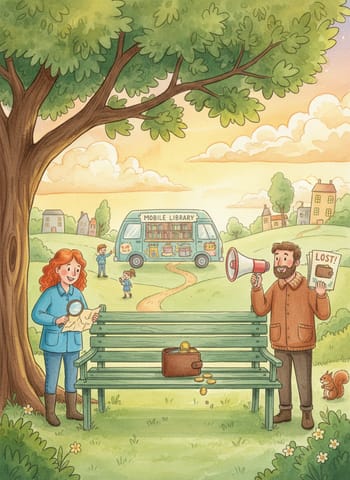
Pilar parked the library van beside the village green and switched off the engine. The morning was bright and quiet. Nobody was waiting yet. She liked this stop best, because the benches faced the old fountain and the grass smelled sweet.
Pilar estacionó la camioneta de la biblioteca junto a la plaza del pueblo y apagó el motor. La mañana era brillante y tranquila. Todavía no había nadie esperando. Esta parada le gustaba más que ninguna, porque las bancas daban a la vieja fuente y la hierba olía dulce.
Uzma climbed out of the passenger side with a box of returned books. She had worked on the van for three months, and she still counted every book twice.
Uzma bajó por el lado del pasajero con una caja de libros devueltos. Llevaba tres meses trabajando en la camioneta y aún contaba cada libro dos veces.
"Pilar, come and look," Uzma called from the far corner of the green. "There's a wallet on the bench."
«Pilar, ven a ver», llamó Uzma desde el rincón más lejano de la plaza. «Hay una cartera en la banca».
Pilar walked over. The wallet was brown and worn at the edges. It lay flat on the wood, as if someone had put it down on purpose.
Pilar se acercó. La cartera era marrón y estaba gastada en los bordes. Estaba plana sobre la madera, como si alguien la hubiera dejado ahí a propósito.
"Don't open it yet," Pilar said. "Let's see if anyone comes back for it."
«No la abras todavía», dijo Pilar. «Veamos si alguien vuelve por ella».
They waited ten minutes. Nobody stopped.
Esperaron diez minutos. Nadie se detuvo.
"Fine," Uzma said. "Now can we open it?"
«Bien», dijo Uzma. «¿Ahora podemos abrirla?».
Pilar nodded. Inside, they found a few coins, a shop receipt and a key on a green ribbon. There was also a small photograph of a boy holding a fish. There was no bank card and no name. There was no phone number either.
Pilar asintió. Adentro encontraron unas monedas, un recibo de una tienda y una llave con un listón verde. También había una pequeña fotografía de un niño sosteniendo un pescado. No había tarjeta bancaria ni nombre. Tampoco había número de teléfono.
"Whoever he is, he's careful," Uzma said. "Or very unlucky."
«Sea quien sea, es cuidadoso», dijo Uzma. «O muy desafortunado».
"Or he doesn't want to be found," Pilar said. "But I think he is just forgetful. Most people are."
«O no quiere que lo encuentren», dijo Pilar. «Pero creo que solo es distraído. La mayoría de la gente lo es».
She put the wallet in her jacket pocket. The first readers had arrived by then, and she had to open the side door of the van. For an hour, Pilar and Uzma stamped cards and answered questions. The wallet stayed heavy against Pilar's side.
Se guardó la cartera en el bolsillo de la chaqueta. Para entonces habían llegado los primeros lectores, y tuvo que abrir la puerta lateral de la camioneta. Durante una hora, Pilar y Uzma sellaron tarjetas y respondieron preguntas. La cartera pesaba contra el costado de Pilar.
At eleven o'clock, Uzma looked up from the desk. "We can't just wait for him," she said. "Let's do something."
A las once, Uzma levantó la vista del escritorio. «No podemos quedarnos esperándolo», dijo. «Hagamos algo».
"Such as what?"
«¿Como qué?».
"Ask around. The village shop is right there. The owner knows everybody."
«Preguntar por ahí. La tienda del pueblo está justo ahí. La dueña conoce a todos».
So they put a sign on the van door that said BACK IN TEN MINUTES. Then they walked across the green. The owner looked at the wallet for a long time and turned it over twice.
Así que pusieron un letrero en la puerta de la camioneta que decía VUELVO EN DIEZ MINUTOS. Luego cruzaron la plaza caminando. La dueña miró la cartera durante un buen rato y le dio la vuelta dos veces.
"I've never seen it," she said. "A lot of men in this village have brown wallets."
«Nunca la he visto», dijo. «Muchos hombres de este pueblo tienen carteras marrones».
"Do you recognise the photograph?" Pilar asked.
«¿Reconoce la fotografía?», preguntó Pilar.
"A boy with a fish. That could be anyone's son, or anyone's brother." The owner gave it back. "The police station is in the next town. That's your best chance."
«Un niño con un pescado. Podría ser el hijo de cualquiera, o el hermano de cualquiera». La dueña se la devolvió. «La comisaría está en el pueblo siguiente. Esa es su mejor oportunidad».
They tried the barber next. Then they asked the man who sold newspapers and a woman who was watering flowers. Nobody knew anything. Everybody had an opinion, though. One person said the wallet belonged to a farmer. Another said it belonged to a tourist who had already left.
Probaron luego con el barbero. Después preguntaron al hombre que vendía periódicos y a una mujer que regaba flores. Nadie sabía nada. Aunque todos tenían una opinión. Una persona dijo que la cartera era de un granjero. Otra dijo que era de un turista que ya se había ido.
By noon, they were back at the van with nothing to show for their walk. Uzma sat on the step and rubbed her feet.
Para el mediodía, estaban de vuelta en la camioneta sin nada que mostrar de su caminata. Uzma se sentó en el escalón y se frotó los pies.
"That was a failure," she said.
«Eso fue un fracaso», dijo.
"It was a first attempt," Pilar said. "There is a difference."
«Fue un primer intento», dijo Pilar. «Hay una diferencia».
"Is there?"
«¿La hay?».
"Yes. A failure stops. An attempt tells you what to try next."
«Sí. Un fracaso se detiene. Un intento te dice qué probar después».
Uzma laughed. "You should put that on a poster."
Uzma rio. «Deberías ponerlo en un cartel».
The afternoon was slow. Pilar offered to drive the wallet to the police station, but Uzma shook her head. "Then the owner has to find the police station first," she said. "Think about it. He would never look there. He would look where he lost it."
La tarde fue lenta. Pilar se ofreció a llevar la cartera a la comisaría, pero Uzma negó con la cabeza. «Entonces el dueño tiene que encontrar primero la comisaría», dijo. «Piénsalo. Nunca buscaría allí. Buscaría donde la perdió».
Pilar took the wallet out again and spread its contents on the desk. She looked at the coins, the receipt, the key, and the photograph. Then she noticed something she had missed before. A thin strip of paper had slipped behind the photograph. She pulled it out carefully.
Pilar sacó la cartera otra vez y extendió su contenido sobre el escritorio. Miró las monedas, el recibo, la llave y la fotografía. Entonces notó algo que antes se le había escapado. Una fina tira de papel se había deslizado detrás de la fotografía. La sacó con cuidado.
It was a due-date slip, the kind the van printed for every borrowed book. The ink had faded, but the stamp was clear. It showed a small van with open doors, the old symbol of the library.
Era un comprobante de fecha de devolución, de los que la camioneta imprimía por cada libro prestado. La tinta se había desvanecido, pero el sello se veía claro. Mostraba una pequeña camioneta con las puertas abiertas, el viejo símbolo de la biblioteca.
"Uzma," Pilar said. "Look at this."
«Uzma», dijo Pilar. «Mira esto».
Uzma leaned over her shoulder. "A slip from our van. What's the book?"
Uzma se inclinó sobre su hombro. «Un comprobante de nuestra camioneta. ¿Cuál es el libro?».
"Small Boats and How to Mend Them." Pilar read the faded line again. "He borrowed it two years ago. Before you started."
«Botes pequeños y cómo repararlos». Pilar volvió a leer la línea desvanecida. «Lo pidió prestado hace dos años. Antes de que tú empezaras».
"Can we find him in the records?"
«¿Podemos encontrarlo en los registros?».
"No. We delete every name when a book comes back. That is the rule, and it is a good rule." Pilar smiled slowly. "But he must have loved that book. People keep slips for books they love."
«No. Borramos cada nombre cuando un libro regresa. Esa es la regla, y es una buena regla». Pilar sonrió despacio. «Pero debe de haber amado ese libro. La gente guarda los comprobantes de los libros que ama».
"So he might come back for another one."
«Así que podría volver por otro».
"Exactly. Nobody will come looking for a lost wallet. But a man who loves boats will always come looking for a book about boats."
«Exacto. Nadie vendrá a buscar una cartera perdida. Pero un hombre que ama los botes siempre vendrá a buscar un libro sobre botes».
Uzma stood up. "Then we stop chasing him, and we let him chase us."
Uzma se puso de pie. «Entonces dejamos de perseguirlo, y dejamos que él nos persiga a nosotras».
They worked quickly. Pilar found the last copy of Small Boats and How to Mend Them on the bottom shelf. Uzma set it on a stand beside the door. Next to it, she placed a hand-written card. It said: A WALLET WAS FOUND ON THE GREEN BENCH. IF YOU CAN DESCRIBE WHAT IS INSIDE, ASK THE DRIVER.
Trabajaron rápido. Pilar encontró el último ejemplar de Botes pequeños y cómo repararlos en el estante de abajo. Uzma lo puso en un atril junto a la puerta. Al lado colocó una tarjeta escrita a mano. Decía: SE ENCONTRÓ UNA CARTERA EN LA BANCA VERDE. SI PUEDE DESCRIBIR LO QUE HAY DENTRO, PREGUNTE A LA CONDUCTORA.
They kept the stand there for the rest of the afternoon. Several people stopped to look at it. Nobody claimed anything.
Dejaron el atril ahí el resto de la tarde. Varias personas se detuvieron a mirarlo. Nadie reclamó nada.
At four o'clock, Pilar started the engine for the second stop. It was a farm road at the edge of the valley. Uzma held the book stand steady on her knees. The road was rough, and the van shook like a loose drawer.
A las cuatro, Pilar arrancó el motor para la segunda parada. Era un camino rural en el borde del valle. Uzma sostenía el atril de libros firme sobre las rodillas. El camino era áspero y la camioneta temblaba como un cajón suelto.
Only one reader was waiting at the farm road. He wore a blue work shirt and stood at the gate with his hands in his pockets. His fingers were dark with oil. He came up the steps slowly and stopped when he saw the stand.
Solo un lector esperaba en el camino rural. Llevaba una camisa de trabajo azul y estaba en la verja con las manos en los bolsillos. Tenía los dedos oscuros de aceite. Subió los escalones despacio y se detuvo al ver el atril.
"Is that Small Boats?" he asked. "I've been looking for that for two years."
«¿Eso es Botes pequeños?», preguntó. «Llevo dos años buscándolo».
"We kept it for you," Uzma said, before she could stop herself.
«Se lo guardamos», dijo Uzma, antes de poder contenerse.
Pilar gave her a look, then turned to the man. "Did you lose anything today? Anything small and brown?"
Pilar le lanzó una mirada y luego se volvió hacia el hombre. «¿Ha perdido algo hoy? ¿Algo pequeño y marrón?».
The man put a hand to his back pocket and froze. "My wallet," he said. "I thought I left it at home. I've been turning the house over since lunch."
El hombre se llevó una mano al bolsillo trasero y se quedó helado. «Mi cartera», dijo. «Pensé que la había dejado en casa. Llevo desde el almuerzo poniendo la casa patas arriba».
"What is in it?" Pilar asked.
«¿Qué hay en ella?», preguntó Pilar.
"Not much. Some coins. A receipt for wire. And a photo of me when I was seven, with the biggest fish I ever caught." He grinned. "That was a lie, by the way. It was a small fish, and my father held it closer to the camera."
«No mucho. Unas monedas. Un recibo de alambre. Y una foto mía a los siete años, con el pescado más grande que he pescado». Sonrió. «Eso fue mentira, por cierto. Era un pescado pequeño, y mi padre lo sostuvo más cerca de la cámara».
Pilar handed over the wallet. The man checked every part of it, one thing at a time. He seemed afraid the items had changed. Then he held the photograph up to the light and laughed.
Pilar le entregó la cartera. El hombre revisó cada parte, una cosa a la vez. Parecía temer que los objetos hubieran cambiado. Luego levantó la fotografía a la luz y rio.
"I sat on that bench to read the first chapter of this book," he said. "I must have put the wallet down to turn the page. How did you find me?"
«Me senté en esa banca a leer el primer capítulo de este libro», dijo. «Debí de dejar la cartera para pasar la página. ¿Cómo me encontraron?».
"We didn't," Uzma said. "You found us."
«No lo hicimos», dijo Uzma. «Usted nos encontró a nosotras».
He borrowed the book at once. Pilar stamped the card, and Uzma printed a new slip, which he folded carefully into the wallet. At the door, he stopped and took the key on the green ribbon out of the wallet.
Se llevó el libro prestado de inmediato. Pilar selló la tarjeta, y Uzma imprimió un comprobante nuevo, que él dobló con cuidado dentro de la cartera. En la puerta, se detuvo y sacó de la cartera la llave con el listón verde.
"Please keep this for me," he said.
«Por favor, guárdenme esto», dijo.
"Why?" Pilar asked.
«¿Por qué?», preguntó Pilar.
"Because I have another one at home, and this is the last one I should carry around." He pressed it into her hand. "I'll tell you what it opens when I bring the boat."
«Porque tengo otra en casa, y esta es la última que debería llevar por ahí». Se la puso en la mano. «Les diré qué abre cuando traiga el bote».
He went down the steps and walked toward the gate, whistling. Pilar watched him go, with the key warm in her palm.
Bajó los escalones y caminó hacia la verja, silbando. Pilar lo vio irse, con la llave tibia en la palma.
"What boat?" Uzma whispered.
«¿Qué bote?», susurró Uzma.
"I have no idea."
«No tengo ni idea».
Pilar hung the key on the hook above the driver's seat. It swung there while they drove home, tapping the glass. Neither of them said another word about it.
Pilar colgó la llave del gancho sobre el asiento del conductor. Se balanceó allí mientras conducían a casa, golpeteando el vidrio. Ninguna de las dos dijo otra palabra al respecto.