The Wallet on the Green Bench
Cerita bahasa Inggris gratis level B1 untuk pelajar, bisa dibaca online dalam 7 bahasa, dengan pilihan untuk mendengarkannya di aplikasi Storyteller gratis.
Two library van workers find a wallet with no name in it and try two very different ways to find its owner.
Itu cuplikannya! Dengarkan cerita lengkapnya di aplikasi Storyteller gratis. Unduh aplikasi
Audio belum tersedia saat ini.
Pilar parked the library van beside the village green and switched off the engine. The morning was bright and quiet. Nobody was waiting yet. She liked this stop best, because the benches faced the old fountain and the grass smelled sweet.
Pilar memarkir van perpustakaan di samping lapangan rumput desa dan mematikan mesin. Paginya cerah dan tenang. Belum ada yang menunggu. Ia paling suka perhentian ini, karena bangku-bangkunya menghadap air mancur tua dan rumputnya berbau harum.
Uzma climbed out of the passenger side with a box of returned books. She had worked on the van for three months, and she still counted every book twice.
Uzma turun dari sisi penumpang sambil membawa sekotak buku yang dikembalikan. Ia sudah tiga bulan bekerja di van itu, dan ia masih menghitung setiap buku dua kali.
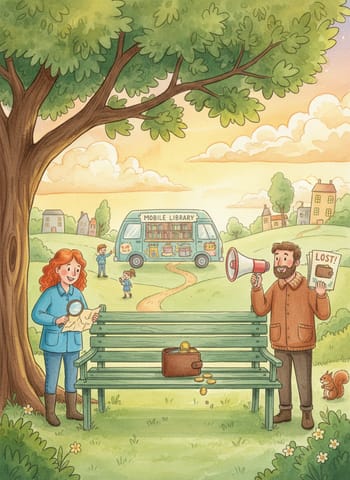
"Pilar, come and look," Uzma called from the far corner of the green. "There's a wallet on the bench."
"Pilar, sini lihat," seru Uzma dari sudut jauh lapangan rumput. "Ada dompet di bangku."
Pilar walked over. The wallet was brown and worn at the edges. It lay flat on the wood, as if someone had put it down on purpose.
Pilar berjalan menghampiri. Dompet itu cokelat dan aus di bagian tepinya. Dompet itu tergeletak datar di atas kayu, seakan seseorang sengaja menaruhnya di sana.
"Don't open it yet," Pilar said. "Let's see if anyone comes back for it."
"Jangan dibuka dulu," kata Pilar. "Kita lihat dulu apakah ada yang kembali mengambilnya."
They waited ten minutes. Nobody stopped.
Mereka menunggu sepuluh menit. Tidak ada yang berhenti.
"Fine," Uzma said. "Now can we open it?"
"Baiklah," kata Uzma. "Sekarang boleh kita buka?"
Pilar nodded. Inside, they found a few coins, a shop receipt and a key on a green ribbon. There was also a small photograph of a boy holding a fish. There was no bank card and no name. There was no phone number either.
Pilar mengangguk. Di dalamnya, mereka menemukan beberapa koin, sebuah struk toko, dan sebuah kunci dengan pita hijau. Ada juga selembar foto kecil seorang anak laki-laki yang memegang ikan. Tidak ada kartu bank dan tidak ada nama. Tidak ada nomor telepon juga.
"Whoever he is, he's careful," Uzma said. "Or very unlucky."
"Siapa pun dia, dia orang yang berhati-hati," kata Uzma. "Atau sangat sial."
"Or he doesn't want to be found," Pilar said. "But I think he is just forgetful. Most people are."
"Atau dia tidak ingin ditemukan," kata Pilar. "Tapi kurasa dia hanya pelupa. Kebanyakan orang begitu."
She put the wallet in her jacket pocket. The first readers had arrived by then, and she had to open the side door of the van. For an hour, Pilar and Uzma stamped cards and answered questions. The wallet stayed heavy against Pilar's side.
Ia memasukkan dompet itu ke saku jaketnya. Para pembaca pertama sudah berdatangan, dan ia harus membuka pintu samping van. Selama satu jam, Pilar dan Uzma mencap kartu dan menjawab pertanyaan. Dompet itu terasa berat di sisi tubuh Pilar.
At eleven o'clock, Uzma looked up from the desk. "We can't just wait for him," she said. "Let's do something."
Pukul sebelas, Uzma mengangkat kepala dari meja. "Kita tidak bisa hanya menunggunya," katanya. "Ayo lakukan sesuatu."
"Such as what?"
"Seperti apa?"
"Ask around. The village shop is right there. The owner knows everybody."
"Bertanya-tanya. Toko desa ada di sana. Pemiliknya kenal semua orang."
So they put a sign on the van door that said BACK IN TEN MINUTES. Then they walked across the green. The owner looked at the wallet for a long time and turned it over twice.
Maka mereka memasang tanda di pintu van yang bertuliskan SEPULUH MENIT LAGI KEMBALI. Lalu mereka berjalan menyeberangi lapangan rumput. Pemilik toko itu menatap dompet tersebut lama sekali dan membaliknya dua kali.
"I've never seen it," she said. "A lot of men in this village have brown wallets."
"Saya belum pernah melihatnya," katanya. "Banyak laki-laki di desa ini punya dompet cokelat."
"Do you recognise the photograph?" Pilar asked.
"Apakah Ibu mengenali fotonya?" tanya Pilar.
"A boy with a fish. That could be anyone's son, or anyone's brother." The owner gave it back. "The police station is in the next town. That's your best chance."
"Anak laki-laki dengan ikan. Itu bisa anak siapa saja, atau adik siapa saja." Pemilik toko mengembalikannya. "Kantor polisi ada di kota sebelah. Itu kesempatan terbaik kalian."
They tried the barber next. Then they asked the man who sold newspapers and a woman who was watering flowers. Nobody knew anything. Everybody had an opinion, though. One person said the wallet belonged to a farmer. Another said it belonged to a tourist who had already left.
Berikutnya mereka mencoba tukang cukur. Lalu mereka bertanya kepada penjual koran dan seorang perempuan yang sedang menyiram bunga. Tidak ada yang tahu apa-apa. Tapi semua orang punya pendapat. Seseorang bilang dompet itu milik petani. Yang lain bilang dompet itu milik turis yang sudah pergi.
By noon, they were back at the van with nothing to show for their walk. Uzma sat on the step and rubbed her feet.
Menjelang tengah hari, mereka sudah kembali ke van tanpa hasil apa pun dari jalan-jalan tadi. Uzma duduk di anak tangga dan memijat kakinya.
"That was a failure," she said.
"Itu gagal," katanya.
"It was a first attempt," Pilar said. "There is a difference."
"Itu percobaan pertama," kata Pilar. "Ada bedanya."
"Is there?"
"Memangnya ada?"
"Yes. A failure stops. An attempt tells you what to try next."
"Ada. Kegagalan berhenti. Percobaan memberi tahu apa yang harus dicoba berikutnya."
Uzma laughed. "You should put that on a poster."
Uzma tertawa. "Kamu harus menaruhnya di poster."
The afternoon was slow. Pilar offered to drive the wallet to the police station, but Uzma shook her head. "Then the owner has to find the police station first," she said. "Think about it. He would never look there. He would look where he lost it."
Siang itu berjalan lambat. Pilar menawarkan diri mengantar dompet ke kantor polisi, tetapi Uzma menggeleng. "Nanti pemiliknya harus menemukan kantor polisi dulu," katanya. "Coba pikir. Dia tidak akan mencari ke sana. Dia akan mencari di tempat ia kehilangannya."
Pilar took the wallet out again and spread its contents on the desk. She looked at the coins, the receipt, the key, and the photograph. Then she noticed something she had missed before. A thin strip of paper had slipped behind the photograph. She pulled it out carefully.
Pilar mengeluarkan dompet itu lagi dan menyebar isinya di atas meja. Ia memandangi koin, struk, kunci, dan foto itu. Lalu ia melihat sesuatu yang sebelumnya terlewat. Secarik kertas tipis terselip di balik foto. Ia menariknya keluar dengan hati-hati.
It was a due-date slip, the kind the van printed for every borrowed book. The ink had faded, but the stamp was clear. It showed a small van with open doors, the old symbol of the library.
Itu secarik slip tanggal jatuh tempo, jenis yang dicetak van itu untuk setiap buku yang dipinjam. Tintanya sudah pudar, tetapi capnya masih jelas. Cap itu menunjukkan sebuah van kecil dengan pintu terbuka, lambang lama perpustakaan itu.
"Uzma," Pilar said. "Look at this."
"Uzma," kata Pilar. "Lihat ini."
Uzma leaned over her shoulder. "A slip from our van. What's the book?"
Uzma mencondongkan badan di balik bahunya. "Slip dari van kita. Bukunya apa?"
"Small Boats and How to Mend Them." Pilar read the faded line again. "He borrowed it two years ago. Before you started."
"Perahu Kecil dan Cara Memperbaikinya." Pilar membaca baris yang pudar itu lagi. "Dia meminjamnya dua tahun lalu. Sebelum kamu mulai bekerja."
"Can we find him in the records?"
"Bisa kita temukan dia di catatan?"
"No. We delete every name when a book comes back. That is the rule, and it is a good rule." Pilar smiled slowly. "But he must have loved that book. People keep slips for books they love."
"Tidak. Kita menghapus setiap nama saat buku dikembalikan. Itu aturannya, dan itu aturan yang bagus." Pilar tersenyum perlahan. "Tapi dia pasti sangat menyukai buku itu. Orang menyimpan slip untuk buku yang mereka sukai."
"So he might come back for another one."
"Jadi mungkin dia akan kembali untuk buku lain."
"Exactly. Nobody will come looking for a lost wallet. But a man who loves boats will always come looking for a book about boats."
"Tepat. Tidak ada yang akan datang mencari dompet yang hilang. Tapi laki-laki yang suka perahu pasti akan datang mencari buku tentang perahu."
Uzma stood up. "Then we stop chasing him, and we let him chase us."
Uzma berdiri. "Kalau begitu kita berhenti mengejarnya, dan kita biarkan dia yang mengejar kita."
They worked quickly. Pilar found the last copy of Small Boats and How to Mend Them on the bottom shelf. Uzma set it on a stand beside the door. Next to it, she placed a hand-written card. It said: A WALLET WAS FOUND ON THE GREEN BENCH. IF YOU CAN DESCRIBE WHAT IS INSIDE, ASK THE DRIVER.
Mereka bekerja cepat. Pilar menemukan eksemplar terakhir Perahu Kecil dan Cara Memperbaikinya di rak paling bawah. Uzma menaruhnya di penyangga di samping pintu. Di sebelahnya, ia menempatkan sebuah kartu tulisan tangan. Bunyinya: SEBUAH DOMPET DITEMUKAN DI BANGKU HIJAU. JIKA ANDA BISA MENYEBUTKAN ISINYA, TANYAKAN KEPADA SOPIR.
They kept the stand there for the rest of the afternoon. Several people stopped to look at it. Nobody claimed anything.
Mereka membiarkan penyangga itu di sana sepanjang sisa sore. Beberapa orang berhenti untuk melihatnya. Tidak ada yang mengaku memiliki apa pun.
At four o'clock, Pilar started the engine for the second stop. It was a farm road at the edge of the valley. Uzma held the book stand steady on her knees. The road was rough, and the van shook like a loose drawer.
Pukul empat, Pilar menyalakan mesin untuk perhentian kedua. Tempatnya jalan pertanian di tepi lembah. Uzma memegangi penyangga buku itu agar tetap stabil di pangkuannya. Jalannya kasar, dan van itu berguncang seperti laci yang longgar.
Only one reader was waiting at the farm road. He wore a blue work shirt and stood at the gate with his hands in his pockets. His fingers were dark with oil. He came up the steps slowly and stopped when he saw the stand.
Hanya satu pembaca yang menunggu di jalan pertanian itu. Ia mengenakan kemeja kerja biru dan berdiri di gerbang dengan tangan di saku. Jari-jarinya hitam oleh oli. Ia menaiki tangga dengan pelan dan berhenti ketika melihat penyangga itu.
"Is that Small Boats?" he asked. "I've been looking for that for two years."
"Itu Perahu Kecil?" tanyanya. "Saya sudah mencarinya selama dua tahun."
"We kept it for you," Uzma said, before she could stop herself.
"Kami menyimpannya untuk Anda," kata Uzma, sebelum sempat menahan diri.
Pilar gave her a look, then turned to the man. "Did you lose anything today? Anything small and brown?"
Pilar menatapnya sekilas, lalu berpaling kepada laki-laki itu. "Apakah hari ini Anda kehilangan sesuatu? Sesuatu yang kecil dan cokelat?"
The man put a hand to his back pocket and froze. "My wallet," he said. "I thought I left it at home. I've been turning the house over since lunch."
Laki-laki itu meraba saku belakangnya dan membeku. "Dompet saya," katanya. "Saya kira tertinggal di rumah. Sejak makan siang saya sudah membongkar seisi rumah."
"What is in it?" Pilar asked.
"Apa isinya?" tanya Pilar.
"Not much. Some coins. A receipt for wire. And a photo of me when I was seven, with the biggest fish I ever caught." He grinned. "That was a lie, by the way. It was a small fish, and my father held it closer to the camera."
"Tidak banyak. Beberapa koin. Struk pembelian kawat. Dan foto saya waktu umur tujuh tahun, dengan ikan terbesar yang pernah saya tangkap." Ia menyeringai. "Omong-omong, itu bohong. Ikannya kecil, dan ayah saya memegangnya lebih dekat ke kamera."
Pilar handed over the wallet. The man checked every part of it, one thing at a time. He seemed afraid the items had changed. Then he held the photograph up to the light and laughed.
Pilar menyerahkan dompet itu. Laki-laki itu memeriksa setiap bagiannya, satu per satu. Ia tampak takut isinya sudah berubah. Lalu ia mengangkat foto itu ke arah cahaya dan tertawa.
"I sat on that bench to read the first chapter of this book," he said. "I must have put the wallet down to turn the page. How did you find me?"
"Saya duduk di bangku itu untuk membaca bab pertama buku ini," katanya. "Saya pasti menaruh dompet itu untuk membalik halaman. Bagaimana kalian menemukan saya?"
"We didn't," Uzma said. "You found us."
"Kami tidak menemukan Anda," kata Uzma. "Anda yang menemukan kami."
He borrowed the book at once. Pilar stamped the card, and Uzma printed a new slip, which he folded carefully into the wallet. At the door, he stopped and took the key on the green ribbon out of the wallet.
Ia langsung meminjam buku itu. Pilar mencap kartunya, dan Uzma mencetak slip baru, yang dilipatnya dengan hati-hati ke dalam dompet. Di pintu, ia berhenti dan mengeluarkan kunci berpita hijau dari dompet itu.
"Please keep this for me," he said.
"Tolong simpankan ini untuk saya," katanya.
"Why?" Pilar asked.
"Kenapa?" tanya Pilar.
"Because I have another one at home, and this is the last one I should carry around." He pressed it into her hand. "I'll tell you what it opens when I bring the boat."
"Karena saya punya satu lagi di rumah, dan yang ini sebaiknya tidak lagi saya bawa-bawa." Ia menekankannya ke tangan Pilar. "Akan saya beri tahu apa yang bisa dibukanya ketika saya membawa perahunya."
He went down the steps and walked toward the gate, whistling. Pilar watched him go, with the key warm in her palm.
Ia menuruni tangga dan berjalan ke arah gerbang sambil bersiul. Pilar memandanginya pergi, dengan kunci yang hangat di telapak tangannya.
"What boat?" Uzma whispered.
"Perahu apa?" bisik Uzma.
"I have no idea."
"Aku tidak tahu."
Pilar hung the key on the hook above the driver's seat. It swung there while they drove home, tapping the glass. Neither of them said another word about it.
Pilar menggantung kunci itu di kait di atas kursi sopir. Kunci itu berayun di sana selama mereka berkendara pulang, mengetuk kaca. Tak satu pun dari mereka berkata apa-apa lagi tentang itu.