The Paintbrush from the Flea Market
Uma história gratuita em inglês de nível A1 para estudantes, para ler online em 7 idiomas, com opção de ouvir no app gratuito Storyteller.
Willa buys an old brush that makes whatever she paints a little bit real.
Essa foi a prévia! Ouça a história completa no app gratuito Storyteller. Baixar o app
O áudio não está disponível no momento.
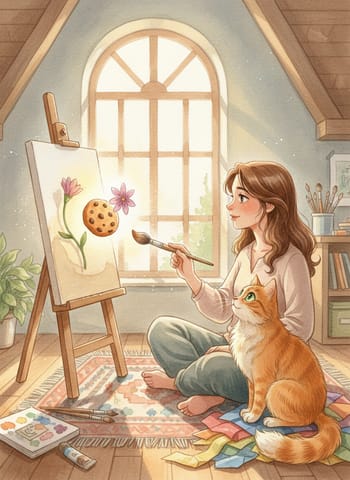
On Sunday, Willa bought an old paintbrush. She found it at the flea market. It cost two coins. The handle was dark wood. The hairs were soft and blue at the tips. The woman at the stall said only one thing. "It likes to paint what is true."
No domingo, Willa comprou um pincel velho. Ela o achou na feira de antiguidades. Custou duas moedas. O cabo era de madeira escura. Os pelos eram macios e tinham as pontas azuis. A mulher da barraca disse só uma coisa. "Ele gosta de pintar o que é verdade."
Willa did not understand. But the brush felt good in her hand. So she bought it.
Willa não entendeu. Mas o pincel ficou bom na mão dela. Então ela o comprou.
On Wednesday, she went to her painting class. It was in the park. The teacher put a bowl of apples on a table. Everyone sat on the grass with paper and paint.
Na quarta-feira, ela foi para a aula de pintura. Era no parque. A professora colocou uma tigela de maçãs sobre uma mesa. Todos se sentaram na grama com papel e tinta.
Willa dipped the new brush in water. She drew a gray cloud at the top. It was a small cloud. She made it softer with one stroke.
Willa molhou o pincel novo na água. Desenhou uma nuvem cinza no alto. Era uma nuvem pequena. Ela a deixou mais suave com uma pincelada.
Then something touched her hand. It was cold and wet. She looked at the paper. A small drop of water sat on the cloud. She looked up at the sky. It was clear and blue.
Então algo tocou a mão dela. Era frio e molhado. Ela olhou para o papel. Uma pequena gota de água estava sobre a nuvem. Ela olhou para o céu. Estava limpo e azul.
"That is strange," she said to herself.
"Que estranho", disse ela para si mesma.
She put the brush in the yellow paint. She made a sun. The paper grew warm under her hand. It felt like a cup of tea. She smiled.
Ela mergulhou o pincel na tinta amarela. Fez um sol. O papel ficou quente sob a mão dela. Era como uma xícara de chá. Ela sorriu.
"What a nice sun," said the girl next to her. The girl's name was Nora. "Mine looks like a lemon."
"Que sol bonito", disse a menina ao lado dela. O nome da menina era Nora. "O meu parece um limão."
Willa wanted to say, "Mine is a magic sun." But she kept quiet.
Willa quis dizer: "O meu é um sol mágico." Mas ficou quieta.
Next, she painted a small blue bird on a branch. She finished the last feather. Then she heard a sound. It was very quiet. It was just one note. Tweet.
Em seguida, pintou um pequeno pássaro azul num galho. Terminou a última pena. Então ouviu um som. Era muito baixinho. Era só uma nota. Piu.
Willa looked around. No one else heard it. The teacher walked past and looked at the apples. The other students bent over their papers.
Willa olhou em volta. Ninguém mais ouviu. A professora passou e olhou para as maçãs. Os outros alunos estavam curvados sobre os papéis.
Willa laughed softly. The old woman was right. The brush painted what was true. Or maybe it made true what she painted. She did not know. She only knew she loved it.
Willa riu baixinho. A velha tinha razão. O pincel pintava o que era verdade. Ou talvez fizesse virar verdade o que ela pintava. Ela não sabia. Só sabia que adorava aquele pincel.
She painted a tiny house. A light came on in its window.
Ela pintou uma casinha minúscula. Uma luz se acendeu na janela.
After half an hour, Nora called out, "Oh no!" Her painting was wet. Her red apple ran down the paper in long lines. A cloud sat over the picture, and it rained. Willa saw her own gray cloud on Nora's paper. The brush was still in her hand.
Depois de meia hora, Nora gritou: "Ai, não!" A pintura dela estava molhada. A maçã vermelha escorria pelo papel em longas linhas. Uma nuvem estava sobre o desenho, e chovia. Willa viu a própria nuvem cinza no papel de Nora. O pincel ainda estava na mão dela.
"I am so sorry," Willa said. "My brush did that."
"Sinto muito", disse Willa. "Foi o meu pincel que fez isso."
"Your brush?" Nora asked. "Don't be silly. The paper is just wet."
"O seu pincel?", perguntou Nora. "Não seja boba. O papel só está molhado."
Willa did not argue. She painted a bright sun on her own paper. Then she held the brush over Nora's picture. A warm light fell on it. Slowly, the paper dried. The red apple stopped running. Nora's mouth fell open.
Willa não discutiu. Pintou um sol brilhante no próprio papel. Depois segurou o pincel sobre o desenho de Nora. Uma luz quente caiu sobre ele. Aos poucos, o papel secou. A maçã vermelha parou de escorrer. Nora ficou de boca aberta.
"How did you do that?" she said.
"Como você fez isso?", perguntou ela.
"I think it is a good brush," said Willa.
"Acho que é um bom pincel", disse Willa.
At the end, the teacher walked around the circle. She stopped at Willa's painting. It showed the sun and the cloud. It showed the bird and the house. The teacher looked at it for a long time.
No fim, a professora passou pelo círculo. Parou diante da pintura de Willa. Ela mostrava o sol e a nuvem. Mostrava o pássaro e a casa. A professora olhou para ela por um bom tempo.
"This is very alive," she said quietly.
"Isto é muito vivo", disse ela baixinho.
Willa dipped the brush in brown paint one more time. She painted a small cup of tea. The smell of mint filled the air. She lifted the paper. She slid it across the grass to her teacher.
Willa molhou o pincel na tinta marrom mais uma vez. Pintou uma pequena xícara de chá. O cheiro de hortelã encheu o ar. Ela levantou o papel. Deslizou-o pela grama até a professora.
The teacher picked up the cup. She smiled and took a sip.
A professora pegou a xícara. Sorriu e tomou um gole.