The Paintbrush from the Flea Market
Una historia gratuita en inglés de nivel A1 para estudiantes, para leer en línea en 7 idiomas, con opción de escucharla en la app gratuita Storyteller.
Willa buys an old brush that makes whatever she paints a little bit real.
¡Ese fue el avance! Escucha la historia completa en la app gratuita Storyteller. Descargar la app
El audio no está disponible en este momento.
On Sunday, Willa bought an old paintbrush. She found it at the flea market. It cost two coins. The handle was dark wood. The hairs were soft and blue at the tips. The woman at the stall said only one thing. "It likes to paint what is true."
El domingo, Willa compró un pincel viejo. Lo encontró en el mercado de pulgas. Costaba dos monedas. El mango era de madera oscura. Las cerdas eran suaves y azules en las puntas. La mujer del puesto solo dijo una cosa: «Le gusta pintar lo que es verdad».
Willa did not understand. But the brush felt good in her hand. So she bought it.
Willa no entendió. Pero el pincel se sentía bien en su mano. Así que lo compró.
On Wednesday, she went to her painting class. It was in the park. The teacher put a bowl of apples on a table. Everyone sat on the grass with paper and paint.
El miércoles fue a su clase de pintura. Era en el parque. El profesor puso un frutero con manzanas sobre una mesa. Todos se sentaron en el pasto con papel y pinturas.
Willa dipped the new brush in water. She drew a gray cloud at the top. It was a small cloud. She made it softer with one stroke.
Willa mojó el pincel nuevo en agua. Dibujó una nube gris arriba. Era una nube pequeña. La suavizó con una sola pincelada.
Then something touched her hand. It was cold and wet. She looked at the paper. A small drop of water sat on the cloud. She looked up at the sky. It was clear and blue.
Entonces algo le tocó la mano. Era frío y mojado. Miró el papel. Una pequeña gota de agua descansaba sobre la nube. Miró hacia el cielo. Estaba despejado y azul.
"That is strange," she said to herself.
—Qué raro —se dijo a sí misma.
She put the brush in the yellow paint. She made a sun. The paper grew warm under her hand. It felt like a cup of tea. She smiled.
Metió el pincel en la pintura amarilla. Hizo un sol. El papel se calentó bajo su mano. Se sentía como una taza de té. Sonrió.
"What a nice sun," said the girl next to her. The girl's name was Nora. "Mine looks like a lemon."
—Qué lindo sol —dijo la chica de al lado. Se llamaba Nora—. El mío parece un limón.
Willa wanted to say, "Mine is a magic sun." But she kept quiet.
Willa quiso decir: «El mío es un sol mágico». Pero se quedó callada.
Next, she painted a small blue bird on a branch. She finished the last feather. Then she heard a sound. It was very quiet. It was just one note. Tweet.
Después pintó un pajarito azul en una rama. Terminó la última pluma. Entonces oyó un sonido. Era muy suave. Solo una nota. Pío.
Willa looked around. No one else heard it. The teacher walked past and looked at the apples. The other students bent over their papers.
Willa miró a su alrededor. Nadie más lo oyó. El profesor pasó de largo mirando las manzanas. Los demás alumnos estaban inclinados sobre sus papeles.
Willa laughed softly. The old woman was right. The brush painted what was true. Or maybe it made true what she painted. She did not know. She only knew she loved it.
Willa se rio bajito. La anciana tenía razón. El pincel pintaba lo que era verdad. O quizá hacía verdad lo que ella pintaba. No lo sabía. Solo sabía que lo adoraba.
She painted a tiny house. A light came on in its window.
Pintó una casita diminuta. Se encendió una luz en su ventana.
After half an hour, Nora called out, "Oh no!" Her painting was wet. Her red apple ran down the paper in long lines. A cloud sat over the picture, and it rained. Willa saw her own gray cloud on Nora's paper. The brush was still in her hand.
Después de media hora, Nora gritó: «¡Ay, no!». Su pintura estaba mojada. Su manzana roja se escurría por el papel en largas líneas. Una nube estaba sobre el dibujo y llovía. Willa vio su propia nube gris sobre el papel de Nora. El pincel seguía en su mano.
"I am so sorry," Willa said. "My brush did that."
—Lo siento muchísimo —dijo Willa—. Mi pincel hizo eso.
"Your brush?" Nora asked. "Don't be silly. The paper is just wet."
—¿Tu pincel? —preguntó Nora—. No digas tonterías. El papel solo está mojado.
Willa did not argue. She painted a bright sun on her own paper. Then she held the brush over Nora's picture. A warm light fell on it. Slowly, the paper dried. The red apple stopped running. Nora's mouth fell open.
Willa no discutió. Pintó un sol brillante en su propio papel. Luego sostuvo el pincel sobre el dibujo de Nora. Una luz cálida cayó sobre él. Poco a poco, el papel se secó. La manzana roja dejó de escurrirse. A Nora se le abrió la boca de asombro.
"How did you do that?" she said.
—¿Cómo hiciste eso? —dijo.
"I think it is a good brush," said Willa.
—Creo que es un buen pincel —dijo Willa.
At the end, the teacher walked around the circle. She stopped at Willa's painting. It showed the sun and the cloud. It showed the bird and the house. The teacher looked at it for a long time.
Al final, el profesor caminó alrededor del círculo. Se detuvo ante la pintura de Willa. Mostraba el sol y la nube. Mostraba el pájaro y la casa. El profesor la miró durante mucho tiempo.
"This is very alive," she said quietly.
—Esto está muy vivo —dijo en voz baja.
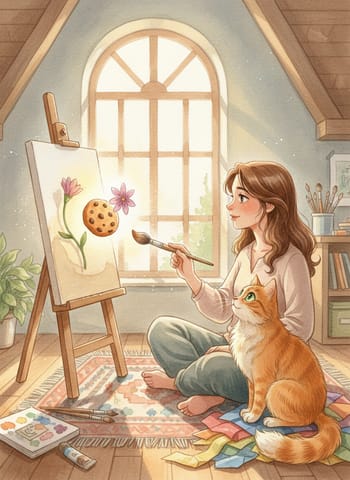
Willa dipped the brush in brown paint one more time. She painted a small cup of tea. The smell of mint filled the air. She lifted the paper. She slid it across the grass to her teacher.
Willa mojó el pincel en pintura marrón una vez más. Pintó una pequeña taza de té. El olor a menta llenó el aire. Levantó el papel. Lo deslizó por el pasto hasta su profesor.
The teacher picked up the cup. She smiled and took a sip.
El profesor tomó la taza. Sonrió y bebió un sorbo.