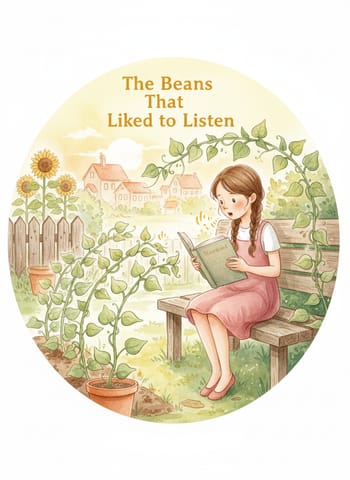
The Beans That Liked to Listen
Una historia gratuita en inglés de nivel A1 para estudiantes, para leer en línea en 7 idiomas, con opción de escucharla en la app gratuita Storyteller.
A shy girl reads aloud to the weak bean plants in the school garden, and they grow toward her voice.
¡Ese fue el avance! Escucha la historia completa en la app gratuita Storyteller. Descargar la app
El audio no está disponible en este momento.
In April, the school garden was in trouble. The soil was dry. The bean plants were thin and pale. The class watered them every day. Nothing changed.
En abril, el huerto de la escuela estaba en problemas. La tierra estaba seca. Las plantas de frijol eran delgadas y pálidas. La clase las regaba todos los días. Nada cambiaba.
Uma looked after the beans on Tuesdays. She was twelve, and she was shy. In class, she never raised her hand. When the teacher asked her to read, her voice shook.
Uma cuidaba los frijoles los martes. Tenía doce años y era tímida. En clase nunca levantaba la mano. Cuando la maestra le pedía que leyera, la voz le temblaba.
One Tuesday after school, she went to the garden alone. The sun was low. The beans leaned to one side.
Un martes después de la escuela, fue sola al huerto. El sol estaba bajo. Los frijoles se inclinaban hacia un lado.
"I am sorry," she said to them. "I do not know how to help."
«Lo siento», les dijo. «No sé cómo ayudarlos».
She sat down on the grass. She had a book in her bag. It was a story about a fox and a boat. She took it out and began to read, very quietly. She read to the beans because nobody else was there.
Se sentó en el pasto. Tenía un libro en la mochila. Era un cuento sobre un zorro y un bote. Lo sacó y empezó a leer, muy bajito. Les leyó a los frijoles porque no había nadie más.
At first, her voice was small. But the garden was calm. The beans did not laugh. Her voice grew stronger. She read the whole first chapter.
Al principio, su voz era pequeña. Pero el huerto estaba tranquilo. Los frijoles no se reían. Su voz se fue haciendo más fuerte. Leyó todo el primer capítulo.
When she stood up, she felt a little better. She took her bag and went home.
Cuando se puso de pie, se sentía un poco mejor. Tomó su mochila y se fue a casa.
The next Tuesday, she came back. The beans were taller. Not much, but she saw it. She looked at the one next to the fence. It was a full hand higher.
El martes siguiente, volvió. Los frijoles estaban más altos. No mucho, pero ella lo notó. Miró el que estaba junto a la cerca. Había crecido una mano entera.
"That is strange," she said. She touched a leaf. It was green and soft.
«Qué raro», dijo. Tocó una hoja. Era verde y suave.
Uma read to them again. This time, she read two chapters. Her voice moved up and down with the story. When the fox spoke, her voice went low and slow.
Uma les leyó otra vez. Esta vez leyó dos capítulos. Su voz subía y bajaba con el cuento. Cuando hablaba el zorro, su voz se volvía grave y lenta.
In May, the beans grew as tall as her knee. Small white flowers opened on every plant.
En mayo, los frijoles crecieron hasta la altura de su rodilla. Pequeñas flores blancas se abrieron en cada planta.
Bruno, a boy from her class, saw her one afternoon. He walked past the fence with a ball. He stopped.
Bruno, un niño de su clase, la vio una tarde. Pasaba junto a la cerca con una pelota. Se detuvo.
"Are you talking to the plants?" he asked.
«¿Le estás hablando a las plantas?», preguntó.
Uma jumped. Her face went hot. "No," she said. "I mean, yes. I read to them."
Uma se sobresaltó. Se le puso la cara roja. «No», dijo. «Bueno, sí. Les leo».
Bruno laughed, but not in a mean way. "That is silly," he said. "Plants do not hear."
Bruno se rio, pero sin burla. «Qué tontería», dijo. «Las plantas no oyen».
"These do," Uma said. She pointed. "Look."
«Estas sí», dijo Uma. Señaló. «Mira».
She opened the book. She read one line, loud and clear. Slowly, the beans leaned toward her like children. A small green leaf turned in her direction.
Abrió el libro. Leyó una línea, fuerte y clara. Poco a poco, los frijoles se inclinaron hacia ella como niños. Una pequeña hoja verde se volvió en su dirección.
Bruno's mouth opened. He dropped the ball. It rolled across the grass. Neither of them moved.
Bruno abrió la boca. Se le cayó la pelota. Rodó por el pasto. Ninguno de los dos se movió.
"They like it," he said at last.
«Les gusta», dijo por fin.
"I think they like my voice," Uma said.
«Creo que les gusta mi voz», dijo Uma.
"You have a lot of listeners," Bruno said. He smiled. "You should read to the class too."
«Tienes muchos oyentes», dijo Bruno. Sonrió. «Deberías leerle también a la clase».
"I cannot," said Uma. "I am afraid."
«No puedo», dijo Uma. «Tengo miedo».
"The beans are not afraid. You read to them every week."
«Los frijoles no tienen miedo. Tú les lees todas las semanas».
She thought about it. That night, she wrote a list of her reading days. She counted nine. Nine times she read without fear.
Lo pensó. Esa noche escribió una lista de sus días de lectura. Contó nueve. Nueve veces había leído sin miedo.
On Open Day, parents came to see the garden. The beans stood tall and full. Families took photos. The teacher asked if someone wanted to speak.
El Día de Puertas Abiertas, los padres vinieron a ver el huerto. Los frijoles se veían altos y llenos. Las familias sacaron fotos. La maestra preguntó si alguien quería hablar.
Nobody spoke. Then Uma lifted her hand.
Nadie habló. Entonces Uma levantó la mano.
She stood in front of the beans with her book. She took a long breath and began to read. Her voice was clear. The crowd grew quiet. The beans turned slowly toward her, and everyone saw it.
Se paró frente a los frijoles con su libro. Respiró hondo y empezó a leer. Su voz era clara. La gente se quedó en silencio. Los frijoles se volvieron despacio hacia ella, y todos lo vieron.
When she finished, Uma closed the book. Then she bowed to the plants.
Cuando terminó, Uma cerró el libro. Luego hizo una reverencia a las plantas.