The Zip and the Two Stories
Una historia gratuita en inglés de nivel B2 para estudiantes, para leer en línea en 7 idiomas, con opción de escucharla en la app gratuita Storyteller.
A small-town reporter cannot choose between two good assignments until a stuck jacket zip and his editor's advice show him what he would regret missing.
¡Ese fue el avance! Escucha la historia completa en la app gratuita Storyteller. Descargar la app
El audio no está disponible en este momento.
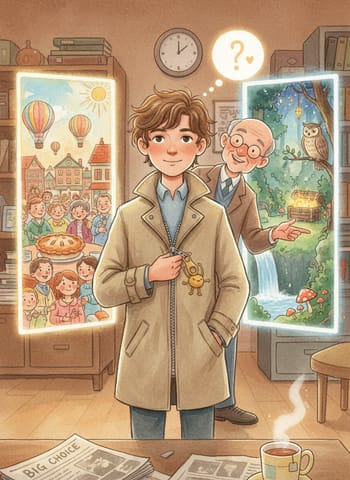
At ten past five, the newsroom of the Courier was as busy as it ever became. Four people were typing and one was eating an apple. Wystan stood by the coat rack with his jacket half on. The zip had stuck halfway up his chest, and nothing he did would move it.
A las cinco y diez, la redacción del Courier estaba tan movida como llegaba a estarlo. Cuatro personas escribían y una comía una manzana. Wystan estaba junto al perchero con la chaqueta a medio poner. El cierre se había atorado a medio camino del pecho, y nada de lo que hacía lo movía.
He had been the only full-time reporter at the Courier for six years. He knew the name of every council member and the opening hours of every office in town. He knew the exact sound the printer made before it jammed. What he did not know, at ten past five, was where to go that evening.
Había sido el único reportero de tiempo completo del Courier durante seis años. Conocía el nombre de cada concejal y el horario de cada oficina del pueblo. Conocía el sonido exacto que hacía la impresora antes de atascarse. Lo que no sabía, a las cinco y diez, era a dónde ir esa noche.
"Wystan," Birgit called from the editor's desk. "Have you decided yet?"
«Wystan», llamó Birgit desde el escritorio de la editora. «¿Ya decidiste?».
"Give me a minute," he said, and pulled at the zip again. It held, as stubborn as a locked door.
«Dame un minuto», dijo, y volvió a jalar el cierre. Se mantuvo firme, terco como una puerta con llave.
The problem was simple to describe. The paper had room for exactly one big story on tomorrow's front page, and Wystan could be in only one place at seven o'clock. At the town hall, the council would vote on a car park behind the high street. It would mean cutting down the last row of old plane trees. Across the river, a young woman was opening a small cinema in a former garage. It had one screen, forty seats and a film nobody else in the region could show.
El problema era sencillo de describir. El periódico tenía espacio para exactamente una gran noticia en la portada de mañana, y Wystan solo podía estar en un lugar a las siete. En el ayuntamiento, el concejo votaría un estacionamiento detrás de la calle principal. Significaría talar la última hilera de viejos plátanos. Al otro lado del río, una joven abría un pequeño cine en un antiguo garaje. Tenía una pantalla, cuarenta asientos y una película que nadie más en la región podía proyectar.
Either story would have been a good one. That was exactly the difficulty.
Cualquiera de las dos noticias habría sido buena. Esa era exactamente la dificultad.
"The car park matters to more people," Wystan said, still tugging. "If the vote goes through, those trees are gone for good. Readers will want to know who voted which way."
«El estacionamiento les importa a más personas», dijo Wystan, aún jalando. «Si la votación pasa, esos árboles desaparecen para siempre. Los lectores querrán saber quién votó cómo».
"They will," Birgit said calmly.
«Querrán», dijo Birgit con calma.
"But the cinema is the kind of story that makes people feel the town is alive. I could write something warm about it." He stopped pulling and sighed. "Which is a thing a reporter should not say about a car park."
«Pero el cine es el tipo de noticia que hace sentir que el pueblo está vivo. Podría escribir algo cálido sobre eso». Dejó de jalar y suspiró. «Que es algo que un reportero no debería decir sobre un estacionamiento».
Birgit stood and walked over, a pencil still tucked behind her ear. She had run the Courier for nine years. In that time, she had learned not to give advice unless somebody was ready to hear it. She looked at the jacket, and she looked at the zip, and then she looked at him with a faint smile.
Birgit se levantó y se acercó, con un lápiz aún metido detrás de la oreja. Había dirigido el Courier durante nueve años. En ese tiempo, había aprendido a no dar consejos a menos que alguien estuviera listo para oírlos. Miró la chaqueta, miró el cierre y luego lo miró a él con una leve sonrisa.
"You are forcing it," she said.
«Lo estás forzando», dijo.
"Obviously I am forcing it. It is stuck."
«Obviamente lo estoy forzando. Está atorado».
"Stop pulling upward," Birgit said. "Go the other way. Move it down a little, until the teeth loosen, and then start again."
«Deja de jalar hacia arriba», dijo Birgit. «Ve para el otro lado. Bájalo un poco, hasta que los dientes se aflojen, y luego empieza de nuevo».
Wystan did as he was told, feeling slightly ridiculous. He slid the zip down about two centimetres, and he felt the tiny teeth come free beneath his fingers. He pulled up again, more gently this time, and the zip rose all the way to his collar in one smooth line.
Wystan hizo lo que le decían, sintiéndose un poco ridículo. Deslizó el cierre unos dos centímetros hacia abajo y sintió que los diminutos dientes se soltaban bajo sus dedos. Volvió a jalar hacia arriba, esta vez con más suavidad, y el cierre subió hasta el cuello en una línea limpia.
"Thank you," he said. "That is very good advice for a jacket."
«Gracias», dijo. «Es un muy buen consejo para una chaqueta».
"It is not only for jackets." Birgit shrugged, and she went back to her desk.
«No es solo para chaquetas». Birgit se encogió de hombros y volvió a su escritorio.
Wystan stood there for a moment with the zip fastened to his chin. He thought about what she had said. For the past twenty minutes, he had been pulling in one direction, trying to prove that one story was objectively better than the other. But maybe they were both good enough, and the real question was not which was bigger. The real question was which one he would regret missing.
Wystan se quedó ahí un momento con el cierre subido hasta la barbilla. Pensó en lo que ella había dicho. Durante los últimos veinte minutos había estado jalando en una sola dirección, tratando de demostrar que una noticia era objetivamente mejor que la otra. Pero quizás las dos eran suficientemente buenas, y la verdadera pregunta no era cuál era más grande. La verdadera pregunta era cuál lamentaría perderse.
He tried to picture the car park vote. He saw the council chamber, the long wooden table and the usual quiet speeches. Whatever happened, the result would appear in the official minutes by morning. A reporter from the regional paper would almost certainly be sitting in the back row. The story would be told either way.
Intentó imaginar la votación del estacionamiento. Vio la sala del concejo, la larga mesa de madera y los discursos tranquilos de siempre. Pasara lo que pasara, el resultado aparecería en las actas oficiales por la mañana. Un reportero del periódico regional casi seguro estaría sentado en la última fila. La noticia se contaría de todos modos.
Then he pictured the owner in her converted garage, trying to light a projector for the first time in front of a room of strangers. Nobody else from the media was going. Nobody else had even been invited. If he did not go, the evening would pass unrecorded, and on Thursday it would be too late to describe what it had felt like.
Luego imaginó a la dueña en su garaje convertido, intentando encender un proyector por primera vez frente a una sala de desconocidos. Nadie más de los medios iba. Nadie más había sido siquiera invitado. Si él no iba, la noche pasaría sin registro, y el jueves sería demasiado tarde para describir cómo se había sentido.
"I will take the cinema," he said.
«Me quedo con el cine», dijo.
Birgit did not look up from her screen. "Are you sure?"
Birgit no levantó la vista de su pantalla. «¿Estás seguro?».
"I am sure that I would regret the other choice more." He picked up his notebook. "The vote will be reported by somebody. This opening will not be unless I am there. And I will call the council clerk at nine, to get the numbers from her directly."
«Estoy seguro de que lamentaría más la otra opción». Tomó su libreta. «La votación la va a cubrir alguien. Esta inauguración no, a menos que yo esté allí. Y llamaré a la secretaria del concejo a las nueve, para obtener los números directamente de ella».
"That is a sensible plan." Now she did look up, and she was smiling properly. "Take a photographer. And Wystan, ask her what the first film is. Nobody has told me yet."
«Es un plan sensato». Ahora sí levantó la vista, y sonreía de verdad. «Lleva un fotógrafo. Y Wystan, pregúntale cuál es la primera película. Nadie me lo ha dicho todavía».
He reached the garage at twenty to seven. A hand-painted sign above the door read ROLL, in plain white letters. Inside, chairs were still being unpacked from boxes, and a string of small lights hung crookedly along the ceiling. The smell of fresh paint and warm dust filled the air.
Llegó al garaje a las siete menos veinte. Un letrero pintado a mano sobre la puerta decía ROLL, en sencillas letras blancas. Adentro, todavía estaban sacando sillas de las cajas, y una tira de lucecitas colgaba torcida por el techo. El olor a pintura fresca y polvo tibio llenaba el aire.
The owner was balanced on a stepladder, wrestling with a cable. She was younger than he had expected, with paint on her sleeves, and she nearly fell off the ladder when she saw his press card.
La dueña estaba en equilibrio sobre una escalera de tijera, peleando con un cable. Era más joven de lo que él esperaba, con pintura en las mangas, y casi se cae de la escalera cuando vio su credencial de prensa.
"You came," she said. "I did not think anybody would."
«Vino», dijo. «No pensé que vendría nadie».
"I almost went to the town hall instead," Wystan said honestly. "Then I decided I would rather see this. By the way, what is the first film?"
«Casi fui al ayuntamiento», dijo Wystan con sinceridad. «Luego decidí que prefería ver esto. Por cierto, ¿cuál es la primera película?».
"It is called The Lone Tree," she said. "It is a hundred years old, and nobody else in the region has a copy."
«Se llama The Lone Tree», dijo ella. «Tiene cien años y nadie más en la región tiene una copia».
By seven o'clock, the forty seats were full. People brought blankets, and one family arrived carrying a folding stool for a child who was too small to see over the row in front. The projector clicked, hummed and hesitated, and for a few seconds the screen stayed blank. Everyone in the room held a breath.
Para las siete, los cuarenta asientos estaban llenos. La gente trajo mantas, y una familia llegó cargando un banquito para un niño demasiado pequeño para ver por encima de la fila de enfrente. El proyector hizo clic, zumbó y vaciló, y durante unos segundos la pantalla quedó en blanco. Todos en la sala contuvieron el aliento.
Then the first picture appeared, a pale field with a single tree, and the whole audience let out a soft sigh together. Wystan wrote nothing at all for almost a minute. He realised that he was smiling, and that the people around him were smiling too.
Entonces apareció la primera imagen, un campo pálido con un solo árbol, y todo el público soltó un suave suspiro al unísono. Wystan no escribió nada durante casi un minuto. Se dio cuenta de que sonreía, y de que la gente a su alrededor también sonreía.
At nine, he stepped outside and called the council clerk. The vote had been a close one, she said, five against four, with the trees spared for another year. She read him the names. He wrote them down in the margin of his notebook, in handwriting that shook slightly from the cold.
A las nueve, salió y llamó a la secretaria del concejo. La votación había sido reñida, dijo ella, cinco contra cuatro, y los árboles se salvaron un año más. Le leyó los nombres. Él los anotó en el margen de su libreta, con una letra que temblaba un poco por el frío.
He stood on the pavement and watched the light from the garage spill across the road. Behind him, through the open door, a murmur of laughter rose and fell. On his chest, the zip of his jacket sat firmly closed, exactly where he had left it.
Se quedó en la acera y vio cómo la luz del garaje se derramaba por la calle. Detrás de él, por la puerta abierta, un murmullo de risas subía y bajaba. En su pecho, el cierre de la chaqueta seguía firmemente cerrado, exactamente donde lo había dejado.
Both stories had been waiting for him, he thought. But had he picked the cinema, or had it, somehow, picked him?
Las dos noticias lo habían estado esperando, pensó. Pero ¿había elegido él el cine, o lo había elegido el cine a él, de alguna manera?