The Model (variant of Le Modèle)
A free B2-level English story for language learners, readable online in 7 languages, with an option to listen via the free Storyteller app.
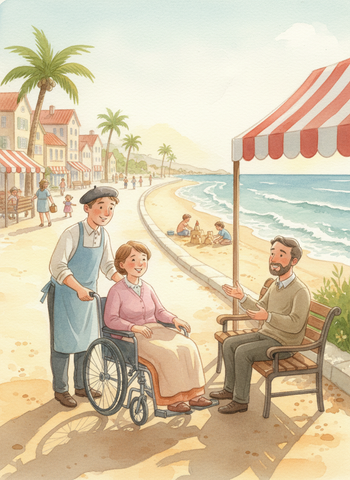
At a seaside resort, a painter silently wheels his crippled wife along the promenade while a friend on a nearby bench tells the reckless act that bound the two together forever.
Curving like a crescent moon, the little town of Etretat, with its white cliffs, its white, shingly beach and its blue sea, lay in the sunlight at high noon one July day. At either extremity of this crescent its two “gates,” the smaller to the right, the larger one at the left, stretched forth—one a dwarf and the other a colossal limb—into the water, and the bell tower, almost as tall as the cliff, wide below, narrowing at the top, raised its pointed summit to the sky.
Curvado como una luna creciente, el pueblecito de Etretat, con sus blancos acantilados, su playa blanca de guijarros y su mar azul, yacía bajo el sol en pleno mediodía de un día de julio. En cada extremo de esta media luna sus dos «puertas», la más pequeña a la derecha, la más grande a la izquierda, se extendían—una un brazo enano y la otra un miembro colosal—hacia el agua, y el campanario, casi tan alto como el acantilado, ancho en su base, angostándose hacia la cima, alzaba su cúspide puntiaguda hacia el cielo.
On the sands beside the water a crowd was seated watching the bathers. On the terrace of, the Casino another crowd, seated or walking, displayed beneath the brilliant sky a perfect flower patch of bright costumes, with red and blue parasols embroidered with large flowers in silk.
En la arena, junto al agua, una multitud estaba sentada observando a los bañistas. En la terraza del Casino otra multitud, sentada o paseando, desplegaba bajo el cielo brillante un auténtico macizo de flores hecho de trajes vistosos, con sombrillas rojas y azules bordadas con grandes flores de seda.
On the walk at the end of the terrace, other persons, the restful, quiet ones, were walking slowly, far from the dressy throng.
En el paseo al final de la terraza, otras personas, las tranquilas, las sosegadas, caminaban despacio, lejos de la multitud elegante.
A young man, well known and celebrated as a painter, Jean Sumner, was walking with a dejected air beside a wheeled chair in which sat a young woman, his wife. A manservant was gently pushing the chair, and the crippled woman was gazing sadly at the brightness of the sky, the gladness of the day, and the happiness of others.
Un joven, conocido y célebre como pintor, Jean Sumner, iba caminando con aire abatido junto a una silla de ruedas en la que estaba sentada una joven mujer, su esposa. Un criado empujaba suavemente la silla, y la mujer inválida contemplaba con tristeza el brillo del cielo, la alegría del día, y la felicidad de los demás.
They did not speak. They did not look at each other.
No hablaban. No se miraban.
“Let us stop a while,” said the young woman.
—Detengámonos un momento —dijo la joven.
They stopped, and the painter sat down on a camp stool that the servant handed him.
Se detuvieron, y el pintor se sentó en un taburete plegable que el criado le alcanzó.
Those who were passing behind the silent and motionless couple looked at them compassionately. A whole legend of devotion was attached to them. He had married her in spite of her infirmity, touched by her affection for him, it was said.
Quienes pasaban por detrás de la pareja silenciosa e inmóvil los miraban con compasión. Toda una leyenda de devoción se había tejido en torno a ellos. Se decía que él se había casado con ella a pesar de su invalidez, conmovido por el afecto que ella le tenía.
Not far from there, two young men were chatting, seated on a bench and looking out into the horizon.
No lejos de allí, dos jóvenes conversaban, sentados en un banco y mirando hacia el horizonte.
“No, it is not true; I tell you that I am well acquainted with Jean Sumner.”
—No, no es verdad; te digo que conozco muy bien a Jean Sumner.
“But then, why did he marry her? For she was a cripple when she married, was she not?”
—Pero entonces, ¿por qué se casó con ella? Porque ella ya era inválida cuando se casó, ¿no es así?
“Just so. He married her—he married her—just as every one marries, parbleu! because he was an idiot!”
—Exactamente. Se casó con ella—se casó con ella—como se casa todo el mundo, ¡pardiez!, porque era un idiota.
“But why?”
—Pero ¿por qué?
“But why—but why, my friend? There is no why. People do stupid things just because they do stupid things. And, besides, you know very well that painters make a specialty of foolish marriages. They almost always marry models, former sweethearts, in fact, women of doubtful reputation, frequently. Why do they do this? Who can say? One would suppose that constant association with the general run of models would disgust them forever with that class of women. Not at all. After having posed them they marry them. Read that little book, so true, so cruel and so beautiful, by Alphonse Daudet: 'Artists' Wives.'
—Pero por qué—pero por qué, amigo mío. No hay por qué. La gente hace cosas estúpidas solo porque las hace. Y, además, ya sabes muy bien que los pintores tienen predilección por los matrimonios disparatados. Casi siempre se casan con modelos, antiguas amantes, mujeres, de hecho, de reputación dudosa, con frecuencia. ¿Por qué hacen esto? ¿Quién puede decirlo? Uno pensaría que el trato constante con el común de las modelos les provocaría un asco eterno hacia esa clase de mujeres. En absoluto. Después de haberlas posado se casan con ellas. Lee ese librito, tan cierto, tan cruel y tan hermoso, de Alphonse Daudet: «Las esposas de los artistas».
“In the case of the couple you see over there the accident occurred in a special and terrible manner. The little woman played a frightful comedy, or, rather, tragedy. She risked all to win all. Was she sincere? Did she love Jean? Shall we ever know? Who is able to determine precisely how much is put on and how much is real in the actions of a woman? They are always sincere in an eternal mobility of impressions. They are furious, criminal, devoted, admirable and base in obedience to intangible emotions.
»En el caso de la pareja que ves ahí, el accidente ocurrió de manera especial y terrible. La mujercita representó una comedia espantosa, o mejor dicho, una tragedia. Lo arriesgó todo para ganarlo todo. ¿Era sincera? ¿Amaba a Jean? ¿Lo sabremos alguna vez? ¿Quién puede determinar con precisión cuánto hay de fingido y cuánto de real en los actos de una mujer? Son siempre sinceras en una movilidad eterna de impresiones. Son furiosas, criminales, entregadas, admirables y viles obedeciendo a emociones intangibles.
“They tell lies incessantly without intention, without knowing or understanding why, and in spite of it all are absolutely frank in their feelings and sentiments, which they display by violent, unexpected, incomprehensible, foolish resolutions which overthrow our arguments, our customary poise and all our selfish plans. The unforeseenness and suddenness of their determinations will always render them undecipherable enigmas as far as we are concerned. We continually ask ourselves:
»Mienten sin cesar y sin intención, sin saber ni comprender por qué, y a pesar de todo son absolutamente francas en sus sentimientos y afectos, que exteriorizan con resoluciones violentas, inesperadas, incomprensibles, insensatas, que echan por tierra nuestros argumentos, nuestra serenidad habitual y todos nuestros planes egoístas. Lo imprevisible y repentino de sus determinaciones las hará siempre para nosotros enigmas indescifrables. Nos preguntamos continuamente:
“'Are they sincere? Are they pretending?'
»¿Son sinceras? ¿Están fingiendo?
“But, my friend, they are sincere and insincere at one and the same time, because it is their nature to be extremists in both and to be neither one nor the other.
»Pero, amigo mío, son sinceras y falsas al mismo tiempo, porque su naturaleza es ser extremosas en ambas cosas y no ser ni la una ni la otra.
“See the methods that even the best of them employ to get what they desire. They are complex and simple, these methods. So complex that we can never guess at them beforehand, and so simple that after having been victimized we cannot help being astonished and exclaiming: 'What! Did she make a fool of me so easily as that?'
»Mira los métodos que incluso las mejores de ellas emplean para conseguir lo que desean. Son complejos y sencillos a la vez, estos métodos. Tan complejos que nunca podemos adivinarlos de antemano, y tan sencillos que, después de haber sido víctimas de ellos, no podemos sino asombrarnos y exclamar: «¡Cómo! ¿Se burló de mí con tanta facilidad?».
“And they always succeed, old man, especially when it is a question of getting married.
»Y siempre lo consiguen, amigo mío, especialmente cuando se trata de lograr el matrimonio.
“But this is Sumner's story:
»Pero esta es la historia de Sumner:
“The little woman was a model, of course. She posed for him. She was pretty, very stylish-looking, and had a divine figure, it seems. He fancied that he loved her with his whole soul. That is another strange thing. As soon as one likes a woman one sincerely believes that they could not get along without her for the rest of their life.
»La mujercita era modelo, por supuesto. Posaba para él. Era bonita, de aspecto muy elegante, y tenía una figura divina, según parece. Él imaginó que la amaba con toda su alma. Eso es otra cosa extraña. En cuanto a uno le gusta una mujer, cree sinceramente que no podría vivir sin ella el resto de su vida.
“One knows that one has felt the same way before and that disgust invariably succeeded gratification; that in order to pass one's existence side by side with another there must be not a brutal, physical passion which soon dies out, but a sympathy of soul, temperament and temper. One should know how to determine in the enchantment to which one is subjected whether it proceeds from the physical, from a certain sensuous intoxication, or from a deep spiritual charm.
»Uno sabe que ha sentido lo mismo antes y que el hastío siempre sucedió a la satisfacción; que para pasar la existencia junto a otro no debe haber una pasión brutal, física, que pronto se extingue, sino una simpatía de alma, de temperamento y de carácter. Uno debería saber determinar, en el encantamiento al que está sometido, si proviene de lo físico, de cierta embriaguez sensual, o de un profundo hechizo espiritual.
“Well, he believed himself in love; he made her no end of promises of fidelity, and was devoted to her.
»Bien, él se creyó enamorado; le hizo toda clase de promesas de fidelidad, y se mostró devoto de ella.
“She was really attractive, gifted with that fashionable flippancy that little Parisians so readily affect. She chattered, babbled, made foolish remarks that sounded witty from the manner in which they were uttered. She used graceful gesture's which were calculated to attract a painter's eye. When she raised her arms, when she bent over, when she got into a carriage, when she held out her hand to you, her gestures were perfect and appropriate.
»Ella era realmente atractiva, dotada de esa frivolidad a la moda que las parisinas suelen tener con tanta facilidad. Charlaba, parloteaba, hacía observaciones tontas que sonaban ingeniosas por la manera en que las decía. Empleaba gestos graciosos calculados para atraer la mirada de un pintor. Cuando levantaba los brazos, cuando se inclinaba, cuando subía a un coche, cuando te tendía la mano, sus gestos eran perfectos y adecuados.
“For three months Jean never noticed that, in reality, she was like all other models.
»Durante tres meses Jean nunca notó que, en realidad, ella era como todas las demás modelos.
“He rented a little house for her for the summer at Andresy.
»Le alquiló una casita para el verano en Andresy.
“I was there one evening when for the first time doubts came into my friend's mind.
»Yo estaba allí una noche cuando por primera vez surgieron dudas en la mente de mi amigo.
“As it was a beautiful evening we thought we would take a stroll along the bank of the river. The moon poured a flood of light on the trembling water, scattering yellow gleams along its ripples in the currents and all along the course of the wide, slow river.
»Como era una noche hermosa, se nos ocurrió dar un paseo a lo largo de la orilla del río. La luna derramaba un torrente de luz sobre el agua temblorosa, esparciendo destellos amarillos a lo largo de sus ondas en las corrientes y por todo el curso del río ancho y lento.
“We strolled along the bank, a little enthused by that vague exaltation that these dreamy evenings produce in us. We would have liked to undertake some wonderful task, to love some unknown, deliciously poetic being. We felt ourselves vibrating with raptures, longings, strange aspirations. And we were silent, our beings pervaded by the serene and living coolness of the beautiful night, the coolness of the moonlight, which seemed to penetrate one's body, permeate it, soothe one's spirit, fill it with fragrance and steep it in happiness.
»Paseábamos por la orilla, un poco exaltados por esa vaga exaltación que producen en nosotros estas noches de ensueño. Nos habría gustado emprender alguna tarea maravillosa, amar a algún ser desconocido y deliciosamente poético. Nos sentíamos vibrar de arrebatos, anhelos, extrañas aspiraciones. Y guardábamos silencio, nuestro ser impregnado de la serena y viva frescura de la hermosa noche, la frescura de la luz de luna, que parecía penetrar en el cuerpo, impregnarlo, calmar el espíritu, llenarlo de fragancia y sumergirlo en la felicidad.
“Suddenly Josephine (that is her name) uttered an exclamation:
»De pronto Josefina (así se llamaba) lanzó una exclamación:
“'Oh, did you see the big fish that jumped, over there?'
»«¡Oh! ¿Viste el gran pez que saltó, allí?»
“He replied without looking, without thinking:
»Él respondió sin mirar, sin pensar:
“'Yes, dear.'
»«Sí, querida.»
“She was angry.
»Ella se enfadó.
“'No, you did not see it, for your back was turned.'
»«No, no lo viste, porque estabas de espaldas.»
“He smiled.
»Él sonrió.
“'Yes, that's true. It is so delightful that I am not thinking of anything.'
»«Sí, es verdad. Es tan delicioso que no estoy pensando en nada.»
“She was silent, but at the end of a minute she felt as if she must say something and asked:
»Ella se quedó callada, pero al cabo de un minuto sintió que debía decir algo y preguntó:
“'Are you going to Paris to-morrow?'
»«¿Vas a ir a París mañana?»
“'I do not know,' he replied.
»«No lo sé», respondió él.
“She was annoyed again.
»Ella se molestó de nuevo.
“'Do you think it is very amusing to walk along without speaking? People talk when they are not stupid.'
»«¿Te parece muy divertido caminar sin hablar? La gente habla cuando no es tonta.»
“He did not reply. Then, feeling with her woman's instinct that she was going to make him angry, she began to sing a popular air that had harassed our ears and our minds for two years:
»Él no respondió. Entonces, sintiendo con su instinto femenino que iba a hacerlo enfadar, ella empezó a cantar una canción popular que había martirizado nuestros oídos y nuestras mentes durante dos años:
“'Je regardais en fair.'
»«Je regardais en l'air.»
“He murmured:
»Él murmuró:
“'Please keep quiet.'
»«Por favor, cállate.»
“She replied angrily:
»Ella respondió con furia:
“'Why do you wish me to keep quiet?'
»«¿Por qué quieres que me calle?»
“'You spoil the landscape for us!' he said.
»«¡Nos estropeas el paisaje!», dijo él.
“Then followed a scene, a hateful, idiotic scene, with unexpected reproaches, unsuitable recriminations, then tears. Nothing was left unsaid. They went back to the house. He had allowed her to talk without replying, enervated by the beauty of the scene and dumfounded by this storm of abuse.
»Entonces siguió una escena, una escena odiosa e idiota, con reproches inesperados, recriminaciones improcedentes, y luego lágrimas. No quedó nada sin decir. Regresaron a la casa. Él la había dejado hablar sin responder, exasperado por la belleza de la escena y aturdido por esa tormenta de insultos.
“Three months later he strove wildly to free himself from those invincible and invisible bonds with which such a friendship chains our lives. She kept him under her influence, tyrannizing over him, making his life a burden to him. They quarreled continually, vituperating and finally fighting each other.
»Tres meses después él luchó desesperadamente por liberarse de esos lazos invencibles e invisibles con que semejante amistad encadena nuestras vidas. Ella lo mantenía bajo su influencia, tiranizándolo, haciendo de su vida una carga. Reñían continuamente, se injuriaban y al final llegaban a las manos.
“He wanted to break with her at any cost. He sold all his canvases, borrowed money from his friends, realizing twenty thousand francs (he was not well known then), and left them for her one morning with a note of farewell.
»Él quiso romper con ella a cualquier precio. Vendió todos sus cuadros, pidió dinero prestado a sus amigos, reunió veinte mil francos (por entonces no era muy conocido), y los dejó para ella una mañana con una nota de despedida.
“He came and took refuge with me.
»Vino y se refugió en mi casa.
“About three o'clock that afternoon there was a ring at the bell. I went to the door. A woman sprang toward me, pushed me aside, came in and went into my atelier. It was she!
»Hacia las tres de la tarde sonó el timbre. Fui a la puerta. Una mujer se abalanzó hacia mí, me apartó, entró y se dirigió a mi taller. ¡Era ella!
“He had risen when he saw her coming.'
»Él se había levantado al verla llegar.
“She threw the envelope containing the banknotes at his feet with a truly noble gesture and said in a quick tone:
»Ella arrojó a sus pies el sobre con los billetes de banco con un gesto verdaderamente noble y dijo con voz cortante:
“'There's your money. I don't want it!'
»«Ahí tienes tu dinero. ¡No lo quiero!»
“She was very pale, trembling and ready undoubtedly to commit any folly. As for him, I saw him grow pale also, pale with rage and exasperation, ready also perhaps to commit any violence.
»Estaba muy pálida, temblando y sin duda dispuesta a cometer cualquier locura. En cuanto a él, vi que también palidecía, pálido de rabia y exasperación, dispuesto quizá también a cometer alguna violencia.
“He asked:
»Preguntó:
“'What do you want?'
»«¿Qué quieres?»
“She replied:
»Ella respondió:
“'I do not choose to be treated like a common woman. You implored me to accept you. I asked you for nothing. Keep me with you!'
»«No pienso dejarme tratar como una mujer cualquiera. Me suplicaste que te aceptara. Yo no te pedí nada. ¡Quédate conmigo!»
“He stamped his foot.
ȃl dio una patada en el suelo.
“'No, that's a little too much! If you think you are going—'
»«¡No, eso ya es demasiado! Si crees que vas—»
“I had seized his arm.
»Yo lo había tomado del brazo.
“'Keep still, Jean… Let me settle it.'
»«Quédate quieto, Jean… Déjame arreglar esto a mí.»
“I went toward her and quietly, little by little, I began to reason with her, exhausting all the arguments that are used under similar circumstances. She listened to me, motionless, with a fixed gaze, obstinate and silent.
»Fui hacia ella y con calma, poco a poco, empecé a razonar con ella, agotando todos los argumentos que se usan en circunstancias semejantes. Ella me escuchó, inmóvil, con la mirada fija, obstinada y en silencio.
“Finally, not knowing what more to say, and seeing that there would be a scene, I thought of a last resort and said:
»Finalmente, sin saber qué más decir, y viendo que se avecinaba una escena, pensé en un último recurso y dije:
“'He loves you still, my dear, but his family want him to marry some one, and you understand—'
»«Él todavía te ama, querida, pero su familia quiere que se case con otra persona, y tú comprendes—»
“She gave a start and exclaimed:
»Ella dio un respingo y exclamó:
“'Ah! Ah! Now I understand:
»«¡Ah! ¡Ah! Ahora comprendo.»
“And turning toward him, she said:
»Y volviéndose hacia él, dijo:
“'You are—you are going to get married?'
»«Tú—¿tú te vas a casar?»
“He replied decidedly, 'Yes.'
»Él respondió con firmeza: «Sí.»
“She took a step forward.
»Ella dio un paso adelante.
“'If you marry, I will kill myself! Do you hear?'
»«¡Si te casas, me mato! ¿Me oyes?»
“He shrugged his shoulders and replied:
»Él se encogió de hombros y respondió:
“'Well, then kill yourself!'
»«Bueno, pues mátate.»
“She stammered out, almost choking with her violent emotion:
»Ella balbuceó, casi ahogándose de emoción violenta:
“'What do you say? What do you say? What do you say? Say it again!'
»«¿Qué dices? ¿Qué dices? ¿Qué dices? ¡Repítelo!»
“He repeated:
»Él repitió:
“'Well, then kill yourself if you like!'
»«Bueno, pues mátate si quieres.»
“With her face almost livid, she replied:
»Con el rostro casi lívido, ella respondió:
“'Do not dare me! I will throw myself from the window!'
»«¡No me desafíes! ¡Me tiraré por la ventana!»
“He began to laugh, walked toward the window, opened it, and bowing with the gesture of one who desires to let some one else precede him, he said:
»Él se echó a reír, caminó hacia la ventana, la abrió, y con una reverencia, como el que desea ceder el paso a otro, dijo:
“'This is the way. After you!'
»«Es por aquí. ¡Después de ti!»
“She looked at him for a second with terrible, wild, staring eyes. Then, taking a run as if she were going to jump a hedge in the country, she rushed past me and past him, jumped over the sill and disappeared.
»Ella lo miró un instante con ojos terribles, extraviados, fijos. Luego, tomando impulso como quien va a saltar un seto en el campo, pasó corriendo junto a mí y junto a él, saltó por el alféizar y desapareció.
“I shall never forget the impression made on me by that open window after I had seen that body pass through it to fall to the ground. It appeared to me in a second to be as large as the heavens and as hollow as space. And I drew back instinctively, not daring to look at it, as though I feared I might fall out myself.
»Nunca olvidaré la impresión que me causó aquella ventana abierta después de haber visto pasar ese cuerpo a través de ella para caer al suelo. Me pareció en un segundo tan grande como el cielo y tan hueca como el espacio. Y retrocedí instintivamente, sin atreverme a mirar, como si temiera caer yo mismo.
“Jean, dumfounded, stood motionless.
»Jean, aturdido, quedó inmóvil.
“They brought the poor girl in with both legs broken. She will never walk again.
»Trajeron a la pobre muchacha con las dos piernas rotas. Nunca volverá a caminar.
“Jean, wild with remorse and also possibly touched with gratitude, made up his mind to marry her.
»Jean, enloquecido de remordimiento y quizás también conmovido por la gratitud, se decidió a casarse con ella.
“There you have it, old man.”
»Ahí lo tienes, amigo mío.
It was growing dusk. The young woman felt chilly and wanted to go home, and the servant wheeled the invalid chair in the direction of the village. The painter walked beside his wife, neither of them having exchanged a word for an hour.
Estaba anocheciendo. La joven sintió frío y quiso volver a casa, y el criado empujó la silla de ruedas en dirección al pueblo. El pintor caminaba junto a su esposa, sin que ninguno de los dos hubiera pronunciado palabra durante una hora.
This story appeared in Le Gaulois, December 17, 1883.
Este relato apareció en Le Gaulois, el 17 de diciembre de 1883.
