The Zip and the Two Stories
Cerita bahasa Inggris gratis level B2 untuk pelajar, bisa dibaca online dalam 7 bahasa, dengan pilihan untuk mendengarkannya di aplikasi Storyteller gratis.
A small-town reporter cannot choose between two good assignments until a stuck jacket zip and his editor's advice show him what he would regret missing.
Itu cuplikannya! Dengarkan cerita lengkapnya di aplikasi Storyteller gratis. Unduh aplikasi
Audio belum tersedia saat ini.
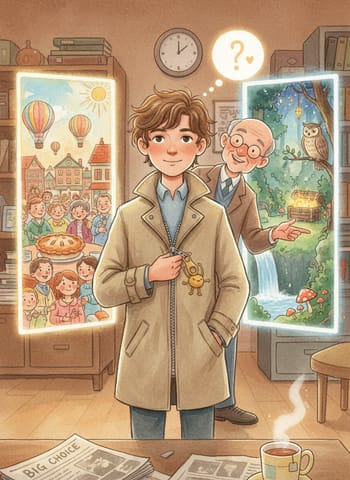
At ten past five, the newsroom of the Courier was as busy as it ever became. Four people were typing and one was eating an apple. Wystan stood by the coat rack with his jacket half on. The zip had stuck halfway up his chest, and nothing he did would move it.
Pukul lima lewat sepuluh, ruang redaksi Courier sedang sesibuk-sibuknya. Empat orang mengetik dan satu orang makan apel. Wystan berdiri di dekat gantungan mantel dengan jaket yang baru separuh terpakai. Ritsletingnya macet di tengah dada, dan apa pun yang ia lakukan tak mau bergerak.
He had been the only full-time reporter at the Courier for six years. He knew the name of every council member and the opening hours of every office in town. He knew the exact sound the printer made before it jammed. What he did not know, at ten past five, was where to go that evening.
Sudah enam tahun ia menjadi satu-satunya reporter purnawaktu di Courier. Ia tahu nama setiap anggota dewan dan jam buka setiap kantor di kota. Ia tahu persis bunyi yang dikeluarkan mesin pencetak sebelum macet. Yang tidak ia tahu, pukul lima lewat sepuluh itu, adalah ke mana ia harus pergi malam ini.
"Wystan," Birgit called from the editor's desk. "Have you decided yet?"
"Wystan," seru Birgit dari meja editor. "Sudah memutuskan?"
"Give me a minute," he said, and pulled at the zip again. It held, as stubborn as a locked door.
"Beri aku semenit," katanya, dan menarik ritsleting itu lagi. Ritsleting itu bertahan, sekeras kepala pintu terkunci.
The problem was simple to describe. The paper had room for exactly one big story on tomorrow's front page, and Wystan could be in only one place at seven o'clock. At the town hall, the council would vote on a car park behind the high street. It would mean cutting down the last row of old plane trees. Across the river, a young woman was opening a small cinema in a former garage. It had one screen, forty seats and a film nobody else in the region could show.
Masalahnya mudah dijelaskan. Surat kabar itu hanya punya tempat untuk satu berita besar di halaman depan besok, dan Wystan hanya bisa berada di satu tempat pada pukul tujuh. Di balai kota, dewan akan memberi suara untuk sebuah tempat parkir di belakang jalan utama. Itu berarti menebang barisan terakhir pohon ara tua. Di seberang sungai, seorang perempuan muda sedang membuka bioskop kecil di bekas garasi. Bioskop itu punya satu layar, empat puluh kursi, dan sebuah film yang tak bisa diputar siapa pun lagi di wilayah itu.
Either story would have been a good one. That was exactly the difficulty.
Kedua berita itu sama-sama bagus. Justru itulah kesulitannya.
"The car park matters to more people," Wystan said, still tugging. "If the vote goes through, those trees are gone for good. Readers will want to know who voted which way."
"Tempat parkir itu penting bagi lebih banyak orang," kata Wystan, masih menarik-narik. "Kalau pemungutan suaranya lolos, pohon-pohon itu hilang selamanya. Pembaca pasti ingin tahu siapa memilih apa."
"They will," Birgit said calmly.
"Pasti," kata Birgit dengan tenang.
"But the cinema is the kind of story that makes people feel the town is alive. I could write something warm about it." He stopped pulling and sighed. "Which is a thing a reporter should not say about a car park."
"Tapi bioskop itu jenis berita yang membuat orang merasa kota ini hidup. Aku bisa menulis sesuatu yang hangat tentangnya." Ia berhenti menarik dan mendesah. "Dan itu hal yang tak pantas diucapkan reporter soal tempat parkir."
Birgit stood and walked over, a pencil still tucked behind her ear. She had run the Courier for nine years. In that time, she had learned not to give advice unless somebody was ready to hear it. She looked at the jacket, and she looked at the zip, and then she looked at him with a faint smile.
Birgit berdiri dan berjalan menghampiri, dengan pensil masih terselip di belakang telinganya. Ia sudah sembilan tahun memimpin Courier. Selama itu, ia belajar untuk tidak memberi nasihat kecuali orang itu siap mendengar. Ia menatap jaket itu, menatap ritsletingnya, lalu menatap Wystan dengan senyum tipis.
"You are forcing it," she said.
"Kamu memaksanya," katanya.
"Obviously I am forcing it. It is stuck."
"Tentu saja aku memaksanya. Ritsletingnya macet."
"Stop pulling upward," Birgit said. "Go the other way. Move it down a little, until the teeth loosen, and then start again."
"Berhenti menarik ke atas," kata Birgit. "Lakukan sebaliknya. Turunkan sedikit, sampai gigi-giginya longgar, lalu mulai lagi."
Wystan did as he was told, feeling slightly ridiculous. He slid the zip down about two centimetres, and he felt the tiny teeth come free beneath his fingers. He pulled up again, more gently this time, and the zip rose all the way to his collar in one smooth line.
Wystan menurut, merasa agak konyol. Ia menggeser ritsleting turun sekitar dua sentimeter, dan merasakan gigi-gigi kecil itu terlepas di bawah jarinya. Ia menariknya ke atas lagi, kali ini lebih lembut, dan ritsleting itu naik sampai ke kerahnya dalam satu garis mulus.
"Thank you," he said. "That is very good advice for a jacket."
"Terima kasih," katanya. "Itu nasihat yang sangat bagus untuk sebuah jaket."
"It is not only for jackets." Birgit shrugged, and she went back to her desk.
"Itu bukan hanya untuk jaket." Birgit mengangkat bahu, lalu kembali ke mejanya.
Wystan stood there for a moment with the zip fastened to his chin. He thought about what she had said. For the past twenty minutes, he had been pulling in one direction, trying to prove that one story was objectively better than the other. But maybe they were both good enough, and the real question was not which was bigger. The real question was which one he would regret missing.
Wystan berdiri sejenak dengan ritsleting terkancing sampai dagu. Ia memikirkan kata-kata Birgit. Selama dua puluh menit terakhir, ia menarik ke satu arah, mencoba membuktikan bahwa satu berita secara objektif lebih baik daripada yang lain. Tetapi mungkin keduanya cukup bagus, dan pertanyaan sebenarnya bukanlah mana yang lebih besar. Pertanyaan sebenarnya adalah mana yang akan ia sesali jika terlewat.
He tried to picture the car park vote. He saw the council chamber, the long wooden table and the usual quiet speeches. Whatever happened, the result would appear in the official minutes by morning. A reporter from the regional paper would almost certainly be sitting in the back row. The story would be told either way.
Ia mencoba membayangkan pemungutan suara tempat parkir itu. Ia melihat ruang sidang dewan, meja kayu panjang, dan pidato-pidato tenang yang biasa. Apa pun yang terjadi, hasilnya akan muncul di notulen resmi besok pagi. Seorang reporter dari koran regional hampir pasti akan duduk di barisan belakang. Beritanya akan tersampaikan bagaimanapun juga.
Then he pictured the owner in her converted garage, trying to light a projector for the first time in front of a room of strangers. Nobody else from the media was going. Nobody else had even been invited. If he did not go, the evening would pass unrecorded, and on Thursday it would be too late to describe what it had felt like.
Lalu ia membayangkan sang pemilik di garasi yang diubahnya, berusaha menyalakan proyektor untuk pertama kali di hadapan ruangan penuh orang asing. Tak ada media lain yang akan datang. Tak ada yang lain bahkan diundang. Kalau ia tidak pergi, malam itu akan berlalu tanpa tercatat, dan pada hari Kamis sudah terlambat untuk menggambarkan bagaimana rasanya.
"I will take the cinema," he said.
"Aku ambil bioskopnya," katanya.
Birgit did not look up from her screen. "Are you sure?"
Birgit tidak mengalihkan pandang dari layarnya. "Kamu yakin?"
"I am sure that I would regret the other choice more." He picked up his notebook. "The vote will be reported by somebody. This opening will not be unless I am there. And I will call the council clerk at nine, to get the numbers from her directly."
"Aku yakin bahwa aku akan lebih menyesali pilihan yang satunya." Ia mengambil buku catatannya. "Pemungutan suara itu akan diberitakan orang lain. Pembukaan ini tidak, kecuali aku ada di sana. Dan aku akan menelepon panitera dewan pukul sembilan, untuk mendapatkan angkanya langsung dari beliau."
"That is a sensible plan." Now she did look up, and she was smiling properly. "Take a photographer. And Wystan, ask her what the first film is. Nobody has told me yet."
"Itu rencana yang masuk akal." Kini ia memang mendongak, dan tersenyum sungguh-sungguh. "Bawa fotografer. Dan Wystan, tanyakan kepadanya apa film pertamanya. Belum ada yang memberi tahu aku."
He reached the garage at twenty to seven. A hand-painted sign above the door read ROLL, in plain white letters. Inside, chairs were still being unpacked from boxes, and a string of small lights hung crookedly along the ceiling. The smell of fresh paint and warm dust filled the air.
Ia sampai di garasi itu pukul tujuh kurang dua puluh. Papan nama buatan tangan di atas pintu bertuliskan ROLL, dengan huruf putih polos. Di dalam, kursi-kursi masih dikeluarkan dari kardus, dan untaian lampu kecil tergantung miring di sepanjang langit-langit. Bau cat baru dan debu hangat memenuhi udara.
The owner was balanced on a stepladder, wrestling with a cable. She was younger than he had expected, with paint on her sleeves, and she nearly fell off the ladder when she saw his press card.
Sang pemilik berdiri di atas tangga lipat, bergulat dengan sebuah kabel. Ia lebih muda daripada yang Wystan duga, dengan cat di lengan bajunya, dan hampir jatuh dari tangga ketika melihat kartu persnya.
"You came," she said. "I did not think anybody would."
"Kamu datang," katanya. "Aku tidak mengira akan ada yang datang."
"I almost went to the town hall instead," Wystan said honestly. "Then I decided I would rather see this. By the way, what is the first film?"
"Aku hampir pergi ke balai kota," kata Wystan jujur. "Lalu aku memutuskan lebih suka melihat ini. Omong-omong, apa film pertamanya?"
"It is called The Lone Tree," she said. "It is a hundred years old, and nobody else in the region has a copy."
"Judulnya The Lone Tree," katanya. "Umurnya seratus tahun, dan tak ada orang lain di wilayah ini yang punya salinannya."
By seven o'clock, the forty seats were full. People brought blankets, and one family arrived carrying a folding stool for a child who was too small to see over the row in front. The projector clicked, hummed and hesitated, and for a few seconds the screen stayed blank. Everyone in the room held a breath.
Pukul tujuh, keempat puluh kursi sudah penuh. Orang-orang membawa selimut, dan satu keluarga datang sambil membawa bangku lipat untuk anak yang terlalu kecil untuk melihat melewati barisan di depannya. Proyektor itu berklik, berdengung, dan ragu, dan selama beberapa detik layar tetap kosong. Semua orang di ruangan menahan napas.
Then the first picture appeared, a pale field with a single tree, and the whole audience let out a soft sigh together. Wystan wrote nothing at all for almost a minute. He realised that he was smiling, and that the people around him were smiling too.
Lalu gambar pertama muncul, sebuah ladang pucat dengan satu pohon, dan seluruh penonton mengembuskan napas lega bersama-sama. Wystan tidak menulis apa pun selama hampir semenit. Ia sadar bahwa ia tersenyum, dan orang-orang di sekitarnya juga tersenyum.
At nine, he stepped outside and called the council clerk. The vote had been a close one, she said, five against four, with the trees spared for another year. She read him the names. He wrote them down in the margin of his notebook, in handwriting that shook slightly from the cold.
Pukul sembilan, ia melangkah keluar dan menelepon panitera dewan. Pemungutan suaranya ketat, katanya, lima lawan empat, dengan pohon-pohon itu diselamatkan untuk satu tahun lagi. Panitera itu membacakan nama-namanya. Wystan menuliskannya di tepi buku catatannya, dengan tulisan tangan yang sedikit gemetar karena dingin.
He stood on the pavement and watched the light from the garage spill across the road. Behind him, through the open door, a murmur of laughter rose and fell. On his chest, the zip of his jacket sat firmly closed, exactly where he had left it.
Ia berdiri di trotoar dan menyaksikan cahaya dari garasi tumpah melintasi jalan. Di belakangnya, lewat pintu yang terbuka, gumam tawa naik dan turun. Di dadanya, ritsleting jaketnya tertutup rapat, persis di tempat ia meninggalkannya.
Both stories had been waiting for him, he thought. But had he picked the cinema, or had it, somehow, picked him?
Kedua berita itu sama-sama menunggunya, pikirnya. Tetapi apakah ia yang memilih bioskop itu, atau bioskop itu, entah bagaimana, yang memilihnya?