The Zip and the Two Stories
一个面向英语学习者的免费 B2 级英语故事,可用 7 种语言在线阅读,也可以在免费的 Storyteller 应用中收听。
A small-town reporter cannot choose between two good assignments until a stuck jacket zip and his editor's advice show him what he would regret missing.
试听结束!在免费的 Storyteller 应用中收听完整故事。 下载应用
音频暂时无法播放。
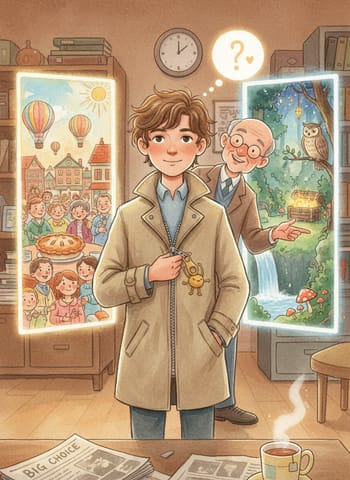
At ten past five, the newsroom of the Courier was as busy as it ever became. Four people were typing and one was eating an apple. Wystan stood by the coat rack with his jacket half on. The zip had stuck halfway up his chest, and nothing he did would move it.
五点十分,《信使报》的编辑部热闹到了一天中的极点。四个人在打字,一个人在啃苹果。怀斯坦站在衣帽架旁,外套穿了一半。拉链卡在胸口的位置,无论他怎么弄都纹丝不动。
He had been the only full-time reporter at the Courier for six years. He knew the name of every council member and the opening hours of every office in town. He knew the exact sound the printer made before it jammed. What he did not know, at ten past five, was where to go that evening.
他是《信使报》唯一的全职记者,已经干了六年。他认得镇上每一位议员的名字,知道每个办公室的开门时间。他还知道打印机卡纸之前发出的确切声音。可五点十分的此刻,他不知道今晚该去哪儿。
"Wystan," Birgit called from the editor's desk. "Have you decided yet?"
“怀斯坦,”比吉特在编辑的桌边喊道,“你决定了吗?”
"Give me a minute," he said, and pulled at the zip again. It held, as stubborn as a locked door.
“给我一分钟,”他说着,又拉了一下拉链。它还是纹丝不动,像一扇锁死的门一样固执。
The problem was simple to describe. The paper had room for exactly one big story on tomorrow's front page, and Wystan could be in only one place at seven o'clock. At the town hall, the council would vote on a car park behind the high street. It would mean cutting down the last row of old plane trees. Across the river, a young woman was opening a small cinema in a former garage. It had one screen, forty seats and a film nobody else in the region could show.
问题很好描述。明天的头版只有一个版面留给大新闻,而七点钟,怀斯坦只能待在一个地方。镇政厅里,议会要对商业街后面的一个停车场进行表决,通过的话,最后一排老梧桐树就要被砍掉。河对岸,一位年轻女子要在一间旧车库里开一家小电影院,只有一块银幕、四十个座位,放映的是这一带别人都放不了的一部电影。
Either story would have been a good one. That was exactly the difficulty.
哪一条都是好新闻。难处恰恰就在这里。
"The car park matters to more people," Wystan said, still tugging. "If the vote goes through, those trees are gone for good. Readers will want to know who voted which way."
“停车场关系到更多人,”怀斯坦说,手还在扯着,“要是表决通过,那些树就永远没了。读者会想知道谁投了赞成,谁投了反对。”
"They will," Birgit said calmly.
“他们会的,”比吉特平静地说。
"But the cinema is the kind of story that makes people feel the town is alive. I could write something warm about it." He stopped pulling and sighed. "Which is a thing a reporter should not say about a car park."
“可电影院那种新闻,能让人觉得镇子是活的。我能写出点温暖的东西。”他停下手,叹了口气。“而这可不是一个记者该对停车场说的话。”
Birgit stood and walked over, a pencil still tucked behind her ear. She had run the Courier for nine years. In that time, she had learned not to give advice unless somebody was ready to hear it. She looked at the jacket, and she looked at the zip, and then she looked at him with a faint smile.
比吉特站起身走过来,耳后还夹着一支铅笔。她当《信使报》的编辑已经九年了。这些年里,她学会了一件事:除非对方准备好听,否则不要给建议。她看看外套,看看拉链,然后带着一丝浅笑看着他。
"You are forcing it," she said.
“你在硬拽,”她说。
"Obviously I am forcing it. It is stuck."
“我当然是在硬拽。它卡住了。”
"Stop pulling upward," Birgit said. "Go the other way. Move it down a little, until the teeth loosen, and then start again."
“别再往上拉了,”比吉特说,“反方向来。往下退一点,等齿松开了,再重新拉。”
Wystan did as he was told, feeling slightly ridiculous. He slid the zip down about two centimetres, and he felt the tiny teeth come free beneath his fingers. He pulled up again, more gently this time, and the zip rose all the way to his collar in one smooth line.
怀斯坦照她说的做了,觉得自己有点可笑。他把拉链往下滑了大约两厘米,手指下那些小小的齿松开了。他再次往上拉,这回轻柔得多,拉链一路顺顺当当地拉到领口。
"Thank you," he said. "That is very good advice for a jacket."
“谢谢,”他说,“对外套来说,这是个很棒的建议。”
"It is not only for jackets." Birgit shrugged, and she went back to her desk.
“不只是对外套。”比吉特耸耸肩,回到了自己的桌子。
Wystan stood there for a moment with the zip fastened to his chin. He thought about what she had said. For the past twenty minutes, he had been pulling in one direction, trying to prove that one story was objectively better than the other. But maybe they were both good enough, and the real question was not which was bigger. The real question was which one he would regret missing.
怀斯坦下巴抵着拉上的拉链,在原地站了片刻。他琢磨着她的话。过去二十分钟里,他一直朝着一个方向使劲,想证明一条新闻客观上比另一条更好。但也许两条都足够好,真正的问题不是哪条更大,而是错过哪一条他会后悔。
He tried to picture the car park vote. He saw the council chamber, the long wooden table and the usual quiet speeches. Whatever happened, the result would appear in the official minutes by morning. A reporter from the regional paper would almost certainly be sitting in the back row. The story would be told either way.
他试着想象停车场的表决。他看到议事厅,长长的木桌,和往常一样平静的发言。不管结果如何,到早上都会出现在官方会议记录里。区域报纸的记者几乎肯定会坐在后排。这个故事无论如何都会有人讲。
Then he pictured the owner in her converted garage, trying to light a projector for the first time in front of a room of strangers. Nobody else from the media was going. Nobody else had even been invited. If he did not go, the evening would pass unrecorded, and on Thursday it would be too late to describe what it had felt like.
然后他想象那位女主人在改造过的车库里,第一次当着一屋子陌生人启动放映机。没有别的媒体会去,甚至没有人收到邀请。要是他不去,这个夜晚就会无人记录,等到星期四,就来不及描述它是什么感觉了。
"I will take the cinema," he said.
“我去电影院,”他说。
Birgit did not look up from her screen. "Are you sure?"
比吉特没有从屏幕上抬头。“你确定?”
"I am sure that I would regret the other choice more." He picked up his notebook. "The vote will be reported by somebody. This opening will not be unless I am there. And I will call the council clerk at nine, to get the numbers from her directly."
“我确定,选了另一个我会更后悔。”他拿起笔记本。“表决总会有人报道,这场开业不会,除非我在场。九点钟我再给议会书记员打个电话,直接向她问清票数。”
"That is a sensible plan." Now she did look up, and she was smiling properly. "Take a photographer. And Wystan, ask her what the first film is. Nobody has told me yet."
“这个计划很明智。”这时她抬起了头,笑得很真心。“带上摄影师。还有,怀斯坦,问问她第一部放什么片子。到现在还没人告诉我呢。”
He reached the garage at twenty to seven. A hand-painted sign above the door read ROLL, in plain white letters. Inside, chairs were still being unpacked from boxes, and a string of small lights hung crookedly along the ceiling. The smell of fresh paint and warm dust filled the air.
他六点四十分到了车库。门上方手绘的招牌用朴素的白色字母写着“放映”。里面,椅子还在从箱子里往外拆,一串小彩灯歪歪斜斜地挂在天花板下。空气里满是新鲜油漆和温热灰尘的气味。
The owner was balanced on a stepladder, wrestling with a cable. She was younger than he had expected, with paint on her sleeves, and she nearly fell off the ladder when she saw his press card.
女主人正站在梯子上跟一根电缆较劲。她比他预想的要年轻,袖子上沾着油漆,一看到他的记者证,差点从梯子上掉下来。
"You came," she said. "I did not think anybody would."
“你来了,”她说,“我还以为不会有人来呢。”
"I almost went to the town hall instead," Wystan said honestly. "Then I decided I would rather see this. By the way, what is the first film?"
“我差点去了镇政厅,”怀斯坦老实说,“后来我决定还是更想看这个。顺便问一句,第一部片子是什么?”
"It is called The Lone Tree," she said. "It is a hundred years old, and nobody else in the region has a copy."
“叫《孤树》,”她说,“有一百年了,这一带别人都没有拷贝。”
By seven o'clock, the forty seats were full. People brought blankets, and one family arrived carrying a folding stool for a child who was too small to see over the row in front. The projector clicked, hummed and hesitated, and for a few seconds the screen stayed blank. Everyone in the room held a breath.
七点钟,四十个座位全满了。人们带来了毯子,有一家人还带来一张折叠凳,给一个个子太小、看不到前排前方的孩子。放映机咔哒作响,嗡嗡运转,又迟疑了一下,有那么几秒钟,银幕一片空白。屋里每个人都屏住了呼吸。
Then the first picture appeared, a pale field with a single tree, and the whole audience let out a soft sigh together. Wystan wrote nothing at all for almost a minute. He realised that he was smiling, and that the people around him were smiling too.
然后第一个画面出现了:一片苍白的田野,田野里一棵孤零零的树。整个观众席同时发出一声轻轻的叹息。怀斯坦将近一分钟什么都没写。他意识到自己在微笑,而周围的人也在微笑。
At nine, he stepped outside and called the council clerk. The vote had been a close one, she said, five against four, with the trees spared for another year. She read him the names. He wrote them down in the margin of his notebook, in handwriting that shook slightly from the cold.
九点,他走到外面,给议会书记员打了电话。她说表决很接近,五票反对,四票赞成,那些树又多保住了一年。她把名字念给他听。他把它们记在笔记本的页边,字迹因为寒冷而微微发抖。
He stood on the pavement and watched the light from the garage spill across the road. Behind him, through the open door, a murmur of laughter rose and fell. On his chest, the zip of his jacket sat firmly closed, exactly where he had left it.
他站在人行道上,看着车库里的灯光洒满街道。他身后,透过敞开的门,一阵阵笑声此起彼伏。胸前,外套的拉链牢牢地拉着,就停在他拉好的地方。
Both stories had been waiting for him, he thought. But had he picked the cinema, or had it, somehow, picked him?
他想,两条新闻一直都在等着他。可究竟是他选了电影院,还是电影院不知怎么选中了他?